
BRAZIL MARKETS · CURRENCY
The real lost more than 1% against the US dollar on Wednesday and slid to its weakest level since April 2025, with one dollar costing about R$5.85. The trigger is a stalled budget-tightening bill in the Senate, the upper house of Brazil’s Congress.
The government fears an amendment could weaken it. Our real-to-dollar guide explains how the exchange rate works, and the wider picture is in our Brazil economy pillar.
Key Facts
- What is new Real down over 1% to about R$5.85 per dollar, weakest since April 2025.
- Why Senate vote on a fiscal package worth up to US$10.3 billion stalled.
- What it means for you US$100 buys about R$585, against R$535 on 27 October.
- What next Senate amendment votes, then the lower house, then the December rate decision.
- Prediction markets Polymarket, a US platform, gives 84.5% odds of no December rate change (18 Nov, 2:20 p.m. ET).
A currency move this size says less about Brazil’s economy than about trust: investors want proof that the government can control its debt.
Why a Stalled Senate Vote Moves the Currency
The bill, a complementary law proposal known as PLP 299/2026, would cut tax breaks, curb the highest public salaries and hold back spending. The Senate approved its main text on 12 November by 45 votes to 31, but four amendment votes were still pending.
On Wednesday the Senate did not finish those votes, and its president, Davi Alcolumbre, said more talks were needed. The sticking point is a cap on tax offsets that could be worth up to R$18.3 billion (about US$3.1 billion) in 2027.
The government says the package could improve the budget by up to R$60 billion (about US$10.3 billion) in 2027. If the Senate finishes, the Chamber of Deputies, the lower house, must still vote.
How Fast the Real Has Fallen
The dollar closed at R$5.51 on 6 November and at R$5.78 on Tuesday, according to RT market data. On Wednesday it traded near R$5.85 in the afternoon, the highest since April 2025.
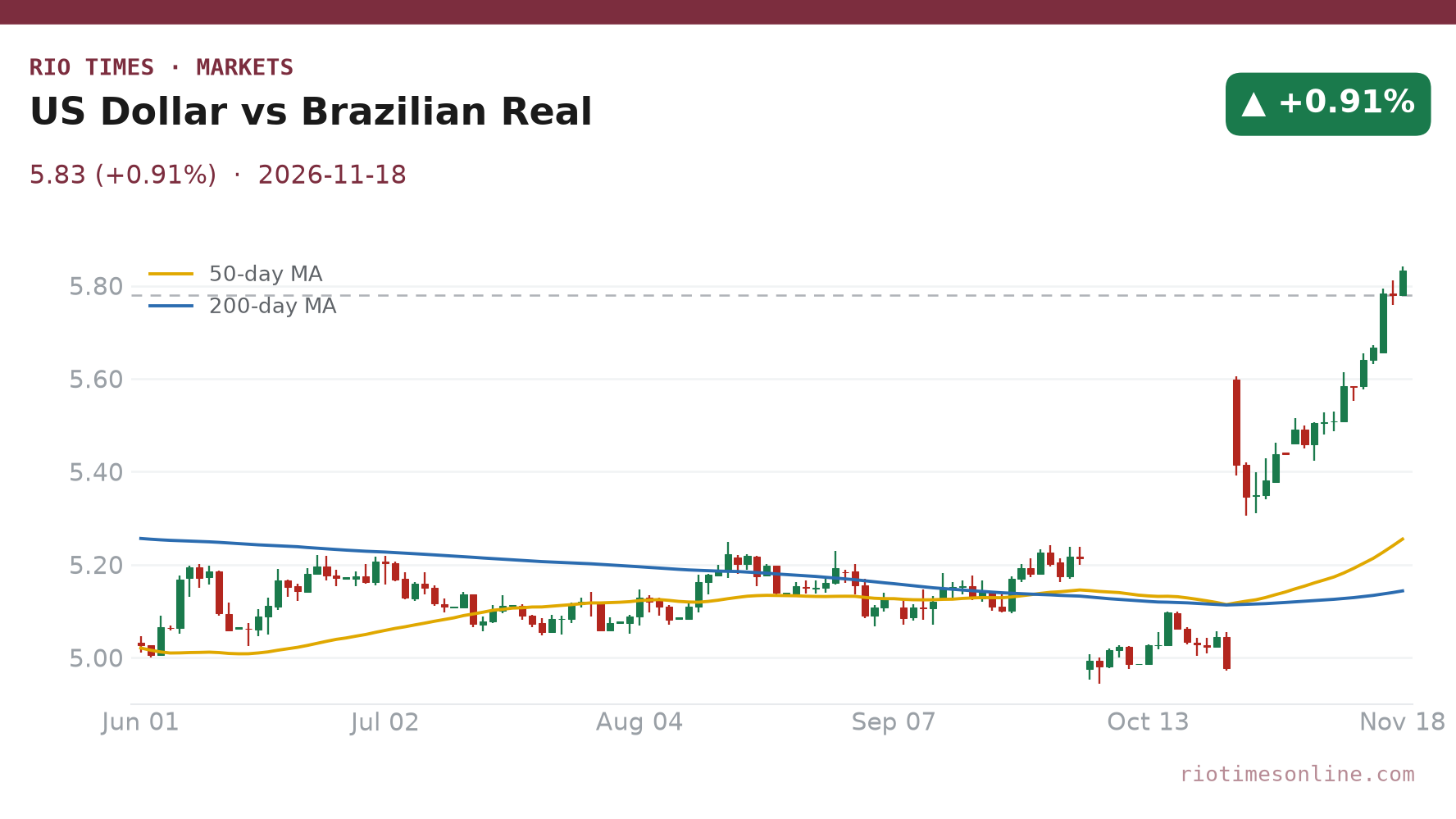
The climb reverses the real’s late-October strength, when the dollar fell as low as R$5.31 on 27 October. Preliminary central bank data show about US$18.1 billion of net foreign money entered Brazil in October, the largest monthly inflow of 2026.
In November through the 13th, the same data show a net outflow of US$765 million. The financial channel, which covers investments, profit transfers and interest, lost US$3.48 billion, while trade brought in US$2.72 billion.
What It Means for US Readers
Dollar-based investors in Brazilian shares lose twice: when stocks drop and when reais convert into fewer dollars. The iShares MSCI Brazil ETF (EWZ), a US-listed fund of Brazilian shares, was about 2.8% lower at 2 p.m. ET.
For travellers and expats paid in dollars, a weaker real is a discount: US$100 buys about R$585, up from R$535 on 27 October. Exporters that earn dollars gain, while importers and companies with dollar debts lose.
What Prediction Markets Say
Polymarket, a prediction-market platform, lists a market on Brazil’s central bank decision in December, with US$113,152 traded. As of 2:20 p.m. ET on 18 November, traders put no change at 84.5%, a cut of any size at 10.3% and a rise at 4.2%, bets rather than polls.
Why we show this: prediction markets turn real-money bets into a live probability that moves within minutes of the news, which is why investors, campaigns and newsrooms in the United States now follow them closely. We show them next to polls and official results, never instead of them.
What Is Not Known
It is not yet clear whether senators will accept the cap on tax offsets, or when the Chamber will vote. Wednesday’s close was not final at the time of writing.
The first test is whether the dollar stays above R$5.80, a level it had not crossed since April 2025 until this week. A Senate deal would ease the pressure, while a watered-down text would confirm investors’ fears; see our reports on the Senate’s second vote on spending curbs and the split on the left over the plan.
Frequently Asked Questions
Why is the Brazilian real falling?
Investors doubt Brazil’s budget plan after the Senate left key amendment votes unfinished on Wednesday 18 November. The dollar rose more than 1% to about R$5.85.
What does a weaker real mean for US visitors?
Dollars go further: US$100 buys about R$585, against about R$535 on 27 October. Imported goods in Brazil can get dearer, though.
Sources: Banco Central do Brasil (capital-flow statistics), Brazilian Federal Senate, B3, RT market data, Polymarket.
This article was produced by The Rio Times’ automated AI newsroom. Editorial responsibility: Matthias Camenzind, Publisher and Editor-in-Chief. The Rio Times also runs Ask Rio Times, which answers from 100,000+ of our own articles, the daily Latin America Power Map, and prediction-market odds on elections and markets.. How we use AI · Report an error
Brazil runoff, Sunday, October 25: Brazil runoff: date, poll closing times and when results start. Latest: Brazil runoff polls, Flávio 51%, Lula 49%.