
Published Wednesday, Nov. 18, 8:45 a.m. ET (2:45 p.m. Madrid) · Source: published polls, Spain’s Cabinet election decree, PolymarketSpain’s Socialists are closing the gap, but not fast enough to change the headline. Three polls published this week still give the conservative Partido Popular (PP) and the conservative Vox party together a majority in the Spain Election 2026 vote on Nov. 29.
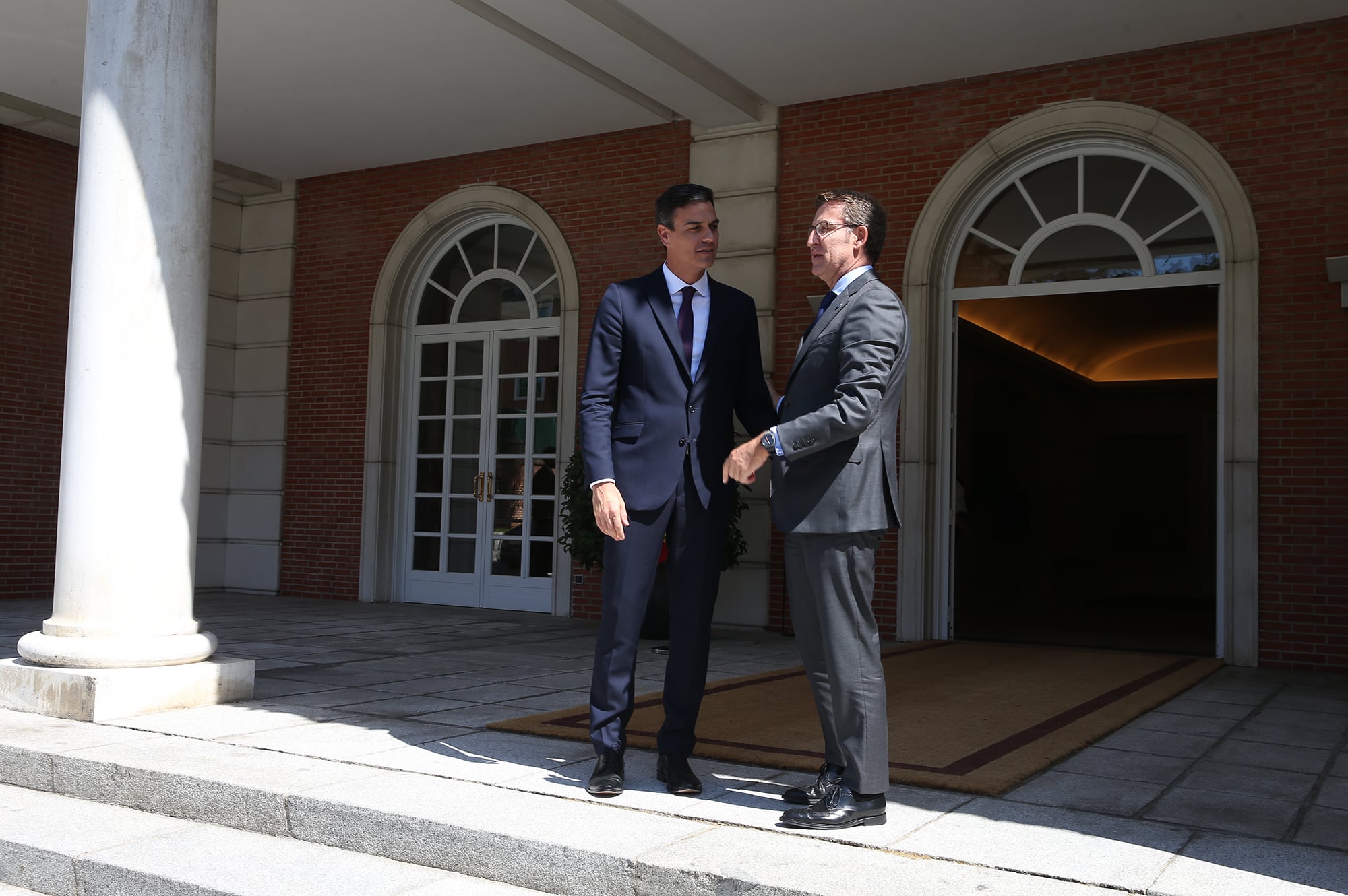
Prime Minister Pedro Sánchez’s Spanish Socialist Workers’ Party (PSOE) gained ground in all three. The next test is a live television debate with PP leader Alberto Núñez Feijóo on Thursday, Nov. 19, at 4:00 p.m. ET (22:00 in Madrid).
Key Facts
- Vote Sunday, Nov. 29, for the 350-seat Congress and the Senate; 176 seats win a majority.
- 40dB poll (Nov. 16) PP 31.5%, Socialists 30.3%, Vox 18%; PP plus Vox about 190 seats.
- Other polls NC Report and IMOP give PP plus Vox 201-205 and 194 seats.
- Next Sánchez-Feijóo debate, Thursday, Nov. 19, 4:00 p.m. ET (22:00 Madrid).
- Prediction markets Polymarket, a prediction platform: Feijóo 85.5%, Sánchez 12.8% for prime minister (Nov. 18, 8:25 a.m. ET).
This story is part of our coverage of the Spain Election 2026. Dates, times and how to follow it are in our guide.
Spain’s Socialists are gaining in the polls, but the right-wing bloc still leads before Thursday’s debate.
In plain English
Spain elects a new parliament on Nov. 29, and the parliament then picks the prime minister. The PP, Spain’s main conservative party, and Vox, a harder-right party, are polling ahead of Sánchez’s centre-left Socialists.
Socialists Gain in New Polls
A tracking poll by 40dB, a Spanish polling firm, for the newspaper El País (Nov. 16) put the PP at 31.5%, the Socialists at 30.3% and Vox at 18%. The Socialists rose from 29.9% and crossed 30% in that poll for the first time since the 2023 election.
A poll by NC Report for the newspaper La Razón projected 201 to 205 seats for the PP and Vox combined and 102 to 104 for the Socialists. Socialist support rose half a point to 26.1%.
A poll by IMOP for the newspaper El Confidencial put the right bloc at 194 seats and the Socialists at 109. Socialist support rose one point to 26.9%.
Why the State Poll Stands Apart
The Centro de Investigaciones Sociológicas (CIS), the state-run pollster led by Socialist José Félix Tezanos, remains the outlier. Last week it projected 134 to 143 seats for the Socialists and 155 to 171 for the PP and Vox together, short of the 176 needed in the 350-seat Congress.
What Prediction Markets Say
Polymarket, a crypto-based prediction platform, priced Feijóo at 85.5% to become prime minister on Nov. 18 at 8:25 a.m. ET. It put Sánchez at 12.8% and Vox leader Santiago Abascal at 1.2%, with US$4.0 million traded on the market.
These prices are bets, not polls. Why we show this: prediction markets turn real-money bets into a live probability that moves within minutes of the news, which is why investors, campaigns and newsrooms in the United States now follow them closely.
We show them next to polls and official results, never instead of them.
The Debate, Then the Vote
Sánchez and Feijóo meet on Thursday, Nov. 19, at 22:00 Spanish time, or 4:00 p.m. ET, in a debate organised by the Academia de Televisión, a Spanish television industry body. María Casado moderates, a lottery set Feijóo to open and Sánchez to close, and five themed blocks include housing, the economy, corruption and migration.
Ada Colau, a former Barcelona mayor whose Frente Amplio list competes on the left, is aiming for more than 10% of the vote and 22 seats. See our Spain election polls page for the running numbers.
What It Means for US Readers
A PP-Vox government would put a conservative-nationalist bloc in charge of Spain, the euro zone’s fourth-largest economy. A new prime minister can take office only after the new Congress meets on Dec. 23.
The debate starts at 4:00 p.m. ET on Thursday. State broadcaster RTVE says it will carry it on its digital platforms, but US availability is not confirmed.
What Is Not Known
Fieldwork dates and sample sizes for the 40dB, NC Report and IMOP polls were not stated in the reports we reviewed. Whether any stream will be open to US viewers is not confirmed.
Polls and markets can both miss, because Spain’s seat counts depend on results in 52 constituencies (50 provinces plus Ceuta and Melilla), not the national vote share.
Frequently Asked Questions
When is Spain’s general election?
Spain votes on Sunday, Nov. 29, 2026, for the 350-seat Congress and the Senate. A party or bloc needs 176 Congress seats for a majority.
When is the Sánchez-Feijóo debate?
It is scheduled for Thursday, Nov. 19, at 22:00 Spanish time, which is 4:00 p.m. ET. The Academia de Televisión, a Spanish television industry body, organises it.
Who is ahead in the polls?
Three polls this week show the PP and Vox together winning a majority, although the Socialists are gaining. The state-run CIS poll is the outlier, projecting the two right-wing parties short of 176 seats.
What do prediction markets say?
Polymarket prices Feijóo at 85.5% to become prime minister and Sánchez at 12.8%. These prices are bets, not polls.
Sources: 40dB, NC Report, IMOP and the Centro de Investigaciones Sociológicas (CIS) polls; Polymarket; Academia de Televisión; RTVE; Spain’s Cabinet election decree.
This article was produced by The Rio Times’ automated AI newsroom. Editorial responsibility: Matthias Camenzind, Publisher and Editor-in-Chief. The Rio Times also runs Ask Rio Times, which answers from 100,000+ of our own articles, the daily Latin America Power Map, and prediction-market odds on elections and markets.. How we use AI · Report an error
Spain's Election and Pedro Sánchez
- How Spain Got Here: Pedro Sánchez’s Eight Years in Power
- Why Spain’s Prime Minister Pedro Sánchez Could Lose His Job
- Spain’s Next Leader? Meet Alberto Núñez Feijóo
- Spain Explained 2026, How It Ranks in Europe