Brazil Population 2026: 214.2 Million, State by State

BRAZIL · SOCIETY
Updated 1 time · Latest: 21 October 2026
Key Facts
- —The country Brazil is Latin America’s largest country by population and the seventh most populous in the world, and its national statistics agency, IBGE, publishes the official count.
- —Why it matters The Brazil population is the largest in Latin America and about 61% of the size of the US population, and it drives budgets, services and the long-term outlook for pensions and labour.
- —Why now IBGE released its newest official estimate on 28 August 2026, the first set of 2026 numbers for every state and municipality.
- —What happened Brazil’s population reached 214,211,951 on 1 July 2026, up 790,914 people, or 0.37%, in a year and slower than the 0.39% gain of 2025.
- —The numbers São Paulo state has 46,179,008 people, the city of São Paulo 11,911,337, and Roraima grew fastest at 3.01% while Rio Grande do Sul added just 54 people.
- —The outlook The population is projected to peak at 220,425,299 in 2041 and fall to 199,228,708 by 2070, while the median age climbs from 36.1 to 51.2.
- —What it means for you US exporters, investors and travellers should plan for a market that still adds people but now grows mainly through rising incomes, not a bigger headcount.
- —Still open How much of the 7.8 million base-year adjustment above the 2022 census count is coverage correction, and whether births and migration follow IBGE’s path to the 2041 peak.
- —Power Index Brazil ranks 1st of 14 in The Rio Times Latin America Power Index, with 75.0 points (October 2026 edition).
Live tonight
Brazil’s runoff, live
The official TSE count for Flávio Bolsonaro and Lula, updated every minute (voting closed at 7 p.m. Brasília, 6 p.m. ET).
Brazil runoff polls · Polymarket and Kalshi odds · When results come · Brazil election poll data (CSV)
Prediction markets · who wins the runoff
Implied chance of winning Brazil’s presidency on 25 October, from traders’ prices.
Polymarket
Flávio Bolsonaro – · Lula – (US$249 million traded)
Kalshi (regulated in the US by the CFTC)
Flávio Bolsonaro 0.4% · Lula 99.6%
As of 25 October, 11:40 pm ET (03:40 Lisbon), updated every 20 minutes. Prices are bets, not polls, and can move fast.
Why we show this: prediction markets turn real-money bets into a live probability that moves within minutes of the news, which is why investors, campaigns and newsrooms in the United States now follow them closely. We show them next to polls and official results, never instead of them.
Brazil has 214,211,951 people, according to the official estimate of the Brazilian Institute of Geography and Statistics (IBGE) for 1 July 2026, up from 203,080,756 in the 2022 census. IBGE released the estimate on 28 August 2026, and it is 790,914 people, or 0.37%, more than a year earlier.
About 214 million people live in Brazil, which the United Nations ranks seventh in the world behind India, China, the United States, Indonesia, Pakistan and Nigeria. For US readers, that is about 61% of the US population of 349.0 million in mid-2026, and well ahead of Mexico at 133.0 million.
IBGE’s figures add up exactly from 5,571 municipal entries to the 26 states and the Federal District. Our Brazil news hub and our guide to Brazil’s population by race and ethnic group cover the wider picture.
Brazil Population 2026 by Region and State
The Southeast is home to 89,015,421 people, or 41.6% of Brazil, followed by the Northeast with 57,366,981 (26.8%) and the South with 31,498,532 (14.7%). The North has 18,929,341 people (8.8%) and the Central-West 17,401,676 (8.1%).
São Paulo is the largest state with 46,179,008 people, or 21.6% of the country, ahead of Minas Gerais with 21,460,311 and Rio de Janeiro with 17,225,410. Bahia (14,889,472), Paraná (11,952,456) and Rio Grande do Sul (11,233,317) complete the six largest states.
IBGE’s 2024 projections, which match the 2026 estimate, split the population into 109,804,639 women and 104,407,312 men. Our calculation from the country’s land area of about 8.5 million square kilometres gives roughly 25 people per square kilometre.
All 27 Brazilian States Ranked by Population
The list below ranks the 26 states and the Federal District by their estimated population on 1 July 2026. Shares of Brazil and one-year growth are our calculations from IBGE’s 2025 and 2026 estimates.
- 1. São PauloSoutheast · 21.6% of Brazil · +0.21% in a year46,179,008
- 2. Minas GeraisSoutheast · 10.0% of Brazil · +0.31% in a year21,460,311
- 3. Rio de JaneiroSoutheast · 8.0% of Brazil · +0.01% in a year17,225,410
- 4. BahiaNortheast · 7.0% of Brazil · +0.12% in a year14,889,472
- 5. ParanáSouth · 5.6% of Brazil · +0.52% in a year11,952,456
- 6. Rio Grande do SulSouth · 5.2% of Brazil · +0.00% in a year11,233,317
- 7. PernambucoNortheast · 4.5% of Brazil · +0.22% in a year9,583,176
- 8. CearáNortheast · 4.3% of Brazil · +0.36% in a year9,302,211
- 9. ParáNorth · 4.1% of Brazil · +0.52% in a year8,756,324
- 10. Santa CatarinaSouth · 3.9% of Brazil · +1.54% in a year8,312,759
- 11. GoiásCentral-West · 3.5% of Brazil · +0.96% in a year7,495,033
- 12. MaranhãoNortheast · 3.3% of Brazil · +0.09% in a year7,024,557
- 13. AmazonasNorth · 2.0% of Brazil · +0.91% in a year4,360,926
- 14. ParaíbaNortheast · 2.0% of Brazil · +0.44% in a year4,182,828
- 15. Espírito SantoSoutheast · 1.9% of Brazil · +0.58% in a year4,150,692
- 16. Mato GrossoCentral-West · 1.8% of Brazil · +1.46% in a year3,950,330
- 17. Rio Grande do NorteNortheast · 1.6% of Brazil · +0.25% in a year3,463,737
- 18. PiauíNortheast · 1.6% of Brazil · +0.24% in a year3,392,617
- 19. AlagoasNortheast · 1.5% of Brazil · +0.01% in a year3,221,128
- 20. Federal DistrictCentral-West · 1.4% of Brazil · +0.44% in a year3,009,996
- 21. Mato Grosso do SulCentral-West · 1.4% of Brazil · +0.74% in a year2,946,317
- 22. SergipeNortheast · 1.1% of Brazil · +0.34% in a year2,307,255
- 23. RondôniaNorth · 0.8% of Brazil · +0.31% in a year1,757,338
- 24. TocantinsNorth · 0.7% of Brazil · +0.58% in a year1,595,994
- 25. AcreNorth · 0.4% of Brazil · +0.39% in a year887,794
- 26. AmapáNorth · 0.4% of Brazil · +0.43% in a year809,953
- 27. RoraimaNorth · 0.4% of Brazil · +3.01% in a year761,012
The six largest states hold 57.4% of all Brazilians, and the smallest, Roraima, has 761,012 people. Our report on the states leading the population decline shows how different the paths of individual states are.
Which Brazilian States Are Growing Fastest
Roraima, on the border with Venezuela, grew fastest at 3.01%, adding 22,240 people to reach 761,012. Santa Catarina in the South added the most people, 125,730 to reach 8,312,759, a rise of 1.54%, and farm state Mato Grosso grew 1.46%.
At the other end, Rio Grande do Sul added 54 people, Alagoas 280 and Rio de Janeiro 1,863 over the year. All 27 federative units grew, but nine of them grew by 0.25% or less.
By region, the Central-West grew fastest at 0.94%, followed by the North (0.68%) and the South (0.60%). The Southeast and the Northeast each grew 0.21%, which is our calculation from IBGE’s state tables.
Brazil’s Biggest Cities in the 2026 Estimate
The city of São Paulo has 11,911,337 people, the most of any Brazilian municipality, followed by Rio de Janeiro with 6,731,133 and Brasília with 3,009,996. Fortaleza (2,582,360) and Salvador (2,559,945) complete the top five, which together hold 26,794,771 people, or 12.5% of Brazil.
Belo Horizonte (2,415,451), Manaus (2,327,101), Curitiba (1,832,183), Recife (1,588,983) and Goiânia (1,511,709) rank sixth to tenth. These are municipal populations, so they leave out the suburbs and neighbouring cities that make up the larger metropolitan areas.
Fifteen municipalities have more than 1 million people, adding Belém, Porto Alegre, Guarulhos, Campinas and São Luís, and together they hold 42,886,420 people, or 20.0% of Brazil. At the other end, 3,816 of the 5,571 entries in IBGE’s table, or 68.5%, have fewer than 20,000 residents, by our count.
Why Different Sources Give Different Numbers
Several figures circulate for the same question, and each answers it differently. The 2022 census counted 203,080,756 residents, while IBGE’s estimate for mid-2026 is 214,211,951.
The United Nations, whose model online counters such as Worldometer use, puts Brazil at 213.6 million for mid-2026, about 649,000 fewer than IBGE. Counts quoted elsewhere can therefore differ by a few hundred thousand people.
The census is a count taken in 2022, while the estimate is a model that adds births and deaths and corrects for people the census missed. IBGE’s 2024 projections use a post-enumeration survey and a demographic reconciliation of births, deaths and migration to make that correction, according to the agency’s methodology report.
The correction is already visible in 2022, when IBGE’s own series puts the population at 210,862,983, or 7,782,227 above the census count. By our calculation that is about 70% of the 11,131,195 gap between the census and the 2026 estimate, and the other 3,348,968 is growth from 2022 to 2026.
The practical rule is to say 203 million for the people the 2022 census counted and 214 million for the people living in Brazil today. Always check which series and which year a number comes from, because IBGE republished its whole projection series in 2024 and older figures no longer match.
Why Brazil’s Population Growth Is Slowing
Brazil’s fertility rate is about 1.51 children per woman in 2026, down from 2.32 in 2000 and 1.58 in 2022, and well below the roughly 2.1 needed to keep a population steady. IBGE expects it to fall to 1.44 by 2040.
Annual births fell from 3.6 million in 2000 to 2.6 million in 2022, and IBGE’s 2024 projections count about 2.39 million births and 1.56 million deaths in 2026. Natural growth is therefore about 837,000 people.
Deaths are projected to exceed births from 2042, which is the arithmetic behind the 2041 peak. Longer lives delay the turn but do not prevent it, since life expectancy at birth rises from 77.0 years in 2026 to 83.9 in 2070.
Brazil’s Population Is Getting Older
The median age is 36.1 in 2026, up from 25.3 in 2000 and 34.4 in 2022, and IBGE projects 42.4 in 2041 and 51.2 in 2070. Life expectancy at birth is 77.0 years in 2026 against 71.1 in 2000.
People aged 65 and older number 25,646,543, or 12.0% of the population, against 10.4% in 2022, while children aged 0 to 14 number 41,060,882, or 19.2%, down from 20.4%. IBGE projects that people aged 65 and older will reach about 40.6 million by 2041, or 18.4% of the population.
People aged 65 and older are projected to outnumber children aged 0 to 14 from 2036, and to make up 31.0% of the population by 2070. The working-age group, aged 15 to 64, peaks in 2035 at 149,594,746 and then shrinks every year until 2070, when it is projected at 113,603,532.
That is the pressure point for pensions, which Brazil reformed in 2019. The reform set minimum retirement ages of 65 for men and 62 for women for most workers, with transition rules for people already working.
Our reading of the projections is that the reform bought time but did not change the demographics. The pressure on public finances therefore builds as the working-age group shrinks after 2035.
Where Brazilians Live and What They Believe
Brazil is highly urban, with 177.5 million of the 203.1 million people in the 2022 census, or 87.4%, living in urban areas. That is 16.6 million more urban residents than in 2010 and 4.3 million fewer rural ones.
The census also asked about religion for people aged 10 and older, and 56.7% said they are Catholic in 2022, down from 65.1% in 2010. Evangelicals rose from 21.6% to 26.9% and people with no religion from 7.9% to 9.3%.
Brazil Population Forecast to 2041 and Beyond
IBGE projects that Brazil’s population will keep growing until 2041, when it peaks at 220,425,299 people, and then fall every year. The projection is 218,369,418 for 2050 and 199,228,708 for 2070, almost exactly the 199,226,702 of 2013.
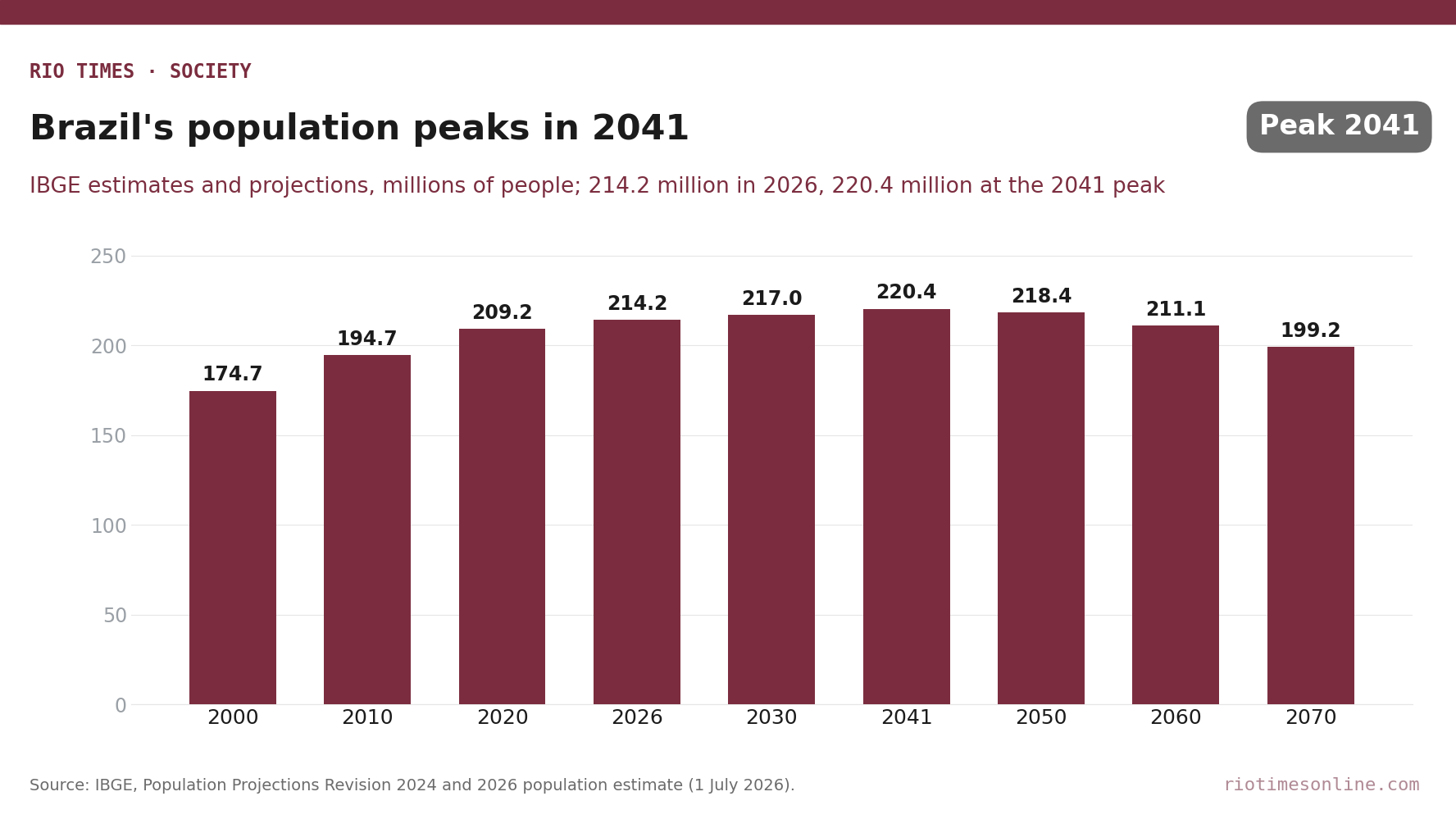
The chart uses IBGE’s 2024 projections, which match the 2026 estimate at 214.2 million. Falling births are the main driver, as our report on the fall in Brazilian births shows.
Brazil Population in 2100 According to the UN
IBGE stops its projections at 2070, so for 2100 only the United Nations publishes a figure. Its medium variant puts Brazil at about 219.3 million in 2042, its peak, and 163.4 million in 2100.
The UN sees the world population peaking at about 10.29 billion in 2084 and easing to 10.18 billion by 2100. Brazil’s turn therefore comes about four decades before the world’s, so it will pass its peak while the global population is still growing.
What It Means for You
For US exporters and investors, the Brazil population of 214 million is growing 0.37% a year, so sales growth must come from higher incomes and market share. Our analysis: Santa Catarina, the Central-West and Roraima, where growth runs at more than twice the national rate, are where the customer base is growing fastest in percentage terms.
For travellers and expats, the biggest cities are São Paulo and Rio de Janeiro. São Paulo alone holds 5.6% of all Brazilians.
For companies planning a decade ahead, the working-age population stops growing in 2035, so skilled labour is likely to get more expensive. Health care, insurance and services for older customers have a growing market.
Our analysis: location beats the national average, because states such as Roraima and Santa Catarina keep growing while others stand still. Companies choosing where to open a shop or a distribution centre should ask which state, not which country.
For anyone following public policy, slower growth and a median age of 36.1 point to more pressure on pensions and health care and less on schools. In IBGE’s projections the group aged 65 and older grows by about 3.7 million between 2022 and 2026.
What Is Not Known
The estimate is a model, not a headcount, and IBGE does not publish how much of the 7,782,227 difference between its 2022 figure and the census count is coverage correction. Its methodology report gives the adjustment by age group and state.
The United Nations uses a different model and puts Brazil at 213.6 million in mid-2026, about 649,000 fewer than IBGE, so counts quoted elsewhere may not match. The municipal tables give 2026 totals but no age breakdown, so the age figures here are national projections, not city or state counts.
It is also not known how migration will change the path, because the projections assume trends that may not hold. IBGE published its estimate on 28 August in both 2025 and 2026, so the next is expected in late August 2027.
All figures are IBGE’s as of 1 July 2026 unless stated. The United Nations figures come from its World Population Prospects 2024.
More country population guides: Mexico population, Colombia population, Egypt population, Kenya population, Brazil population by race.
Frequently Asked Questions
How many people live in Brazil?
About 214.2 million people live in Brazil, as IBGE estimates 214,211,951 residents on 1 July 2026. The last census, in 2022, counted 203,080,756.
What is the Brazil population in 2026?
IBGE’s official estimate is 214,211,951 on 1 July 2026, up 790,914 people or 0.37% on 2025. The United Nations uses a different model and puts Brazil at 213.6 million.
Why do sources show 203 million and 214 million for Brazil?
The 203,080,756 figure is the 2022 census count, while 214,211,951 is IBGE’s 2026 estimate, which adds growth since 2022 and a correction for people the census missed. IBGE’s own series already put the 2022 population at 210,862,983.
Is the Brazil population growing or shrinking?
It is still growing, but slowly, by 790,914 people in the year to July 2026. IBGE projects a peak of 220.4 million in 2041, followed by a decline.
When will Brazil’s population peak?
IBGE projects the peak in 2041 at 220,425,299 people, with the first fall in 2042. The United Nations expects its peak a year later, in 2042, at about 219.3 million.
Which Brazilian state has the most people?
São Paulo, with 46,179,008 people or 21.6% of Brazil. Minas Gerais (21,460,311) and Rio de Janeiro (17,225,410) are next.
Where does Brazil rank in world population?
Brazil is the seventh most populous country in the world in the UN’s 2026 figures, behind India, China, the United States, Indonesia, Pakistan and Nigeria. It is the largest in Latin America, ahead of Mexico at 133.0 million.
Sources: IBGE, Population Estimates 2026 (1 July 2026 reference date); IBGE, Population Estimates 2025; IBGE SIDRA, table 6579, estimated resident population by state; IBGE, Population Projections, 2024 Revision (indicators, age groups); IBGE, projections methodology report; IBGE, 2022 Census population; IBGE, Census 2022 urban and rural areas (release of 14 November 2024); IBGE 2022 Census religion results, as reported by Agência Brasil; Constitutional Amendment 103 of 2019 (pension reform); United Nations, World Population Prospects 2024.
This article was drafted with automated assistance and reviewed before publication. How we use AI · Report an error · Editorial responsibility: Matthias Camenzind, Editor-in-Chief