
BRAZIL ECONOMY · DATA
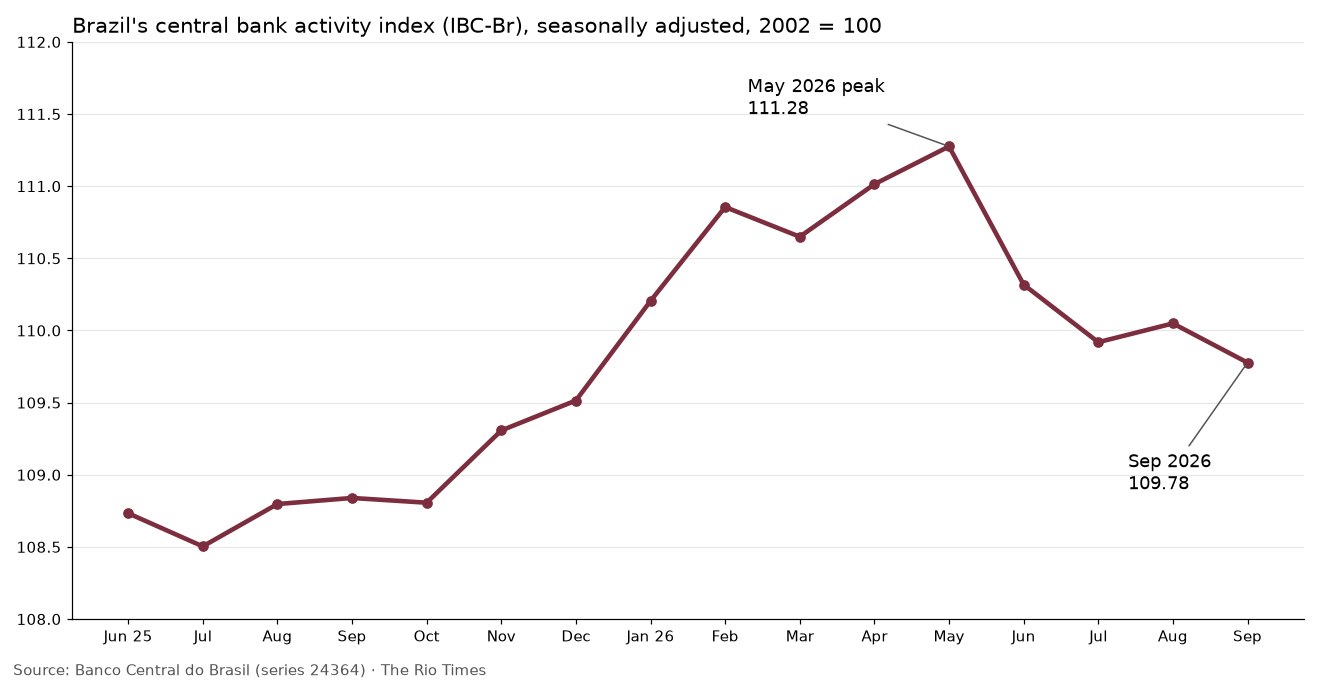
Brazil’s economy lost a little more steam in September, and the trend since spring points down. The Banco Central do Brasil, the central bank, said on Monday 16 November 2026 that its IBC-Br activity index fell 0.2% from August.
Economists had expected a 0.3% drop, so the miss was small, but the index now stands 1.3% below its May peak. It is the first firm hint of what the official GDP count from IBGE, Brazil’s statistics institute, will say in December.
Key Facts
- The number IBC-Br fell 0.2% in September versus 0.3% expected; it is 1.3% below May’s peak.
- Third quarter Activity averaged 0.9% below the second quarter, the central bank’s data show.
- What next IBGE, Brazil’s statistics institute, publishes official third-quarter GDP in December.
- For you US holders of Brazilian assets watch whether Selic, Brazil’s benchmark rate, cuts resume on 9 December.
- Prediction markets Prediction market Polymarket gives about 81% to a third-quarter GDP contraction (16 November, 7:14 a.m. ET).
The IBC-Br is the central bank’s monthly stand-in for GDP, the official tally of everything Brazil produces. September’s dip leaves the third quarter weaker than the second.
What the Central Bank Reported
On the central bank’s seasonally adjusted series, the index stood at 109.78 points in September, against 110.05 in August (2002 = 100). It peaked at 111.28 in May and has fallen in three of the four months since.
On the latest revised data, June fell 0.9%, July 0.4%, August rose 0.1% and September fell 0.2%. Over the three months to September, activity averaged 0.9% below the previous three months.
Why a Monthly Index Matters Before GDP
GDP, the official measure of national output, comes from the statistics agency IBGE only once a quarter. The central bank’s index fills the gap, though the two can differ and both get revised later.
The central bank’s release names no single cause for the dip. Its policy rate, the Selic, stands at 13.75% after its rate committee, Copom, held it on 4 November, a level meant to cool demand.
IBGE counted 0.5% growth in the second quarter from the first. A 0.9% slide in the central bank’s gauge for the third quarter would mark a sharp turn, although the two measures are not the same ruler.
What Prediction Markets Say
Polymarket, a prediction-market platform, lists a market on Brazil’s third-quarter GDP growth, with US$57,714 traded. At 7:14 a.m. ET on 16 November it priced a fall of 0.3% to 0.1% at 46.0% and a fall of more than 0.3% at 34.8%.
It priced growth of 0.0% to 0.2% at 14.0% and 0.3% to 0.5% at 6.3%. Prices are rounded bets, not polls, and together the two falling ranges imply about 81%.
Why we show this: prediction markets turn real-money bets into a live probability that moves within minutes of the news, which is why investors, campaigns and newsrooms in the United States now follow them closely. We show them next to polls and official results, never instead of them.
What It Means for US Readers
The clearest winner from weak growth is the holder of Brazilian government bonds, because falling rates lift bond prices if the central bank resumes cuts. The clearest loser is the US exporter selling machinery or farm inputs into a softer Brazilian market.
Companies that sell mostly inside Brazil, such as Itaú (ITUB), the country’s largest private bank, feel a slowdown first. Exporters such as miner Vale (VALE) lean more on China and commodity prices, as our Ibovespa guide explains.
What Is Not Known
We could not confirm a sector breakdown of the September fall from the central bank’s own data. So we do not say whether farms, factories or services drove it.
The index is also revised often, so the 0.2% could change. Whether the third quarter ends in a GDP contraction depends on IBGE’s count, not on this gauge.
What to Watch Next
December: IBGE publishes third-quarter GDP, and the Polymarket growth market settles on that release. Wednesday 9 December: Copom announces its next Selic decision in the evening in Brasília.
Frequently Asked Questions
What is Brazil’s IBC-Br?
It is the central bank’s monthly index of economic activity, often called a GDP preview. It combines farm, industry and services data into one number.
Is Brazil in a recession?
A common rule of thumb is two straight quarterly falls in GDP. IBGE reported 0.5% growth for the second quarter and publishes the third in December.
Sources: Banco Central do Brasil, IBC-Br seasonally adjusted series, release of 16 November 2026; Banco Central do Brasil, Copom decision of 4 November 2026; IBGE, quarterly national accounts and calendar; Polymarket, Brazil GDP Growth in Q3 2026 (accessed 16 November 2026, 7:14 a.m. ET).
This article was produced by The Rio Times’ automated AI newsroom. Editorial responsibility: Matthias Camenzind, Publisher and Editor-in-Chief. The Rio Times also runs Ask Rio Times, which answers from 100,000+ of our own articles, the daily Latin America Power Map, and prediction-market odds on elections and markets.. How we use AI · Report an error
Brazil runoff, Sunday, October 25: Brazil runoff: date, poll closing times and when results start. Latest: Brazil runoff polls, Flávio 51%, Lula 49%.