Brazil Sells US$1 Billion to Steady the Real
A US$1 billion sale is small next to Brazil's reserves, but it shows how seriously the central bank takes the real's slide.

Brazil Markets
Brazil’s central bank reached into its dollar reserves on Thursday and sold US$1 billion for good, trying to stop the real from sliding further. A day earlier it had only lent dollars to the market for a short time.
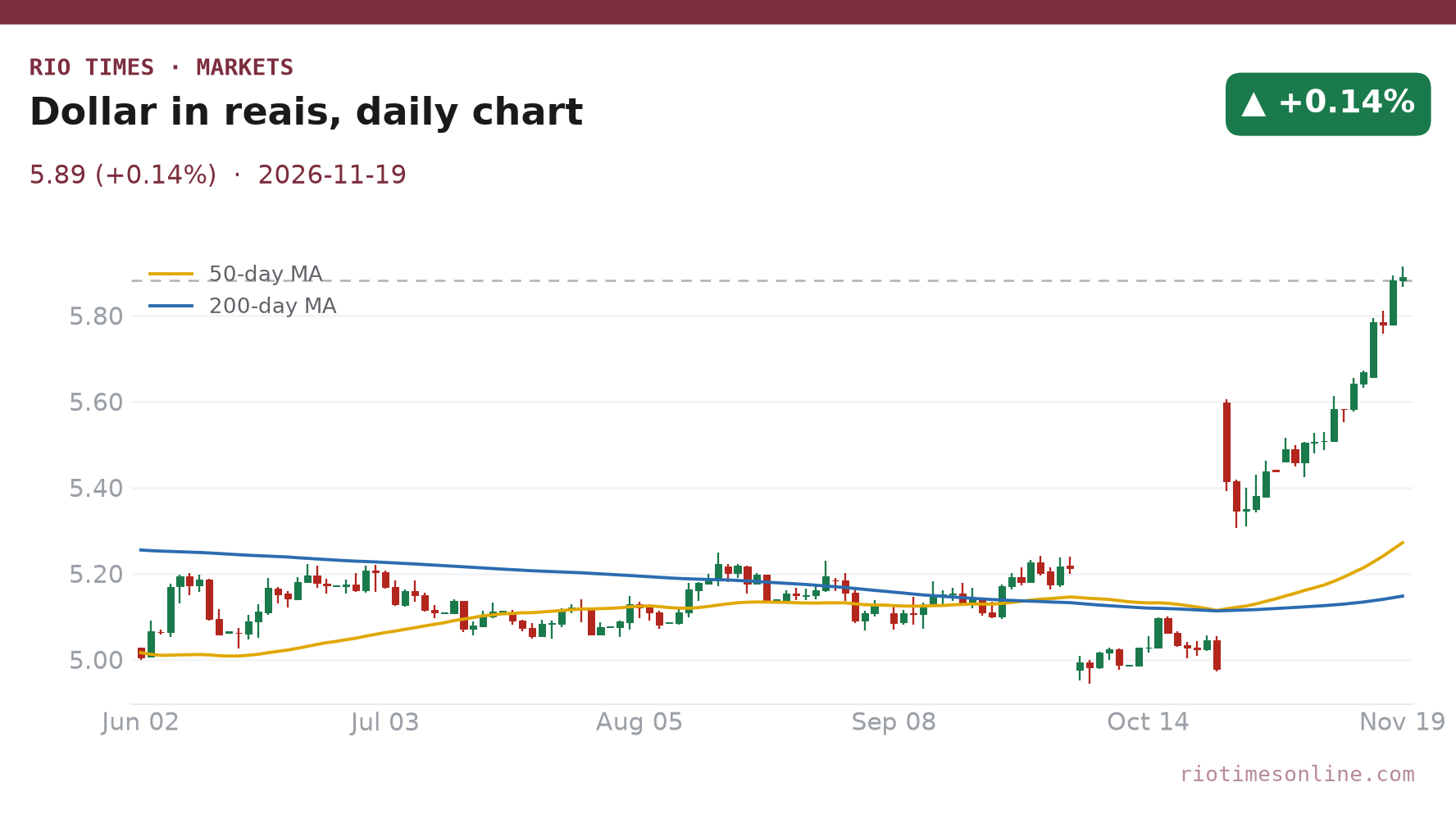
The relief lasted minutes. The dollar dropped from its day high of R$5.9287 right after the sale, then climbed back to R$5.895 by 10:30 a.m. ET.
Key Facts
- The sale. The bank sold US$1 billion outright at R$5.86 per dollar, 10:03 to 10:08 a.m. ET.
- The size. That is about 0.3% of the US$363.6 billion in reserves on 18 November.
- The market. The dollar peaked at R$5.9287 and traded near R$5.895 at 10:30 a.m. ET.
- Next. Brazil takes a holiday on 20 November; the lower house still must pass the fiscal bill.
- Prediction markets. Polymarket: about 79% odds of no Brazil rate change in December (10:55 a.m. ET).
A US$1 billion sale is small next to Brazil’s reserves, but it shows how seriously the central bank takes the real’s slide.
Why the Central Bank Stepped In
The real has lost ground all week as investors worry about Brazil’s public debt, the money the government owes. On Wednesday the dollar closed at R$5.8677, up 1.48% and its fifth straight daily gain, the highest close in 19 months.
Brazil’s Senate, the upper house of Congress, finished approving a budget-tightening bill that night, but investors doubt it saves enough. Our report on the Senate vote explains what the bill changes, and the lower house, the Chamber of Deputies, has yet to vote.
The pressure also comes from abroad. Minutes of the US Federal Reserve’s October meeting, released on 18 November, showed almost all officials judged further rate rises likely appropriate, and higher US rates pull money out of emerging markets.
Spot Sale Versus Line Auction, in Plain English
The central bank has two ways to supply dollars. A line auction lends them for a short time and takes them back later, so reserves are only borrowed.
A spot sale is final: the dollars leave the reserves for good. On Wednesday the bank ran two line auctions worth US$1 billion in total, and on Thursday it moved to the spot sale.
The bank said it accepted five bids at R$5.86 per dollar, below the day’s high. Reserves stood at US$363.6 billion on 18 November, according to the bank’s own data, so US$1 billion is about 0.3% of them.
That leaves plenty of ammunition, but each spot sale is permanent.
What It Means for US Readers
The losers are dollar-based holders of Brazilian assets, because a weaker real shrinks their value. The iShares MSCI Brazil ETF (EWZ), a US-listed fund of Brazilian stocks, and ADRs (US-listed receipts of Brazilian shares) such as Petrobras (PBR) and Itaú (ITUB) feel the same drag.
The winners are dollar earners with costs in reais, such as the iron ore miner Vale (VALE), and visitors paid in dollars: US$100 buys about R$589 at Thursday’s rate. Our real-to-dollar guide explains how the rate works, and the wider picture is in our Brazil economy guide.
What Happens Next
One sale does not fix the cause, which is doubt about Brazil’s debt. Friday 20 November is a national holiday, so currency trading may be thin, and any further central bank sale would shrink reserves again.
Brazil publishes its mid-month inflation reading on Thursday 26 November (7 a.m. ET). October budget and debt figures follow in the last days of November.
What Prediction Markets Say
Traders on Polymarket, a crypto-based prediction market, put about 79% on no change in Brazil’s central bank rate at its December decision, with US$115,570 traded as of 10:55 a.m. ET on 19 November. They give 7.0% to a quarter-point cut and 2.9% to a quarter-point rise, and these prices are real-money bets, not polls.
Why we show this: prediction markets turn real-money bets into a live probability that moves within minutes of the news, which is why investors, campaigns and newsrooms in the United States now follow them closely. We show them next to polls and official results, never instead of them.
What Is Not Known
We found no central bank statement on whether more spot sales are planned. It is also unclear how much the bank is willing to spend if the dollar returns to R$5.93.
Sources: Banco Central do Brasil (central bank), spot auction notice (19 November 2026); Banco Central do Brasil, international reserves series (18 November 2026); Polymarket, Bank of Brazil decision in December (19 November, 10:55 a.m. ET); Agência Senado, the Senate news service, Senate completes vote (18 November 2026); Federal Reserve, FOMC minutes (18 November 2026); USD/BRL and EWZ quotes, RT market data (19 November 2026).
This article was produced by The Rio Times’ automated AI newsroom. Editorial responsibility: Matthias Camenzind, Publisher and Editor-in-Chief. The Rio Times also runs Ask Rio Times, which answers from 100,000+ of our own articles, the daily Latin America Power Map, and prediction-market odds on elections and markets.. How we use AI · Report an error
LatAm Markets: Live Signals → — real-time movers, turnover leaders and FX across Latin America.
Brazil runoff, Sunday, October 25: Brazil runoff start time and results schedule. Latest: Brazil runoff polls, Flávio 51%, Lula 49%.
Frequently Asked Questions
Did Brazil’s central bank sell dollars on 19 November?
Yes. It sold US$1 billion from its reserves in a spot auction at R$5.86 per dollar, with five bids accepted between 10:03 and 10:08 a.m. ET.
Does selling dollars weaken Brazil’s reserves?
A spot sale permanently reduces them. At US$363.6 billion on 18 November, reserves are large, and US$1 billion is about 0.3% of the total.