Who Is Rodrigo Paz? Bolivia’s President, His Fuel Shock and His Bet on the US
PROFILES · BOLIVIA
Key Facts
- —The country Bolivia, a landlocked Andean nation of 11.3 million people, holds some of the world’s largest lithium resources. It is going through its deepest economic adjustment in decades after its gas revenue and dollar reserves ran down.
- —Who he is Rodrigo Paz Pereira, 59, president since 8 November 2025. A former mayor of Tarija and senator, he is the son of former president Jaime Paz Zamora.
- —Power base He won the runoff of 19 October 2025 with 54.96 percent. His Christian Democratic Party is the largest group in Congress but has no majority.
- —Record He ended fuel price freezes, floated the boliviano and secured Congress’s approval for a US$1.9 billion IMF programme. He also rebuilt ties with Washington.
- —Controversies Charges from his time as mayor over a Tarija bridge contract, which he has contested. A detained former adviser and an open feud with his own vice-president.
- —Outlook Next tests: an IMF board vote, the first inflation data after the diesel increase and a state of exception that runs to about mid-December.
Who is Rodrigo Paz? He is the centre-right outsider who ended nearly two decades of socialist rule in Bolivia. He now runs a painful fuel and currency adjustment, backed by Washington and the IMF.
Rodrigo Paz matters beyond Bolivia because he is testing whether a country can leave a state-run gas economy without breaking apart. For investors, travellers and anyone paid in dollars, his decisions on fuel, the currency and the streets set the rules.
Early life and career
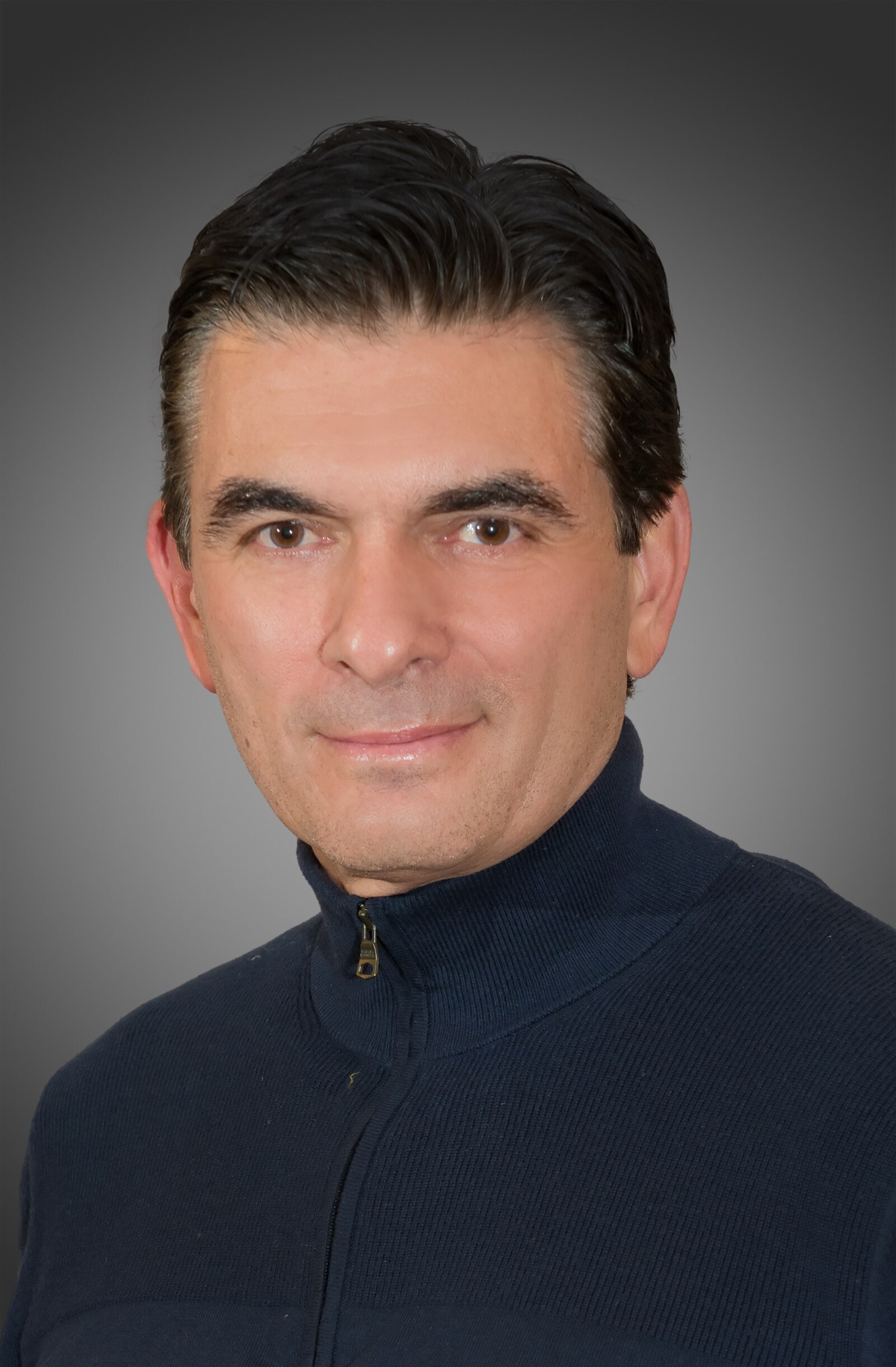
Rodrigo Paz Pereira was born on 22 September 1967 in Santiago de Compostela, Spain. His mother, Carmen Pereira, is Spanish. His father, Jaime Paz Zamora, co-founded the Revolutionary Left Movement (MIR). He was president of Bolivia from 1989 to 1993.
The family spent years in exile in Spain during the military rule of General Hugo Banzer. They returned after Banzer stepped down in 1978. Paz went to Jesuit schools in several countries, then to the San Ignacio school in La Paz.
He studied at American University in Washington, D.C. He took a bachelor’s degree in international relations, majoring in economics, and a master’s in political management. His family tree also includes Víctor Paz Estenssoro, a four-time president and his great-uncle.
His first public jobs were diplomatic. In the late 1990s he served as commercial attaché at Bolivia’s embassy in Spain and as chargé d’affaires to the World Trade Organization.
In 2002 he won a seat in the Chamber of Deputies for Tarija, the southern gas region, on the MIR ticket. He was re-elected in 2005 and served until 2010. He then presided over Tarija’s municipal council from 2010 to 2015.
Rise to power
Paz became mayor of Tarija in 2015 and held the post until 2020. He reshaped the city centre with pedestrian streets and plazas. In 2020 he left the mayor’s office to become a senator for Tarija. He sat for Civic Community, the alliance of former president Carlos Mesa.
For most of the 2025 campaign he was an afterthought. He polled near the bottom of an eight-candidate field and failed to qualify for the first televised debate in early August. He ran for the Christian Democratic Party (PDC) under the slogan “capitalism for all”.
His running mate, Edmand Lara, was a late choice. Lara is a former police captain who was dismissed from the force in 2023 after denouncing police corruption in viral TikTok videos. His anti-corruption message drew voters that Paz alone could not reach.
On Sunday 17 August 2025 Paz topped the first round with 32.06 percent, ahead of former president Jorge “Tuto” Quiroga with 26.70 percent. The candidate of the ruling Movement Toward Socialism (MAS) took about 3 percent.
The runoff on Sunday 19 October 2025 was the first in Bolivian history. The official count by the Supreme Electoral Tribunal gave Paz 3,519,534 votes, or 54.96 percent. Quiroga took 2,884,661 votes, or 45.04 percent, and accepted the result.
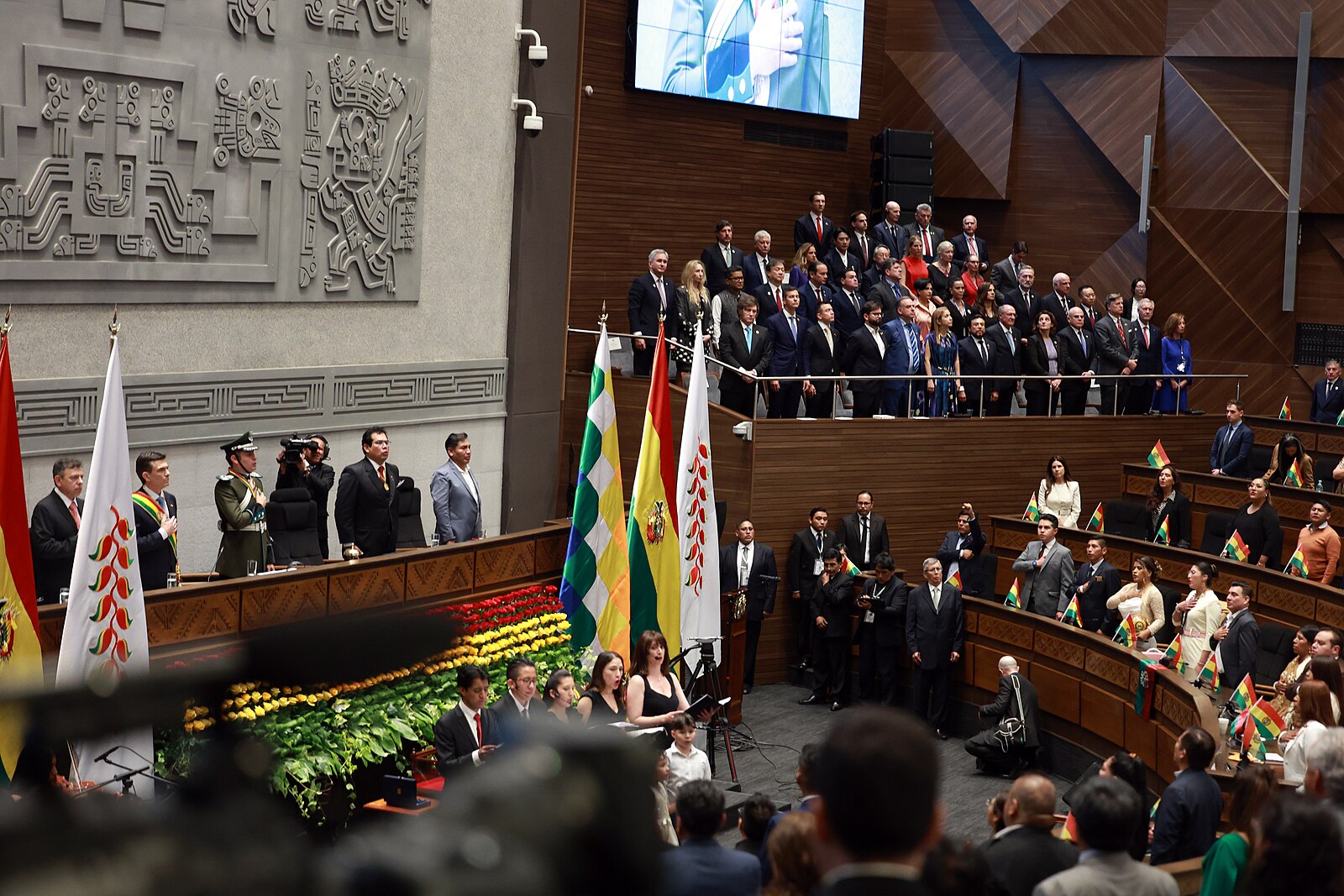
Paz was sworn in on Saturday 8 November 2025. His victory ended almost twenty years of MAS rule. That era began with Evo Morales in 2006 and was broken only by an interim government in 2019 and 2020.
Power base
Paz’s power rests on a thin base. The PDC is the largest group in Congress, but it has no majority. MAS holds just 2 of 130 seats in the lower house and none in the Senate.
For most votes he needs the centre-right blocs of Quiroga and of businessman Samuel Doria Medina, who backed him in the runoff. They have helped on big votes, such as the IMF programme, but they also check him. In August 2026 Congress censured his economy minister, José Gabriel Espinoza, by 91 votes to 34. Paz replaced him with his deputy, Christian Morales.
His cabinet leans on technocrats with careers in international finance, development agencies and business, not in unions or social movements. That makes it credible with lenders. It also leaves Paz with few allies among the rural unions and the Bolivian Workers’ Central (COB), which can shut the roads.
His relationship with his own vice-president is openly hostile. Lara, who as vice-president presides over the Legislative Assembly, has attacked ministers and the president’s inner circle in public.
Record in office
The economy dominates the record. Paz inherited a country that had spent its dollar reserves on a fixed exchange rate and on cheap imported fuel. Twelve-month inflation had hit 24.86 percent in July 2025, according to the national statistics institute (INE).
On 17 December 2025 Supreme Decree 5503 ended a roughly twenty-year freeze on fuel prices. Petrol rose from 3.74 to 6.96 bolivianos a litre, from about US$0.54 to US$1.00 at the old fixed rate. Diesel rose from 3.72 to 9.80 bolivianos a litre, from about US$0.53 to US$1.41. The minimum wage rose 20 percent, to 3,300 bolivianos a month (about US$272 today).
Rates in this article use 12.11 bolivianos to the US dollar, the market rate published by open.er-api.com on 30 September 2026. Older prices use the fixed rate of 6.96 that applied at the time.
The package set off strikes and road blockades led by the COB. On 11 January 2026 the government agreed to repeal Decree 5503 and draft a new one with the unions, but it kept the new fuel prices.
Anger kept building, and the biggest protests of his term came later. Rural unions, the COB and Morales loyalists ran roadblocks for 53 days in May and June 2026, demanding his resignation. Paz refused to step down, and the ombudsman’s office put the death toll at 22.
On Saturday 20 June Paz declared a 90-day state of exception, and soldiers helped police clear the roads. Congress extended it by another 90 days on 17 September. On 29 July prosecutors issued an arrest warrant for Morales on charges including terrorism. Morales denies orchestrating the blockades and calls the case persecution.
On Friday 26 June the government ended the peg of 6.96 bolivianos to the dollar that had held since 2011. The official rate opened at 9.73 on Monday 29 June and reached 12.22 on 25 September, according to the central bank.
On 29 July IMF staff agreed a 36-month Extended Fund Facility of about US$1.9 billion. Congress approved it in September. Hours after the Senate vote, Paz ended the diesel subsidy for most buyers. Supreme Decree 5716 lifted the price about 83 percent, from 9.80 to 17.95 bolivianos a litre (from about US$0.81 to US$1.48).
He paired the increase with cash aid of 874 million bolivianos (about US$72 million) for some 2.9 million people. Truckers and small firms were offered cheap loans. Some numbers have improved. Twelve-month inflation fell to 5.02 percent in August 2026, and net reserves recovered to US$4.14 billion.
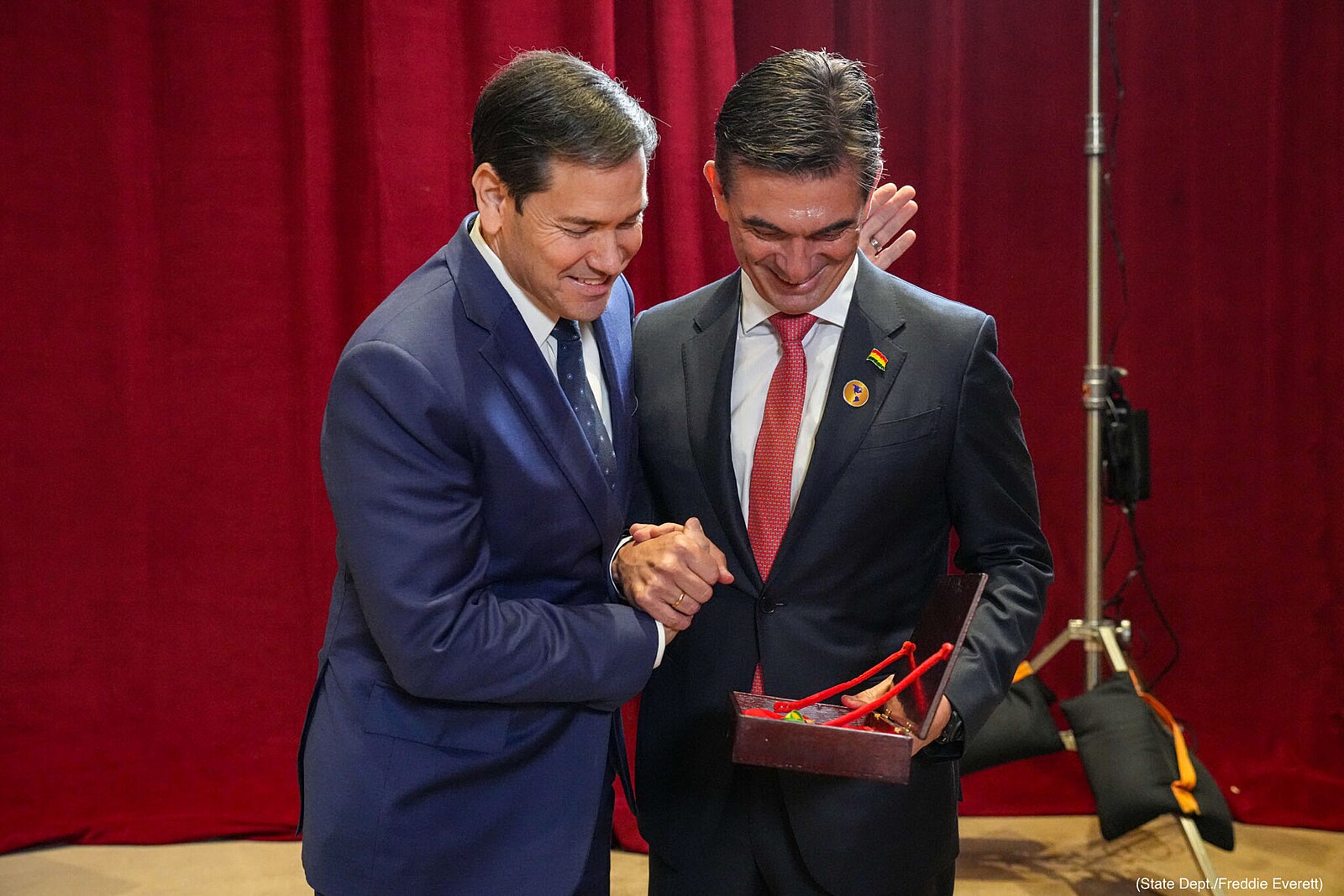
Foreign policy has swung hardest. Paz has rebuilt ties with Washington that Morales cut in 2008, when Bolivia expelled the US ambassador. Both governments agreed in November 2025 to restore ambassadors. From December 2025, US citizens could visit Bolivia visa-free for up to 90 days.
On Saturday 7 March 2026 Paz joined Donald Trump and other regional leaders in Doral, Florida. The Shield of the Americas summit focused on fighting drug cartels. He has distanced Bolivia from Cuba, Venezuela and Nicaragua and moved closer to Argentina’s Javier Milei.
From 19 to 27 September 2026 Paz was in the United States. He addressed the UN General Assembly in New York on 24 September. He says 32 meetings produced about US$10 billion in lender commitments over two to three years. Most of that would be loans, not grants.
Controversies
The oldest cases date from his time as mayor. On 25 February 2025 prosecutors charged Paz over the “4 de Julio” bridge in Tarija. The contract was signed in 2018 for 73.2 million bolivianos (about US$10.5 million at the fixed rate). It ran years late and was terminated in 2022.
The charges include harmful contracts, uneconomic conduct and breach of duties. In September 2025 Tarija’s departmental prosecutor said there were five proceedings against Paz, three of them with formal accusations. His defence had challenged them, and the challenge was before the full chamber of the departmental court.
In October 2025 a 2021 forensic audit by the prosecution service came to light. It found that the bridge contract caused no economic damage to the state. Paz has called the charges an attack on his candidacy, and no court has convicted him.
A second controversy involves Fernando Cerimedo, an Argentine political consultant who worked with Paz. Cerimedo was detained at Santa Cruz’s Viru Viru airport on 18 August 2026. Prosecutors charged him with the attempted femicide of his former partner, a lawyer who was shot and wounded. It is an accusation, not a conviction.
On Monday 31 August Lara played an unverified audio recording. He said it captured First Lady María Elena Urquidi and Cerimedo discussing the removal of the police commander. Lara filed a criminal complaint. Prosecutors rejected the complaint against the first lady within 48 hours for lack of evidence.
On Monday 28 September 2026 lawmakers, including Lara, demanded that Paz disclose the cost of his US trip and prove what it achieved. The same day, the US State Department restricted visas for 22 Bolivians. It publicly designated Attorney General Roger Mariaca, accusing him of taking bribes to facilitate drug trafficking. Washington published no evidence, and no Bolivian court has convicted Mariaca.
What to watch
The IMF board vote. Congress approved the programme, but the Fund had published no board date by late September. Approval would release the first tranche and, according to the government, help unlock more than US$5 billion from other lenders.
September inflation. INE publishes it in early October. It is the first official reading to include the diesel increase. A jump would test the central bank’s promise to keep inflation below double digits.
Petrol and wages. The government has committed to ending all fuel subsidies from 2027, and petrol is still subsidised. Paz has also promised to renegotiate the minimum wage at the end of 2026, using actual inflation data.
The streets and the courts. The extended state of exception runs to about mid-December 2026. Watch the COB, the rural unions loyal to Morales, the warrant against Morales and any movement in the Tarija cases.
Washington. A full US ambassador still needs to be nominated and confirmed by the US Senate. The fallout from the visa list of 28 September will show how far Paz backs US pressure on his own justice system.
What this means for foreigners and investors
Paz is the most market-friendly president Bolivia has had in two decades. His government wants foreign capital in gas, lithium and farming, and it has restored normal relations with the United States. That is a real change for investors who avoided the country under MAS.
The risks are political, not ideological. He lacks a majority, his vice-president is a rival and the unions can close the roads for weeks. Contracts that need congressional approval, such as the stalled lithium deals, can take a long time.
For visitors and residents, the practical change is money. Anyone paid in dollars receives far more bolivianos than under the old peg, while local prices have risen much less. Anyone paid in bolivianos has lost ground. Road blockades remain the main travel risk, so overland plans need spare days.
Connected Coverage
Bolivia Explained: The Paz Government, the Fuel Crisis and What to Watch
Bolivia’s President Faces Demands to Disclose the Cost of His US Trip
US Visa Restrictions Hit 27 People in Bolivia, Colombia, Ecuador and Peru
Bolivia Extends State of Exception by Three Months and Calls Referendum: What Expats Need to Know
Bolivia Ends Diesel Subsidy for Large Consumers as YPFB Admits Crisis
US Replaces Its Top Diplomat in Bolivia Again as Ambassador Swap Stalls
What Is Not Known
Where the Tarija cases stand. The last public updates, from September and October 2025, predate his presidency. Whether the proceedings have advanced or been suspended since he took office is not on the public record.
Whether the IMF money arrives on time. The board date and the size of the first payment are open. So is the timing of the US$10 billion in commitments Paz describes.
How long his coalition holds. Paz depends on rival blocs for every major vote. Whether they support the petrol increase planned for 2027 and a renewal of the state of exception is undecided.
What Washington has on Bolivia’s justice system. The State Department published no evidence against Mariaca or the others it named on 28 September. How Paz’s government will respond is not yet clear.
As of 28 September 2026 the story is open. Paz has stabilised some numbers, but the costs of adjustment fall mainly on Bolivians paid in bolivianos.
Sources: Election results from Bolivia’s Supreme Electoral Tribunal and loan terms from the IMF. Inflation from INE, exchange rates from the central bank, court records as reported by Bolivian media. All accessed 28 September 2026.
- Supreme Electoral Tribunal (OEP) — official runoff results, 2025
- El Día — official first-round results, August 2025
- Eju.tv — official runoff count, 22 October 2025
- International Monetary Fund — staff-level agreement with Bolivia, 29 July 2026
- PBS NewsHour / AP — profile of Rodrigo Paz
- Correo del Sur — Tarija prosecutor on five cases, 2 September 2025
- Prensa Latina — charges over the 4 de Julio bridge, 25 February 2025
- Polish Institute of International Affairs — Shield of the Americas summit, 7 March 2026
- Open Exchange Rates API — US dollar rates, 30 September 2026
Frequently Asked Questions
Who is Rodrigo Paz?
Rodrigo Paz Pereira is the president of Bolivia, sworn in on 8 November 2025. Born in Spain in 1967, he is the son of former president Jaime Paz Zamora and was mayor of Tarija and a senator before winning the presidency.
How did Rodrigo Paz win the 2025 election?
He came from near the bottom of the polls to top the first round on 17 August 2025 with 32.06 percent. He then beat Jorge Quiroga in the runoff on 19 October with 54.96 percent to 45.04 percent.
What has Rodrigo Paz done about the economy?
He ended the long freeze on fuel prices, floated the boliviano in June 2026 and ended the diesel subsidy for most buyers in September. He also won congressional approval for a 36-month IMF programme of about US$1.9 billion.
What is Rodrigo Paz accused of?
Prosecutors charged him in February 2025 over a bridge contract from his time as mayor of Tarija, including harmful contracts and breach of duties. His defence has challenged the proceedings, and no court has convicted him.
What are Rodrigo Paz’s relations with the United States?
Close. He has rebuilt ties that Bolivia cut in 2008, agreed to restore ambassadors and attended the Shield of the Americas summit with Donald Trump in March 2026. US citizens can now visit Bolivia visa-free for up to 90 days.
This article was produced by The Rio Times’ automated newsroom system. How we use AI · Report an error
In depth
Read More from The Rio Times