Venezuela Opposition Calls to Abolish Corpoelec

ENERGY · VENEZUELA
Key Facts
- —The country Venezuela, governed by acting president Delcy Rodríguez, lives with daily power rationing. Corpoelec, the state electricity corporation, runs generation, transmission and distribution nationwide.
- —What happened On Friday 2 October, Carlos Ocariz of the opposition party Primero Justicia proposed abolishing Corpoelec and restoring seven regional power companies, La Verdad and Contrapunto reported.
- —The numbers Ocariz said average daily outages in Petare, eastern Caracas, rose from five to eight hours. Engineers put the national shortfall at about 3,000 megawatts (El Nacional, 2 October).
- —What it means for you Nothing changes yet. This is an opposition proposal, and cuts of 8 to more than 12 hours a day continue in several states, El Nacional reported on 2 October.
- —Still open Whether the government responds, how the plan could become law, and whether the 1,300 megawatts promised for October to December arrive on time.
The opposition party Primero Justicia wants to abolish Corpoelec, Venezuela’s state power company, and return electricity to regional firms. National party leader Carlos Ocariz set out the plan on Friday 2 October at a protest in Petare, eastern Caracas.
He spoke among residents complaining of constant blackouts and failing transformers, La Verdad reported. A day earlier, officials had said a new turbine in Zulia state would reach the grid within 72 hours.
Four proposals to abolish Corpoelec and decentralise power
Ocariz put forward four measures, Contrapunto reported. The first is to abolish Corpoelec, which he called “a nest of corruption and centralism that ended electricity for Venezuelans”.
The second is to restore regional operators: Edelca for Puerto Ordaz, Cadafe for the east, and Electricidad de Caracas.
Enelbar would return in Barquisimeto and Enelven in Maracaibo. Seneca would serve Porlamar, on Margarita Island, and Eleval would serve Valencia.
Third, he wants managers chosen on merit rather than for ties to the governing party. Fourth, he called for audits and fully transparent tenders for power contracts.
“With the same people we will get the same results,” Ocariz said, naming corruption and a worse quality of life. He argued that results could come in the short to medium term, using resources Venezuela already has.
How large the power shortfall is
Engineers Víctor Poleo and José Aguilar put national demand at about 15,000 megawatts, El Nacional reported on 2 October. Available generation is near 12,000, leaving a deficit of roughly 3,000 megawatts, covered by rationing.
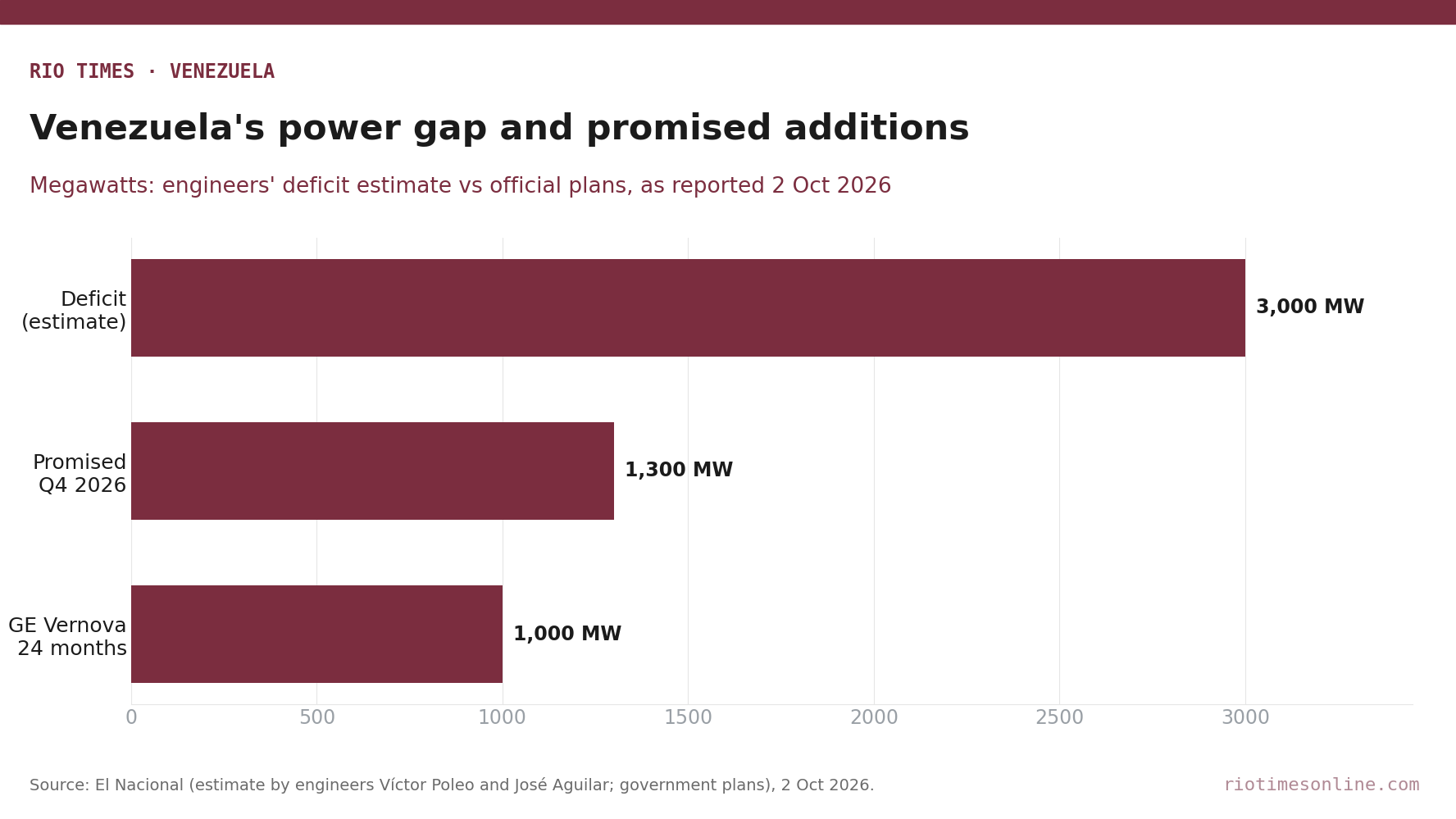
These are independent estimates, not official figures. Cuts of 8 to more than 12 hours a day hit states including Zulia, Mérida, Táchira and Nueva Esparta, the paper said.
Why the party targets centralisation
Corpoelec was set up in 2007 as a single state corporation for the electricity sector. The firms Ocariz named are former regional operators that once ran the service, La Verdad noted.
Political activist Karín Salanova, in a statement carried by Contrapunto, said Corpoelec has had 11 presidents in 19 years. She counted more than 3,400 protests over public services, with electricity the main complaint.
Ocariz said average daily outages in Petare had risen from five to eight hours. That figure comes from the party and has not been independently confirmed.
The government’s recovery plan
The Rodríguez government has blamed peak demand on high temperatures and asked Venezuelans to use less power, El Nacional reported. In September she alleged sabotage of the grid.
The electricity ministry has promised 1,300 megawatts of new capacity in the last quarter of 2026, the paper reported. A deal with US equipment maker GE Vernova foresees 1,000 megawatts within 24 months and over 5,000 within four years.
If the quarterly promise is met, it would close more than two fifths of the estimated gap. In Zulia, unit TZ07 is due online soon (Venezuela Says Zulia Turbine Is Due on Grid in 72 Hours).
What Is Not Yet Known
Corpoelec and the government had not responded publicly to the proposal by Saturday morning. Ocariz did not say how the plan would be passed into law or paid for.
It is also unclear whether other opposition parties support the idea. Nor is it known how quickly regional companies could be rebuilt, or whether promised capacity arrives on schedule.
Sources: La Verdad, 2 October 2026; Contrapunto, Primero Justicia proposal and statement by Karín Salanova, 2 October 2026; El Nacional, 2 October 2026.
Editorial responsibility: Matthias Camenzind, Editor-in-Chief · Editorial standards · Report an error