Suriname Sends Second Rice Aid Shipment to Venezuela

AID · SURINAME
Key Facts
- —The country Suriname, a small Dutch-speaking state on the north-east coast of South America, took part in Venezuela’s Petrocaribe oil-credit scheme and signed nine cooperation deals with Caracas in September.
- —What happened Suriname handed 55.45 tonnes of rice to Venezuela at the port of La Guaira on Thursday 1 October 2026, its second aid shipment since the earthquakes of 24 June.
- —Who is involved Ambassador Georgette García Elías delivered the rice for President Jennifer Simons. Foreign ministry official Gustavo Díaz Aular and Admiral José Rafael Hernández Abchi received it for Venezuela.
- —What it means for you The rice is meant for quake-hit families. Venezuela counted 6,509 dead as of 24 August (government via EFE); the World Bank put direct damage at US$19.6 billion (23 July).
- —Still open The value of the rice, where it will be distributed and whether Suriname plans a third shipment have not been disclosed.
Suriname has sent Venezuela a second rice aid shipment of 55.45 tonnes, packed in two 20-foot containers. It was handed over on Thursday 1 October at the port of La Guaira, north of Caracas.
The rice is meant for people hit by the twin earthquakes of 24 June and for the recovery that follows. A first consignment arrived by plane in August, the Surinamese government said.
What Was Delivered, and to Whom
The Ministry of Foreign Affairs, International Business and Cooperation, known by its Dutch initials BIS, announced the delivery in a press release. The Paramaribo dailies De Ware Tijd and Suriname Herald reported it on 2 and 3 October.
Ambassador Georgette García Elías handed over the cargo on behalf of President Jennifer Simons. She said the gift showed Suriname’s solidarity with the Venezuelan people.
On the Venezuelan side, Gustavo Díaz Aular, a director general at the foreign ministry, received the rice. Admiral José Rafael Hernández Abchi took delivery with him.
“With this additional contribution, Suriname gives further shape to its commitment to the affected population,” the ministry said. It added that the donation reflects close ties of friendship between the two countries.
The Scale of Need in Venezuela
Two earthquakes of magnitude 7.2 and 7.5 struck northern Venezuela on 24 June. Coastal La Guaira, where the rice was landed, was the worst-hit state.
On 24 August the government raised the death toll to 6,509, the Spanish news agency EFE reported. Families marked 100 days on Friday: Venezuela Earthquake: 144 Children Missing as La Guaira Mourns 100 Days On.
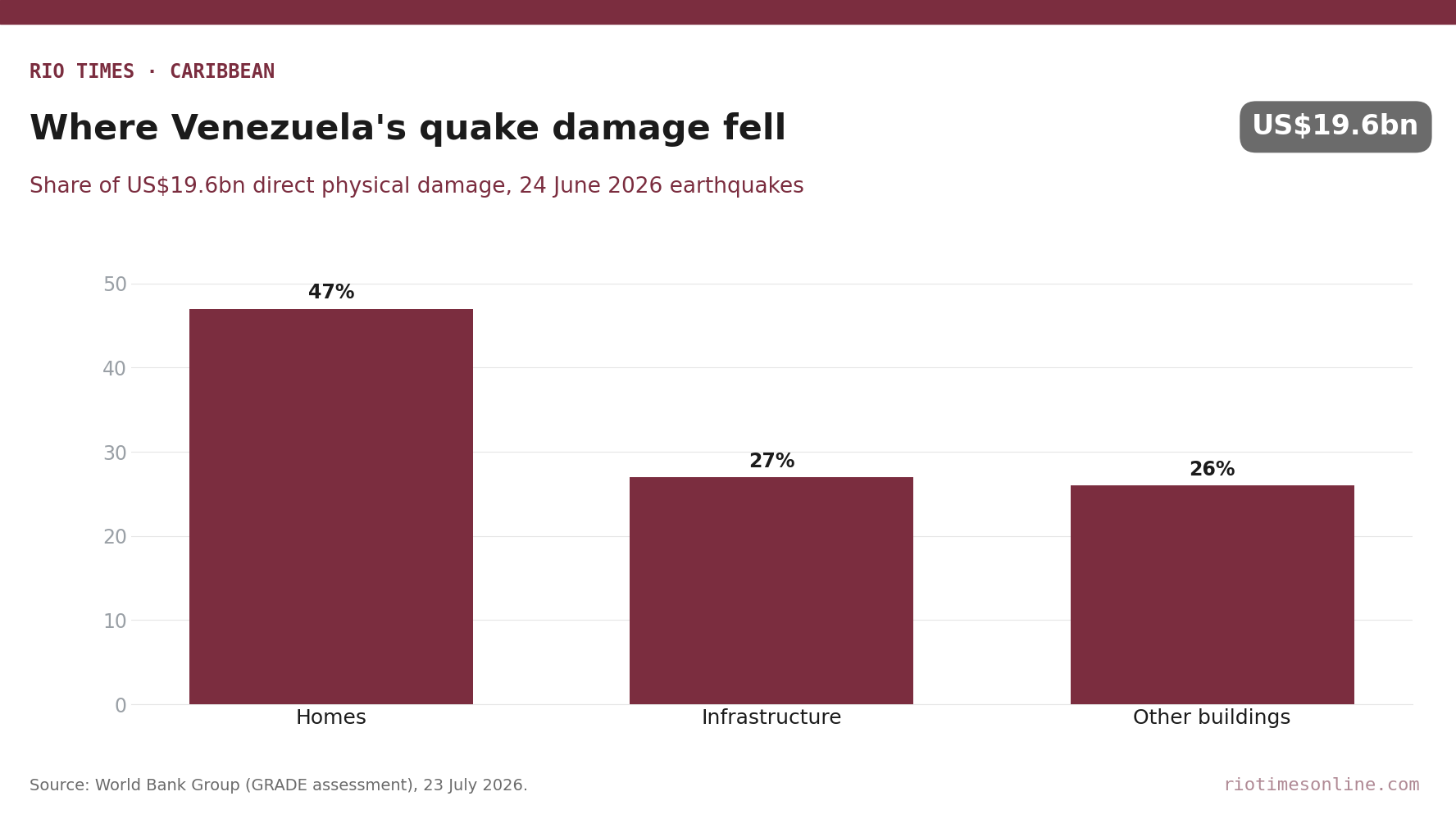
The World Bank estimated direct physical damage at US$19.6 billion on 23 July. Homes made up 47 percent of that, infrastructure 27 percent and other buildings 26 percent.
Against that bill, 55 tonnes of rice is a modest gift. Food aid meets daily needs rather than rebuilding costs, and part of its value is political.
A Pledge Kept in Stages
Suriname offered help within days of the quakes. In late June, Foreign Minister Melvin Bouva said Suriname was ready to send rice, water and some medication.
Bouva called that the support the government could give, the Times of Suriname reported. The Venezuelan embassy in Paramaribo also collected public donations until the end of June.
The August consignment came by air, while this second rice aid shipment went by sea. Neither report gave the size of the first delivery, so the two cannot be compared.
Aid Alongside an Open Dispute
The shipment follows September talks in Paramaribo, covered in Suriname Signed Nine Agreements With Venezuela, Then Raised the Court Seizure of Venezuelan Oil. Nine cooperation agreements were signed, covering fisheries, agrifood, aviation, tourism, oil and gas, and education.
Food security was discussed too. Simons also raised a court seizure of Venezuelan state oil assets in Suriname, tied to the old Petrocaribe oil-credit scheme.
No final ruling in that case has been reported. The rice deliveries suggest practical cooperation is continuing while the legal question stays open.
What Is Not Yet Known
The ministry has not disclosed the value of the rice or where in Venezuela it will be distributed. Nor has it said whether a third shipment is planned.
The coverage reviewed did not give the size of the August airlift. It is also unclear which Venezuelan agency will hand the rice to families.
Sources: Suriname Ministry of Foreign Affairs, International Business and Cooperation (BIS) press release, as reported by De Ware Tijd (DWT Online), 3 October 2026, and Suriname Herald, 2 October 2026; Times of Suriname, June 2026; World Bank Group, 23 July 2026; EFE via La Tribuna, 24 August 2026.
This article was drafted with automated assistance and reviewed before publication. How we use AI · Report an error · Editorial responsibility: Matthias Camenzind, Editor-in-Chief