Nicaragua Politics Explained, Who Holds Power in 2026
NICARAGUA · POLITICS
Key Facts
- —The country Nicaragua is a Central American country that has been governed since January 2007 by Daniel Ortega, who now shares the presidency with his wife, Rosario Murillo.
- —Who holds power Ortega, 80, and Murillo, 75, are co-presidents under a constitution rewritten in 2025, and their Sandinista party (FSLN) holds 76 of the 91 Assembly seats with its alliance.
- —The rules Co-presidents serve six-year terms, and the next election is set for November 2027. A second rewrite, approved once on 1 September 2026, would move it to November 2028.
- —Security forces General Julio César Avilés has commanded the Army since 2010. The 2026 reform would extend the terms of the army and police chiefs from six to seven years.
- —Courts and opposition Ana Julia Guido has presided over the Supreme Court since 1 September 2026. A rights group counted 68 political prisoners as of 24 September 2026.
- —What it means for US readers Washington has sanctioned members of the ruling circle, and a US tariff on non-CAFTA-DR goods rises to 10% on 1 January 2027.
Nicaragua politics in October 2026 is run by one married couple, co-presidents Daniel Ortega and Rosario Murillo. Washington has sanctioned people in their circle and scheduled tariffs on some Nicaraguan goods.
This guide names who holds each office as of October 2026, and why that matters to US travellers, importers and investors.

Nicaragua Politics at a Glance, Two Co-Presidents and One Party
Nicaragua is a republic that its constitution divides into departments, autonomous regions on the Caribbean coast and municipalities. Since February 2025 the presidency has been held jointly by a man and a woman.
The ruling party is the Sandinista National Liberation Front, known as the FSLN, which took power in the 1979 revolution. Ortega has led the country without a break since January 2007.
The 2025 constitution centralises state power in the presidency, according to the US Library of Congress. The presidency coordinates the other branches and supervises the electoral office.
Nicaragua politics now has one centre of decision. The sections below start with the co-presidents, then cover the Assembly, courts, security forces, cabinet and opposition.
For wider context, see the Rio Times Nicaragua hub and the guide Nicaragua Explained.
The Co-Presidents, Daniel Ortega and Rosario Murillo
Daniel Ortega, 80, is a Sandinista commander from the 1979 revolution and the senior co-president. Rosario Murillo, 75, his wife, was vice president before the 2025 reform made her a co-president.
Law 1234 created the co-presidency. The Assembly approved it on 22 November 2024 and it took effect on 18 February 2025, according to the Library of Congress.
Each co-president serves a six-year term, and if one leaves office the other finishes the term.
A study of her speeches suggests Murillo has become the public voice of the government. Gil Guerra of the Hudson Institute analysed 2,404 of her speeches, Infobae reported on 5 October 2026.
References to Ortega fell from 72% in 2024 to 38.5% in 2026.
On the revolution’s anniversary, 19 July 2026, Ortega said “aquí no volverán a haber elecciones”, meaning there will be no more elections, Confidencial reported. He said the Assembly would write laws to keep opponents he called “golpistas”, or coup plotters, out of power.
The Next Generation, Family Members in Office
Laureano Ortega Murillo, the couple’s son, is presidential adviser for investment, trade and international cooperation. Since 2023 he has been the government’s link to China, Russia, Belarus and Iran, Infobae reported on 5 October 2026.
The US Treasury sanctioned two of the couple’s sons on 16 April 2026. It described Maurice Ortega Murillo as presidential delegate for sports and Daniel Edmundo Ortega Murillo as head of the Communication and Citizenship Council.
Guerra counted 181 mentions of Laureano in Murillo’s speeches and called him by far the most visible of the children. He reads this as a sign that Murillo may govern alone for a time and later hand power to Laureano.
That is an analyst’s reading rather than an announced plan. The study found the couple’s other children far less often in Murillo’s speeches.
The National Assembly and the Smaller Parties
The Assembly is a single chamber of 91 deputies, according to its own website in October 2026. The FSLN alliance holds 76 seats and the Constitutionalist Liberal Party (PLC) holds 10.
The Independent Liberal Party (PLI) alliance and the Nicaraguan Liberal Alliance (ALN) hold two seats each.
One seat belongs to the Alliance for the Republic (APRE). In Nicaragua politics these four smaller parties together hold 15 seats.
Gustavo Porras is the Assembly president, according to its own website in October 2026.
Arling Alonso is first vice president of the Assembly and Loria Dixon is first secretary. The reform, Legislative Initiative 202610194, passed its first reading on 1 September 2026.
It would lengthen terms from six to seven years.
The general election would move from November 2027 to November 2028, the Hudson Institute’s analysis says. The current co-presidents and Assembly would stay until January 2029.
The text would also bar anyone who backs sanctions or calls for military intervention from running. It would let the electoral council cancel parties tied to foreign funding.
Nicaraguan law requires approval in two separate legislatures. Murillo announced the second vote for 18 January 2027.
Courts, Prosecutors and the Electoral Council
The constitution says the Supreme Court has ten magistrates elected by the Assembly. Ana Julia Guido, 67, has presided over it since 1 September 2026, La Prensa reported.
That day the Assembly swore her in and accepted the resignation of Alba Luz Ramos for health and retirement reasons.
Guido spent 27 years in the police and then served as attorney general from 2014 for 11 years. The United States, Canada, the European Union, the United Kingdom and Switzerland have sanctioned her over the repression since 2018.
Vice president José Manuel Fuertes, 65, is a former Sandinista party secretary in the department of Boaco. La Prensa lists eight sitting justices as of 9 September 2026, and the seat left by Ramos is empty.
The Supreme Electoral Council (CSE) runs elections and decides which parties may exist. On 25 August 2026 the CSE said it backs all six proposals in the reform, TN8 reported.
The Army and the Police
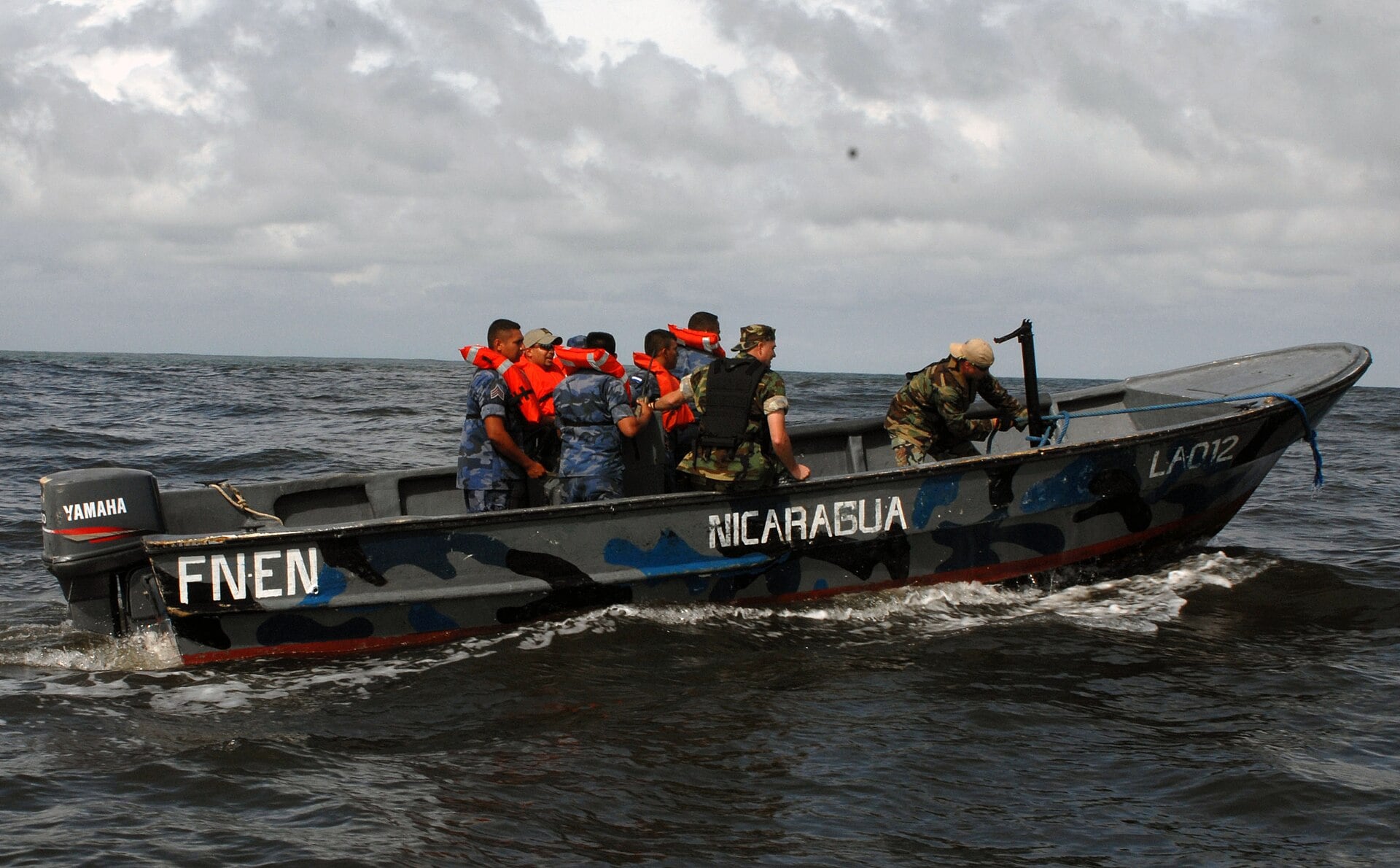
General Julio César Avilés has commanded the Army since 21 February 2010. His fourth term began on 21 February 2025 and runs to 2031, according to Infobae.
At the Army’s 47th anniversary on 2 September 2026, Avilés pledged the military’s firm backing for the constitutional reform. Colonel General Bayardo Rodríguez is chief of the general staff, and Colonel General Marvin Corrales is inspector general.
Nicaragua publishes no current troop figures, and estimates run from about 12,000 to 15,700 people.
The Army and the National Police both answer to the co-presidents.
The 2026 reform would extend the terms of the army and police chiefs from six to seven years, Infobae reported on 2 September 2026.
The Cabinet, Foreign Policy and Gold
Nicaragua’s foreign ministry is led by a co-foreign minister, a title that mirrors the co-presidency. He addressed the UN General Assembly in New York on 26 September 2026, La Prensa reported, and avoided any confrontation with the United States.
Gold is where politics and money meet, and on 16 April 2026 the US Treasury sanctioned two of the co-presidents’ sons and gold-sector firms. It also named Santiago Bermúdez Tapia, whom it described as vice minister of energy and mines.
The Treasury said the gold sector helps the government raise money and keep political control. It tied the sanctions to the forced occupation of a gold plant with US investment.
For the money side of power, see who runs Nicaragua’s economy, and for foreign alliances see Nicaragua Geopolitics Explained.
The Opposition, in Exile and in Prison
In Nicaragua politics the opposition has little room. Before the 2021 election the government barred opposition parties, and Ortega claimed more than 75% of the vote, Confidencial writes.
The Blue and White National Unity group (UNAB), an opposition coalition, urged soldiers on 2 September 2026 not to use weapons against civilians. Juan Sebastián Chamorro has presented a transition proposal backed by 15 opposition organisations, Infobae reported on 5 September 2026.
The Memory and Justice Association counted 68 political prisoners and 31 forced disappearances as of 24 September 2026, Artículo 66 reported. The group says the figure may not cover every case.
Foreign ministers of the Organization of American States (OAS) approved a resolution on 2 October 2026, La Prensa reported. It urges Nicaragua to free political prisoners and restore nationality to people stripped of it.
Nicaragua left the OAS in 2023. In September 2026 Guido said the government will ignore any decision taken by foreign ministers.
The text is covered in detail in the Rio Times report on the OAS resolution.
What It Means for US Readers
The United States is a major market for Nicaraguan exports. US Census data show US imports from Nicaragua of US$4.96 billion in 2025 and US$3.52 billion in January to August 2026.
In December 2025 the US Trade Representative set an extra tariff on Nicaraguan goods outside CAFTA-DR, the regional trade deal with the United States. The rate is 0% in 2026, 10% from 1 January 2027 and 15% from 1 January 2028.
Sanctions reach family members, a vice minister and gold firms. Treasury Secretary Scott Bessent said on 16 April 2026 that the United States “will not allow the illicit confiscation of American-owned assets”.
The State Department advises Americans to reconsider travel to Nicaragua, citing the risk of wrongful detention and arbitrary enforcement of laws. Property owners can read how one case ended in the Rio Times report on seized beach homes.
Nicaragua politics also shapes the region. See Nicaragua and Its Neighbours in Central America for the regional picture.
What Is Not Known
Whether the reform passes unchanged on 18 January 2027 is open, because the text must clear a second legislature. Ortega’s remark of 19 July 2026 that there will be no more elections sits beside a draft that moves the vote to November 2028.
The constitution says the other co-president finishes the term if one is absent. How power would be shared after that is not set out.
As of 9 September 2026 the Assembly had not filled the Supreme Court seat left by Alba Luz Ramos. The OAS follow-up group is due to start work within 30 days of approval, La Prensa reported on 2 October 2026.
The resolution asks the group for recommendations within 60 days. Guido has said Nicaragua will not accept decisions taken by foreign ministers.
Frequently Asked Questions
Who runs Nicaragua in 2026?
In Nicaragua politics, power sits with co-presidents Daniel Ortega, 80, and Rosario Murillo, 75, who are married. The 2025 constitution gives them joint six-year terms and control over the other branches.
Is there a president and a vice president in Nicaragua?
Not since February 2025, when Law 1234 replaced the president and vice president with two co-presidents. If one co-president leaves office, the other finishes the term.
When is the next Nicaragua election?
The 2025 constitution sets it for November 2027. A reform approved once on 1 September 2026 would move it to November 2028 if the Assembly confirms it on or after 18 January 2027.
Is there a real opposition in Nicaragua?
Four small parties hold 15 of the 91 Assembly seats. Nicaragua politics also has 68 political prisoners, according to a rights group count as of 24 September 2026.
Who controls the army and the police?
General Julio César Avilés has led the Army since 2010. Both the army and police chiefs answer to the co-presidents, and the 2026 reform would lengthen their terms to seven years.
Is it safe for Americans to travel to Nicaragua?
The State Department advises Americans to reconsider travel, citing wrongful detention and arbitrary enforcement of laws. Check the current advisory before any trip.
Sources: Asamblea Nacional de Nicaragua, Junta Directiva, 2026-10-22; Asamblea Nacional de Nicaragua, deputies list, 2026-10-22; Constitución Política de Nicaragua, text with Law 1234, 2025-02-18; US Library of Congress, Nicaragua constitutional reforms, 2025-07-02; US Treasury, press release sb0451, 2026-04-16; US Trade Representative, Federal Register notice 2025-22690, 2025-12-12; US Census Bureau, trade with Nicaragua, 2026-10-22; US State Department, Nicaragua travel advisory, 2026-10-22; Hudson Institute, Gil Guerra on Nicaragua’s reforms, 2026-09-01; La Prensa, Nicaragua Supreme Court new justices, 2026-09-09; La Prensa, Ana Julia Guido interview, 2026-09-07; La Prensa, army chief backs Ortega, 2026-08-18; La Prensa, army leadership promotion, 2026-09-03; Infobae, Murillo speeches study, 2026-10-05; Infobae, opposition and the Army, 2026-09-05; Infobae, first approval of the 2026 reform, 2026-09-02; Confidencial, Ortega on elections, 2026-07-20; Artículo 66, political prisoners count, 2026-09-25; TN8, CSE backs the reforms, 2026-08-25; La Prensa, OAS foreign ministers on Nicaragua, 2026-10-02; La Prensa, co-foreign minister at the UN, 2026-09-26.
This article was produced by The Rio Times’ automated newsroom system. How we use AI · Report an error · Editorial responsibility: Matthias Camenzind, Editor-in-Chief
Expat Guide to Nicaragua
What The Rio Times publishes for foreigners who live in or move to Nicaragua.
Start here
- Is Nicaragua Safe for Expats? Crime, Politics and Daily Reality
- Opening a Bank Account in Nicaragua as a Foreigner: Banks, Documents and the Limits
- Moving to Nicaragua: Visas, Costs and Daily Life Under Ortega
- Healthcare in Nicaragua for Expats: Hospitals, Insurance and the Managua Option
Understand Nicaragua
Rotate for Best Experience
This report is optimized for landscape viewing. Rotate your phone for the full experience.
You've reached your free article limit
Subscribe to The Rio Times for unlimited access to our news, expat and nomad guides and market intelligence on Latin America and Africa.
Expat Guide to Nicaragua
What The Rio Times publishes for foreigners who live in or move to Nicaragua.
Start here
- Is Nicaragua Safe for Expats? Crime, Politics and Daily Reality
- Opening a Bank Account in Nicaragua as a Foreigner: Banks, Documents and the Limits
- Moving to Nicaragua: Visas, Costs and Daily Life Under Ortega
- Healthcare in Nicaragua for Expats: Hospitals, Insurance and the Managua Option
Understand Nicaragua