OAS Demands Nicaragua Elections and Prisoner Release

POLITICS · NICARAGUA
Key Facts
- —The country Nicaragua, in Central America, is ruled by co-presidents Daniel Ortega and Rosario Murillo. It left the Organization of American States (OAS) in November 2023.
- —What happened On Friday 2 October, OAS foreign ministers adopted by consensus a resolution demanding free elections and the unconditional release of political prisoners, EFE and AFP reported.
- —Who is involved The text was pushed by the US, Argentina, Colombia, Paraguay, Peru and the Dominican Republic. Mexico said it would not join it; Brazil and Uruguay rejected its “threat to peace” wording.
- —What it means for you Nothing changes inside Nicaragua for now, as the text carries no sanctions. The Dominican Republic said on 2 October it is closing its embassy in Managua.
- —Still open Whether Managua receives a new ministerial follow-up group. The group has up to 60 days to recommend diplomatic and legal steps, according to the resolution text published by the OAS.
Foreign ministers of the Organization of American States (OAS) on 2 October adopted a resolution demanding free Nicaragua elections and prisoner releases. The text was approved by consensus in Washington, EFE and AFP reported.
The OAS last held such an emergency ministers’ meeting in 2019, when the body took up Venezuela. Ortega had said on 19 July that Nicaragua would hold no more elections.
What the resolution demands
The text is titled “The situation in Nicaragua and its continued collective consideration”. It asks Managua to free all political prisoners and disclose the whereabouts of the disappeared, Divergentes reported from the document.
It also asks Nicaragua to restore nationality to people stripped of it and let exiles return safely. It calls for revoking constitutional and legal changes approved in 2025 and 2026.
It also sets conditions for credible Nicaragua elections. These include an independent electoral authority and international observation, according to Divergentes.
The resolution imposes no concrete sanctions on Ortega and his wife, Rosario Murillo, EFE reported. Nicaragua left the OAS in November 2023, so the body cannot apply collective measures against it.
The ministers still argued that leaving the OAS does not free Managua from its human rights obligations. On 2 October The Rio Times reported that rights experts had urged firm action: Rights Experts Urge Firm OAS Action on Nicaragua.
A follow-up group with deadlines
The resolution creates a Ministerial Follow-up Group open to all member states. It must start work within 30 days and seek “prompt, direct engagement” with Managua, including a visit if possible.
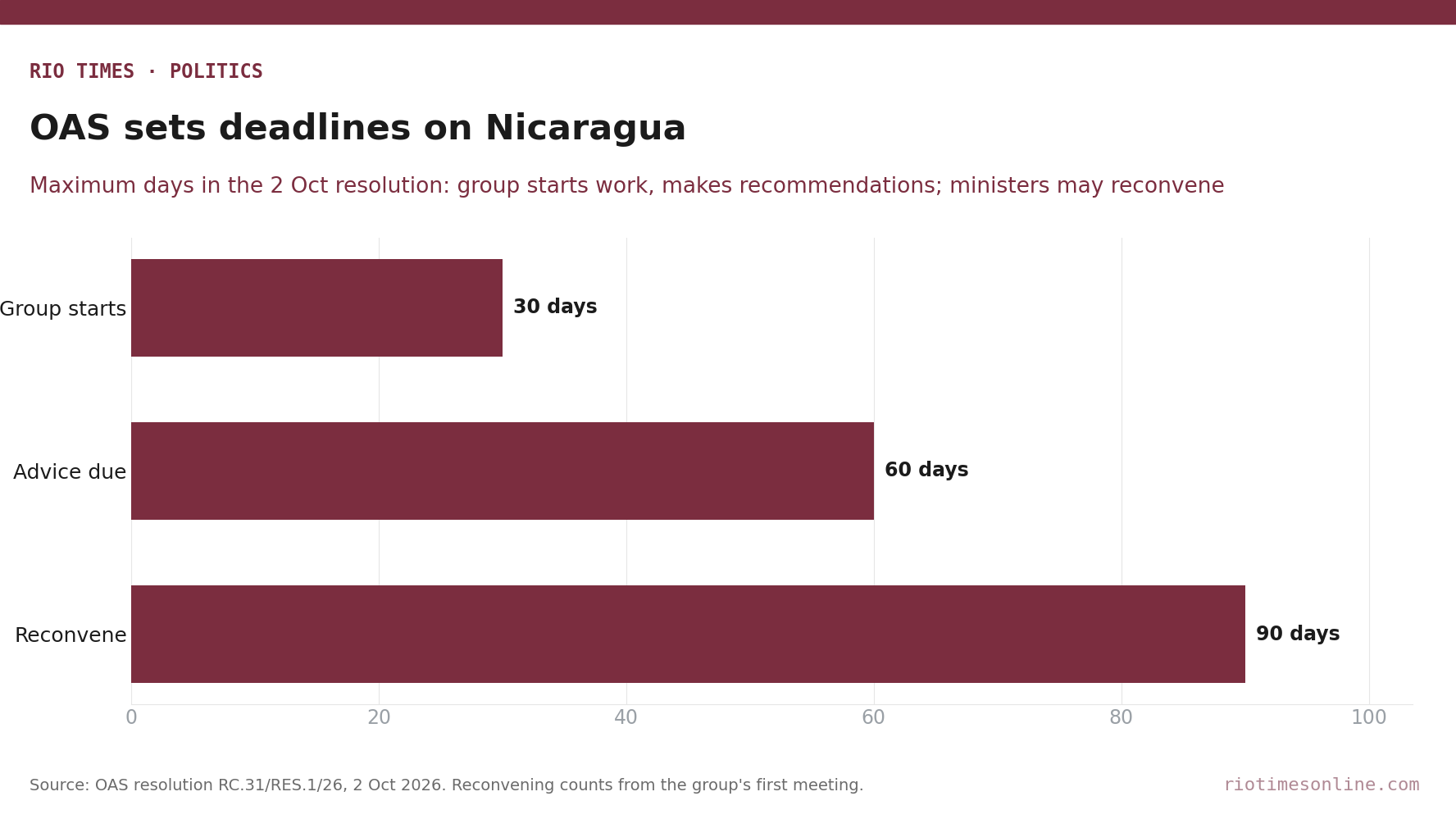
Within 60 days, the group is to recommend “concrete diplomatic and legal actions” that exclude the use of force. The ministers can reconvene within 90 days of the group’s first meeting, the text adds.
The adopted text, published by the OAS as RC.31/RES.1/26, confirms the 60-day limit that AFP and Divergentes reported. An EFE report put it at 90 days, a figure the text applies only to reconvening the ministers.
The final text follows the draft reported on 29 September: OAS Draft Resolution Demands Nicaragua Revoke Its 2025–2026 Constitutional Changes.
Consensus, with dissent on one paragraph
Juan Pablo Segura, US Assistant Secretary of State for Western Hemisphere Affairs, praised the outcome. “It is an unprecedented achievement” that member states reached “unanimous consensus” on such a text, he told a telephone briefing, Prensa Libre reported.
Not every government signed on fully. Mexico’s OAS envoy, Alejandro Encinas, said Mexico would not accompany the resolution, Proceso and Infobae reported.
Mexico objected to a paragraph saying Nicaragua’s practices could endanger regional peace and security. Brazil and Uruguay also distanced themselves from that wording in footnotes to the adopted text.
The OAS text records adoption in plenary but gives no vote count, and no country-by-country tally had been published by Saturday morning. Only seven of 34 member states sent their foreign ministers, EFE reported.
An embassy closes, an ambassador is refused
Dominican Foreign Minister Víctor Bisonó announced at the session that his country would withdraw its embassy in Managua. It stays closed while the conditions he denounced persist, EFE and AFP reported.
US Deputy Secretary of State Christopher Landau said Managua had refused Natasha Franceschi, the new US ambassador. Segura later said “all options are on the table”, Divergentes reported.
OAS Secretary General Albert Ramdin stressed talks. “The most important thing is to seek dialogue with those in charge,” he said, according to AFP. He also urged targeted sanctions that spare the population, EFE reported.
What Is Not Yet Known
No formal response from Managua to the resolution had been reported by Saturday morning. It is unclear whether Ortega and Murillo will receive the follow-up group.
It is also unknown which states will join the group, and no date exists for Nicaragua elections. A second vote on Nicaragua’s constitutional reform is set for 18 January 2027, Efecto Cocuyo reported.
What did the OAS resolution demand from Nicaragua?
Free, fair and inclusive elections, the unconditional release of political prisoners and the return of nationality to those stripped of it. It also asks Managua to reverse constitutional changes made in 2025 and 2026.
Does the resolution bring Nicaragua elections closer?
Not directly. Nicaragua left the OAS in 2023 and the text imposes no sanctions. A follow-up group will seek dialogue and report within 60 days.
Which countries did not fully back the text?
Mexico said it would not accompany the resolution. Brazil and Uruguay distanced themselves from wording that calls Nicaragua a potential threat to regional peace and security.
Sources: OAS, resolution RC.31/RES.1/26, 2 October 2026; EFE, OAS approves resolution demanding elections in Nicaragua, 2 October 2026; Efecto Cocuyo, 2 October 2026; Divergentes, ministerial group and 60-day deadline, 2 October 2026; Divergentes, US reaction, 2 October 2026; Prensa Libre, 2 October 2026; El Financiero (AFP), 2 October 2026; TVN (AFP), Dominican embassy closure, 2 October 2026; Metro Puerto Rico (EFE), 2 October 2026; Proceso, Mexico’s position, 2 October 2026; Infobae, 3 October 2026. Background: The Rio Times, 29 September and 2 October 2026. All retrieved 3 October 2026.
This article was drafted with automated assistance and reviewed before publication. How we use AI · Report an error · Editorial responsibility: Matthias Camenzind, Editor-in-Chief