Haiti Gang Violence Has Killed or Injured 5,700 People

SECURITY · HAITI
Key Facts
- —The country Haiti, a Caribbean nation of about 12 million people, has had no elected president since 2021. It plans a national vote on 13 December 2026.
- —What happened On Friday 2 October the UN human rights chief said at least 5,700 people were killed or injured by gangs, or in operations against them, from 1 January to 11 September 2026.
- —The numbers Over half of those casualties came during security operations. Gangs kidnapped more than 230 people and raped over 1,000 women and girls in the same period (UN rights office, 2 October).
- —What it means for you Importers take note: third-country goods for Haiti may not transit the Dominican Republic and must land at Haitian ports or airports (finance ministry circular, 30 September).
- —Still open Whether the UN-backed Gang Suppression Force, about 1,500 strong according to a UN expert on 2 October, can hold ground before the December vote.
Haiti gang violence killed or injured at least 5,700 people from 1 January to 11 September 2026, the UN human rights office said. Volker Türk, the UN rights chief, gave the figure in Geneva on Friday 2 October.
More than half of those casualties occurred during security operations against the gangs, he said. Türk welcomed the first operations of the UN-backed Gang Suppression Force, but said it remains far below the strength needed.
What the UN figures show
The 5,700 figure counts both deaths and injuries, caused by gangs or during operations against them. Türk said the real numbers are likely much higher, because data on the violence is incomplete.
Gangs also kidnapped more than 230 people and raped over 1,000 women and girls, his office documented. So-called self-defence groups killed or injured some 280 people this year.
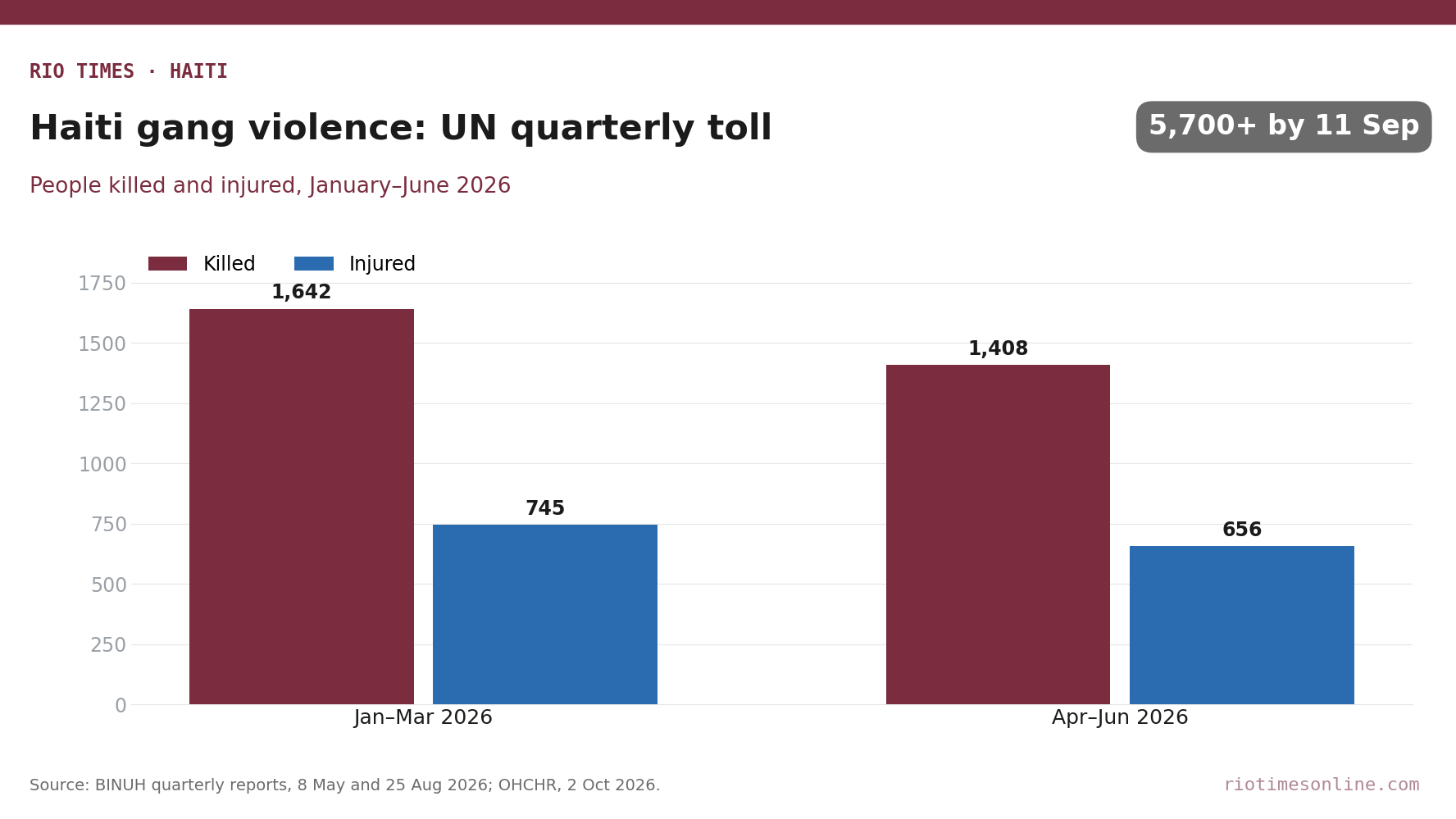
The UN Integrated Office in Haiti (BINUH), the UN political mission in the country, publishes quarterly detail. It counted 1,642 killed and 745 injured from January to March, then 1,408 killed and 656 injured from April to June.
Last year about 6,000 people were killed and 2,700 injured, the Spanish agency EFE reported in El Nacional, a Santo Domingo daily. According to the same report, Türk said summary executions by specialised police units have fallen by almost half compared with 2025.
Children, displacement and Gros-Morne
Some 30 to 50 percent of gang members are children, Türk said, and their recruitment nearly tripled last year. Close to 1.5 million people are forcibly displaced across the country.
The latest flight came from Gros-Morne, in the Artibonite region, after a gang reprisal on 28 September. The International Organization for Migration (IOM) counted about 5,254 people displaced, Le Nouvelliste reported on 2 October.
The reprisal followed a brief operation by the force, as covered in Haiti Gang Suppression Force Faces UN Renewal Vote After Reprisal Kills at Least 11. The UN rights office count stops at 11 September, so it does not include Gros-Morne. The UN Security Council extended the force’s mandate by six months on 29 September.
The state restates its ban on transit through the Dominican Republic
Haiti’s finance ministry has reminded customs that the state recognises no dry port in the Dominican Republic. Nor does it accept any transit or transshipment there of third-country goods bound for Haiti.
The circular is dated 30 September and signed by Finance Minister Serge Gabriel Collin, Le Nouvelliste reported. Such goods must arrive directly at the country’s seaports or international airports, where customs applies duties and taxes.
Products legally made in the Dominican Republic may still enter through official land crossings. The General Customs Administration (AGD) has been told to tighten border controls.
Officials did not link the circular to security in the parts made public. Separately, UN expert William O’Neill said on Friday that weapons also cross that land border, El Nacional reported.
The oldest school carries on in borrowed rooms
Lycée Alexandre Pétion, founded in 1816 and the country’s oldest school, has lost its downtown Port-au-Prince premises to insecurity. It now works from a national school on Rue Capois, Le Nouvelliste reported on 2 October.
The paper says the lycée has educated at least 46 of the country’s heads of state. It keeps teaching after several moves in three years, a small sign of resilience amid the violence.
For the wider picture, see Haiti Gang Crisis Explained 2026 Gangs and the UN Force.
What Is Not Yet Known
BINUH has not yet published its casualty figures for July to September. It is unclear how far the Gros-Morne violence will lift the full-year count.
It is also unclear how fast the force will grow toward its authorised strength before the 13 December vote. Customs has not said how it will enforce the transit ban at the land border.
Sources: OHCHR, High Commissioner Türk statement on Haiti, 2 Oct 2026 · UN News, World News in Brief, 2 Oct 2026 · BINUH, first-quarter 2026 report, 8 May 2026 · BINUH, second-quarter 2026 report · El Nacional (EFE), 3 Oct 2026 · Le Nouvelliste, dry port ban, 2 Oct 2026 · Le Nouvelliste, transit circular, 2 Oct 2026 · Le Nouvelliste, Gros-Morne displacement, 2 Oct 2026 · Le Nouvelliste, Lycée Alexandre Pétion, 2 Oct 2026
Editorial responsibility: Matthias Camenzind, Editor-in-Chief · Editorial standards · Report an error