
GUYANA · POPULATION
Key Facts
- What is happening Guyana counted 878,674 people in its 2022 census; the statistics office now estimates over one million.
- Why it matters Four main groups share a small country, and an oil boom is drawing newcomers.
- The numbers The latest ethnic count, from 2012, was 39.8% East Indian, 29.2% African, 19.9% mixed, 10.5% Amerindian.
- Who is who The Bureau of Statistics counts the people; President Irfaan Ali’s ruling party won the September 2025 vote.
- What to watch Watch for the 2022 census tables on ethnicity and religion, which are not yet published.
- What it means for you The State Department rates Guyana Level 3, reconsider travel (advisory of 12 May 2025).
Guyana is a small country with a young, mixed and fast-changing population. Here is who lives there, where, and how the groups share one country.
The Guyana population was 878,674 at the 2022 census, and the statistics office now estimates 1,025,334 for the end of 2025. Nearly four in ten residents live in one coastal region around the capital, Georgetown.
The country sits on the northern coast of South America, between Venezuela, Brazil and Suriname, with English as its common language. Most people descend from groups who arrived through colonial history, plus the Indigenous peoples who were there first.
More coverage sits on the Rio Times Guyana page and the Guyana explained guide. This guide uses no local-currency amounts, so no exchange rate applies.
Guyana Population in One Page
The list gives each essential fact in one line. Sources and dates follow in the sections below.
- Census 2022: 878,674 people, up 17.63% from 746,955 in 2012.
- Estimate: 956,044 at the end of 2024 and 1,025,334 at the end of 2025, the statistics office says.
- Largest region: Region 4, Demerara-Mahaica, with 347,759 people, or 39.58% of the total.
- Age: about 42% of residents were under 25 at the end of 2025, according to the Bureau of Statistics.
- Ethnic groups (2012): East Indian 39.8%, African 29.2%, mixed 19.9%, Amerindian 10.5%.
- Religion (2012): Hindu 24.8%, Pentecostal 22.8%, other Christian 20.8%, Roman Catholic 7.1%, Muslim 6.8%.
- Foreign-born (2022): 3.07% of residents, the highest share in any census since 1980.
- Density: 4.09 people per square kilometre nationally, but 156 in Region 4.
How Many People Live in Guyana
The Bureau of Statistics, Guyana’s national statistics office, counted 878,674 people on the night of 14 to 15 September 2022. That was 131,719 more than the 746,955 counted in 2012, a rise of 17.63%.
Men numbered 440,882 and women 437,792, or 50.18% and 49.82%, a ratio of 101 men to every 100 women. In 2012 there were 99 men for every 100 women.
Growth averaged 1.64% a year between 2012 and 2022, the Bureau says. The previous decade, 2002 to 2012, had shown a slight fall of 0.06% a year.
The Bureau puts the population at 956,044 at the end of 2024 and 1,025,334 at the end of 2025. It announced the latter figure around World Population Day in July 2026, calling it the first time the country passed one million.
Earlier counts show how unusual the recent jump is. The census found 751,223 people in 2002, 723,673 in 1991 and 759,567 in 1980, so the population was flat for three decades.
Two things drove the change, the Bureau says. Natural increase, meaning births minus deaths, supplied 68% of growth between 2013 and 2022, and net arrivals from abroad supplied the rest.

Where People Live, Coast and Interior
Guyana is mostly forest and savannah, but its people are crowded onto a narrow coastal strip. The coast covers 32.39% of the land and holds 87.16% of residents, or 765,852 people.
The interior, called the hinterland, covers 67.61% of the land and holds 112,822 people, or 12.84%. That is fewer than one person for every square kilometre, at 0.78.
Region 4, Demerara-Mahaica, is the most crowded, with 347,759 residents and about 156 people per square kilometre. Region 3, Essequibo Islands-West Demerara, is second with 143,884 people, followed by Region 6, East Berbice-Corentyne.
Region 8, Potaro-Siparuni, is the smallest, with 13,598 people. Guyana is divided into ten administrative regions, and all ten grew between 2012 and 2022.
The fastest growth was in the interior. Region 7, Cuyuni-Mazaruni, grew 5.14% a year, a mining area, and Region 1, Barima-Waini, grew 3.49%.
Only about one resident in four lives in a town. The towns held 225,814 people in 2022, or 25.70%, and the World Bank puts the urban share at 26.5% in 2025.
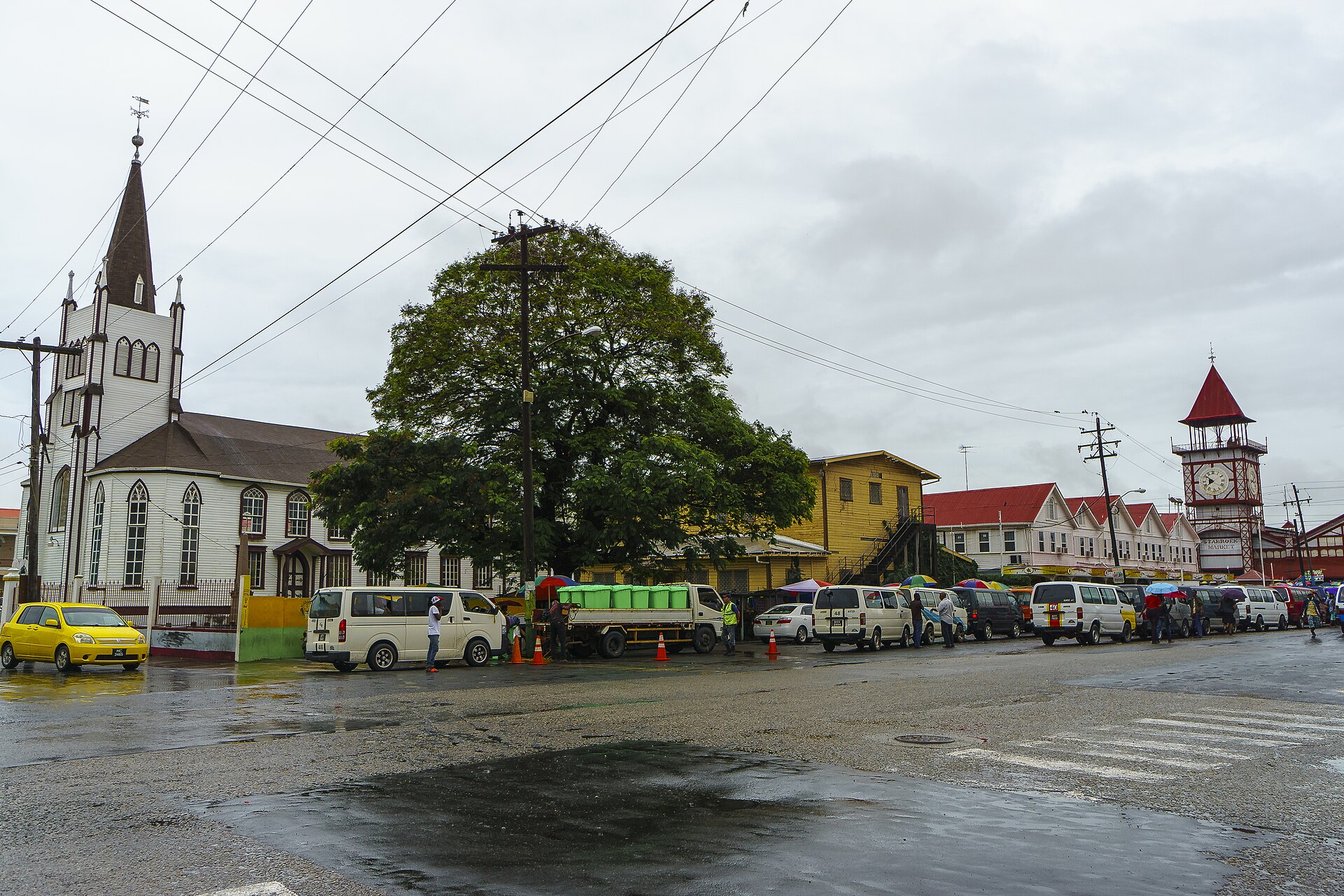
Georgetown, the capital, had 125,683 residents in 2022, up from 120,142 in 2012. Linden had 33,183, New Amsterdam 14,762, Anna Regina 11,846, Corriverton 11,488 and Bartica 11,486.
A Young Country With Smaller Families
Guyana’s age profile is young but ageing slowly. In 2012 the median age, the age that splits the population in half, was 25.1 years, up from 16.3 in 1970.
In 2012, 37.09% of residents were under 18 and 5.13% were 65 or older, the Bureau’s 2012 census report shows. The interior is younger still, with a median age of 17.2 years in Region 9 and 17.5 in Region 1.
At the end of 2025, about 42% of residents were under 25 and 61% under 35, the Bureau says. The largest group, for men and women alike, is aged 25 to 29.
Households are getting smaller. The 2022 census counted 271,946 households, and the average size fell from 3.65 people in 2012 to 3.23.
World Bank data put the fertility rate at 2.4 births per woman in 2024 and life expectancy at 70.3 years. The birth rate was 19.9 per 1,000 people that year.
The government registered 15,750 births and 6,818 deaths in 2022, the Bureau’s census report shows. Those totals are within the population registers, which also count arrivals and departures.
Ethnic Groups, Who Lives in Guyana
The Bureau’s 2012 report describes six main groups plus a mixed group, five of them shaped by colonial immigration policy. Their roots lie in Europe, Africa, China and India, while Amerindians are the Indigenous people.
East Indians, people of South Asian descent, were the largest group in 2012 with 297,493 people, or 39.8%. People of African descent numbered 218,483, or 29.2%.
People of mixed heritage numbered 148,532, or 19.9%, and Amerindians 78,492, or 10.5%. Portuguese descendants were 1,910, Chinese 1,377, white residents 415 and others 253.
The mix has shifted steadily since 1980, the census series shows. East Indians fell from 51.9% to 39.8%, while the mixed group rose from 11.2% to 19.9% and Amerindians from 5.3% to 10.5%.
The Bureau’s 2012 report ties the shift to emigration from the coast and to intermarriage. It says the mixed group comes from marriage between the other groups over time.
The 2022 census has not yet published ethnic tables that we could find. The 2012 figures are therefore the latest official counts, and they will be outdated once the 2022 tables appear.
Where Each Group Lives
The groups live in different places, and the 2012 regional tables show how. East Indians made up about 66% of Region 6, East Berbice-Corentyne, and about 60% of Region 3, Essequibo Islands-West Demerara.
In Region 5, Mahaica-Berbice, they were about 55%, and Africans about 33%. In Region 4, which includes Georgetown, Africans were about 41%, East Indians 35% and the mixed group 21%.
Region 10, Upper Demerara-Berbice, around the mining town of Linden, was about 49% African and about 40% mixed. Region 7, Cuyuni-Mazaruni, was about 41% mixed and 37% Amerindian.
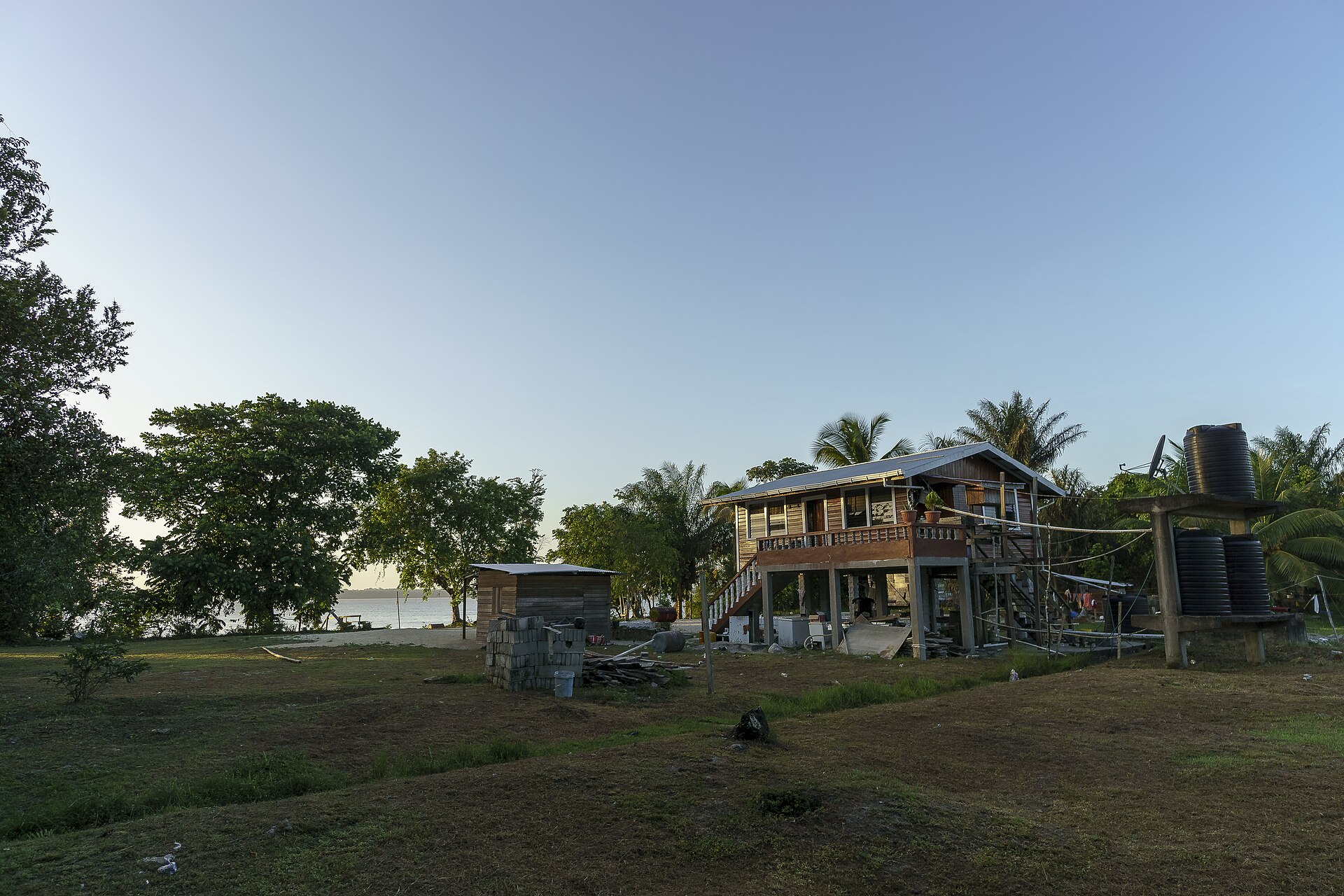
Amerindians were the clear majority in the deep interior, at about 86% in Region 9, Upper Takutu-Upper Essequibo. They were also about 72% in Region 8 and 65% in Region 1.
In May 2025 the government said titled Amerindian land equals 16.48% of the country. It also said 16,174 Amerindians gained land security since 2020.
The ministry that handles Indigenous affairs is the Ministry of Amerindian Affairs. A land title is a legal paper that gives a village ownership of its area.
Languages and Religions
English is the language that joins the groups, the Bureau’s census report says. It describes the groups as fused together by a common language, English.
The religion data come from 2012 and show a mixed country. Hindus were the largest single group at 24.8%, or 185,439 people, followed by Pentecostals at 22.8% and other Christians at 20.8%.
Roman Catholics were 7.1%, Muslims 6.8%, Seventh-day Adventists 5.4% and Anglicans 5.2%. Those with no religion were 3.1%, and Rastafarians 0.5%.
Pentecostal churches grew by about 3.3% a year between 2002 and 2012, the Bureau says. Hindus fell from 28.7% to 24.8% in that decade.
The Bureau notes that stated religion is a self-description and does not prove regular practice. The 2022 religion tables are not yet published.
Migration, Diaspora and Newcomers
Guyana has long lost people to other countries. The Migration Policy Institute, a Washington research group, used data to July 2022 to estimate 550,000 Guyanese abroad.
The same study found that over 55% of Guyanese nationals have left, including about 90% of those with tertiary education. Those are estimates, not census counts.
The Bureau’s registers show the trend reversing. Departures exceeded arrivals every year from 2013 to 2016, and net arrivals turned positive in 2017 at 3,205.
They then rose to 21,714 in 2018 and 36,622 in 2019, before the pandemic cut flows. The figure was 12,752 in 2022, and the Bureau notes these counts miss undocumented migrants.
The 2022 census found 3.07% of residents foreign-born, up from 1.10% in 2012 and 0.54% in 1991. Men were 51.21% of them, and the Bureau says the true share may be understated.
Migrants from the three neighbours, Venezuela, Suriname and Brazil, numbered 15,467 in 2022, against 3,193 in 2012. Venezuelans were 12,654 of them, or 81.81%, a 1,452.64% rise.
Administrative records show 19,709 Venezuelans registered from 2018 to 2022, the Bureau says. It also cites a mid-2024 estimate from the International Organization for Migration, a United Nations body, of about 40,545 Venezuelans.
How the Groups Live Together
Guyana has no single dominant group, so ethnic balance matters in public life. Observers link party support to communities, but Guyana publishes no ethnic vote breakdown, so we make no such claim.
The 2025 election shows how the map looks. GECOM, the elections commission, declared the People’s Progressive Party/Civic (PPP/C) winner in eight of ten districts after the 1 September 2025 vote.
The party received 242,498 votes, the government’s Department of Public Information says. We Invest in Nationhood, a newer opposition party, won 109,066 votes and took Regions 7 and 10.
Mixing is rising in families and neighbourhoods, since the mixed group nearly doubled its share between 1980 and 2012. Shared English, school and the oil economy also pull the groups together.
Dividing lines remain over land, jobs and who benefits from oil. Interior regions grew faster than the coast, which raises questions over services, titles and mining.
What It Means for US Readers
The State Department rated Guyana Level 3, reconsider travel, in an advisory reissued on 12 May 2025. It cites violent crime and limited police resources, so check the latest notice before you book.
Guyanese have a large US community, and the Migration Policy Institute’s 550,000 figure shows how many families span both countries. A US firm hiring in Guyana will meet a young, English-speaking workforce that is concentrated near Georgetown.
Related guides cover Guyanese people and culture, who holds power, the economy’s key players, foreign players and geopolitics. Our earlier news report, Guyana passes 1 million people, covers the milestone.
What Is Not Known
The Bureau has not published, so far as we could find, 2022 census tables on ethnicity, religion, language or age. The figures here for those topics come from 2012 and may have moved.
The estimates of 956,044 and 1,025,334 are not census counts, and the Bureau’s website still shows the 2022 census figure. The World Bank’s series shows 835,986 for 2025, far below the Bureau, so the true count is uncertain.
The census cannot reach everyone. It adjusted by a weighting factor for 33,101 households that refused or could not be reached, and migrants are hardest to count.
We could not find official figures on the Guyanese diaspora in the United States. Whether the State Department has changed its advisory since 12 May 2025 was also not confirmed.
Frequently Asked Questions
How many people live in Guyana?
The census of 15 September 2022 counted 878,674 people. The Bureau of Statistics estimates 1,025,334 for the end of 2025.
What are the main ethnic groups in Guyana?
In 2012 East Indians were 39.8%, Africans 29.2%, people of mixed heritage 19.9% and Amerindians 10.5%. Portuguese, Chinese, white and other groups were under 1% together.
Where do most Guyanese live?
Nearly nine in ten live on the narrow coast, and 39.58% live in Region 4, Demerara-Mahaica, around Georgetown. The interior holds 12.84% of residents.
What religions are practised in Guyana?
In 2012 Hindus were the largest group at 24.8%, then Pentecostals at 22.8% and other Christians at 20.8%. Roman Catholics were 7.1% and Muslims 6.8%.
What language do people speak in Guyana?
English is the common language that joins the groups, the Bureau says. Detailed 2022 language tables have not been published.
Is Guyana’s population growing?
Yes. It grew 17.63% from 2012 to 2022, and the Bureau estimates 1,025,334 by the end of 2025, partly from net arrivals.
Sources: Bureau of Statistics Guyana, Preliminary Report of the 2022 Census; Bureau of Statistics Guyana, 2012 Census Compendium 2 (population composition); Bureau of Statistics Guyana, 2012 Census Compendium 1 (population size and growth); Bureau of Statistics Guyana, census page and population counts; Department of Public Information, Guyana, 2022 census highlights; Department of Public Information, Guyana, GECOM district results of September 2025; Department of Public Information, Guyana, Amerindian land titling (May 2025); World Bank, World Development Indicators for Guyana (fertility, life expectancy, urban share, population); Migration Policy Institute, Guyana oil, labor migration and climate displacement; US State Department, Guyana travel advisory.
This article was produced by The Rio Times’ automated newsroom system. How we use AI · Report an error · Editorial responsibility: Matthias Camenzind, Editor-in-Chief