
GUIDES · COSTA RICA · EXPATS
Key Facts
- •The basic calendar On the Pacific side and in the Central Valley, the dry season runs from December to March and the rainy season from May to October. April and November are transition months.
- •The exception The Caribbean slope has no defined dry season. Its wettest month is December, and it is relatively drier in February to March and September to October.
- •This year The national weather service, the IMN, says El Niño has brought meteorological drought to the Central Valley, the Pacific and the western Northern Zone.
- •October to December The IMN expects an early end to the rainy season, dry-season conditions on the Pacific side and temperatures 1 to 2 °C above normal across the country.
- •Hurricanes The IMN forecasts a less active Atlantic season than normal, with 9 to 12 named storms. The season ends on 30 November.
- •Where to check The IMN, part of the Environment and Energy Ministry, publishes forecasts, warnings and a monthly seasonal outlook at imn.ac.cr.
Costa Rica has two seasons across most of the country: a dry season from December to March and a rainy season from May to October. The Caribbean coast follows a different calendar, and 2026 is not a normal year.
The national weather service, the Instituto Meteorológico Nacional (IMN), says a fast-strengthening El Niño has pushed the Pacific side and the Central Valley into drought and expects the rains to end early. For Americans planning a trip, a winter stay or a move, that points to a drier, hotter autumn than usual in Guanacaste and San José, while the Caribbean stays close to normal.
Two Slopes, Two Calendars
A chain of mountains running from northwest to southeast splits Costa Rica into a Pacific slope and a Caribbean slope, each with its own rainfall pattern, the IMN explains. It divides the country into seven climate regions: the North, Central and South Pacific, the Central Region, the Northern Zone, and the North and South Caribbean.
On the Pacific slope the dry season starts first in the northwest and last in the southeast, and March is the driest and hottest month. The rains return in May. In July and August a dry spell called the veranillo, or canícula, often interrupts them, when the trade winds strengthen. September and October are the wettest months, and Pacific rain falls mostly in the afternoon and early evening.

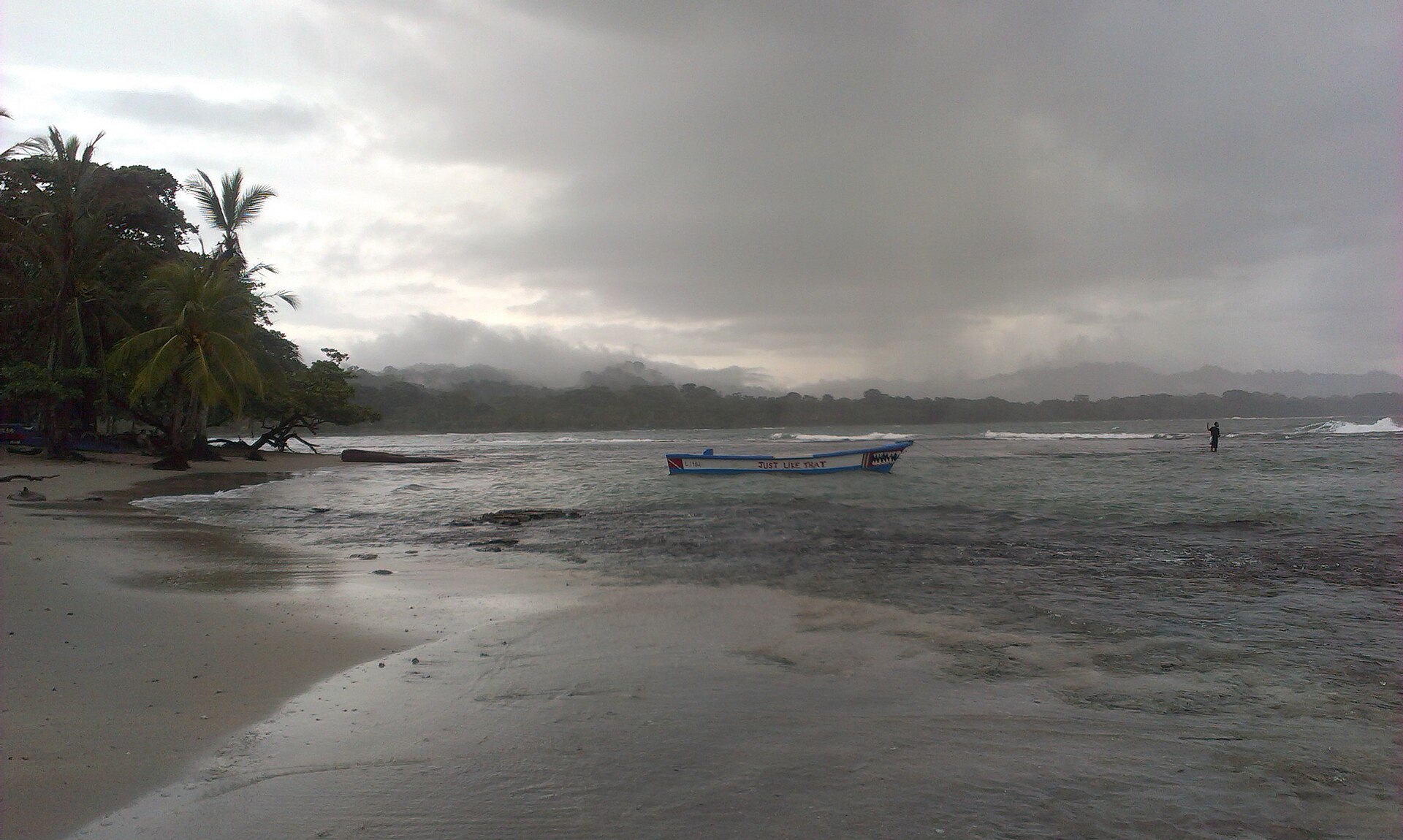
The Caribbean slope never really dries out. Even its least rainy months bring 100 to 200 millimetres, according to the IMN. The coast has two relatively dry spells, in February to March and in September to October, the second just as the Pacific is at its wettest. Caribbean rain tends to fall at night and in the morning.
Region by Region
The figures below are the IMN’s long-term averages, based mainly on the 1961 to 1990 reference period.
- Central Valley (San José). The western part of the valley is wetter, with about 2,300 millimetres a year, than the eastern part, with about 1,700. The dry months run from January to March.
- North Pacific (Guanacaste). One of the driest and hottest parts of the country, with 1,500 to 2,500 millimetres a year. The Tempisque basin averages about 1,700 millimetres, with days around 32 °C and nights around 22 °C. Only 4% of the year’s rain falls between December and March.
- Central Pacific. Its valleys average about 3,500 millimetres a year, with an average high of 31.0 °C and an average low of 22.7 °C.
- South Pacific. About 3,700 millimetres a year on average, and more than 4,500 in some areas, with an average high of 27.9 °C and low of 20.5 °C.
- Northern Zone. The third-wettest region, with more than 3,200 millimetres a year. It has a single rainy season from May to December or January, and each cold front from the north can bring about 6% of the annual total.
- Caribbean. About 3,300 millimetres a year, ranging from about 4,500 in the northeast to about 2,700 around Turrialba. The North Caribbean is wetter than the South, and the rainy stretch from November to February, peaking in December and January, brings about 40% of the annual total.
El Niño and Drought in 2026
In its seasonal outlook updated on Friday 11 September 2026, the IMN said sea temperatures in the Niño 3.4 region of the Pacific had warmed fast, reaching about 2.5 °C above normal in August. That was higher than at the same point of the strong El Niño years 1997 and 2015, and confirms that El Niño has consolidated and is likely to intensify towards the end of 2026.
Its drought early-warning system showed meteorological drought in the Central Valley, the western Northern Zone and the Pacific. The IMN expected September to end with rain 80% below normal in the North Pacific, 60% below in the Central and South Pacific and 50% below in the Central Valley. It expected surpluses of 20% in the North Caribbean and 30% in the South Caribbean.
For October to December, the IMN forecasts dry-season conditions on the Pacific slope and in the Central Valley, rain 30% below normal in the western Northern Zone, and normal rain on the Caribbean slope and in the eastern Northern Zone. It expects an early end to the rainy season, a weaker and later season of cold fronts from the north, and temperatures 1.5 to 2 °C above normal on the Pacific side and in the Central Valley.
Hurricanes and Heavy Rain
The Atlantic hurricane season runs from 1 June to 30 November, the US National Hurricane Center says. Storms that form in the Caribbean Sea usually bring rain to Costa Rica’s Pacific slope rather than its Caribbean coast, the IMN notes.
Hurricane Mitch in 1998 left about 900 millimetres of rain in the Central Pacific around Jacó and Quepos, while the Caribbean coast stayed almost dry, according to the IMN. Hurricane César in 1996, a much weaker storm, caused deaths and heavy damage in Costa Rica.
For 2026 the IMN expects a less active Atlantic season than normal, with 9 to 12 named systems: 5 to 6 tropical storms, 3 to 4 minor hurricanes and 1 to 2 major hurricanes, plus 41 tropical waves. A quieter season still does not rule out a single damaging storm.
What It Means for You
Travellers. For the Pacific beaches and San José, December to March is the reliable dry season. For the Caribbean, the relatively dry windows are February to March and September to October. This autumn, the IMN’s outlook points to an early start of dry conditions on the Pacific side and hotter days than usual everywhere.
People planning a move. Visit any Pacific or Central Valley property in September or October, the wettest months in a normal year, to see how roads, roofs and drainage cope. In Guanacaste, ask about water supply in the dry season, especially in a drought year like 2026.
Remote workers and retirees. The Caribbean’s rain falls mostly at night and in the morning, and the Pacific’s in the afternoon. Plan outdoor time and long drives around those patterns, and follow IMN warnings during storms.
What Is Not Known
The IMN’s outlook is a forecast of likely scenarios, not a guarantee. It is not known how early the rains will end in each region, or how dry the 2027 dry season will be if El Niño keeps strengthening.
The IMN publishes its El Niño bulletin on the second Friday of each month, so its next reading is due on Friday 9 October 2026. Whether the drought will lead to water restrictions in particular towns is not yet clear.
Connected Coverage
Costa Rica Explained: The Country, Its Politics, Its Economy and What to Watch
Costa Rica Ecotourism Explained: Parks, Forest Payments and 2.9 Million Visitors
Living in Ciudad Quesada: A 2026 Guide for Expats in Costa Rica
Frequently Asked Questions
What is the best month to visit Costa Rica?
For the Pacific beaches and the Central Valley, the dry season from December to March is the most reliable, and March is the driest and hottest month. On the Caribbean coast, the relatively dry periods are February to March and September to October.
When is the rainy season in Costa Rica?
On the Pacific slope and in the Central Valley it runs from May to October, with November as a transition month and September and October usually the wettest. The Caribbean slope has no defined dry season, and its wettest month is December.
Is 2026 a normal year for Costa Rica weather?
No. The national weather service, the IMN, says El Niño has brought meteorological drought to the Central Valley, the Pacific and the western Northern Zone, and it expects an early end to the rainy season and above-normal temperatures from October to December.
Does Costa Rica get hurricanes?
Storms that form in the Caribbean Sea usually bring heavy rain to Costa Rica’s Pacific slope. The Atlantic season runs from 1 June to 30 November, and the IMN expects a less active season than normal in 2026, with 9 to 12 named systems.
Where can I check the official forecast?
The Instituto Meteorológico Nacional (IMN), part of the Environment and Energy Ministry, publishes daily forecasts, weather warnings, a monthly seasonal outlook and a monthly El Niño bulletin at imn.ac.cr.
Sources: IMN, seasonal outlook October to December 2026, updated 11 September 2026; IMN, the climate and climate regions of Costa Rica; IMN, climate of the Central Valley; IMN, climate of the North Pacific; IMN, climate of the Central Pacific; IMN, climate of the South Pacific; IMN, climate of the Northern Zone; IMN, climate of the Caribbean slope; IMN, hurricanes and their effects in Costa Rica; IMN, El Niño bulletin; IMN, about the institute; US National Hurricane Center, tropical cyclone climatology. All accessed 7 October 2026.
This article was produced by The Rio Times’ automated newsroom system. How we use AI · Report an error · Editorial responsibility: Matthias Camenzind, Editor-in-Chief