Cost of Living in Cali, Colombia for Foreign Residents
Colombia · Cost of Living
Key Facts
- —What it costs Cali runs from about US$785 a month for a single tenant to roughly US$2,200 for a couple in the north.
- —The thing to ask first Every address carries an estrato from one to six, and it sets the utility tariff, swinging the bill by 72 per cent.
- —What rent looks like Listings on 17 September 2026 ran from about US$304 a month in Guayaquil to nearly US$4,000 in Normandía.
- —The catch Building service charges are quoted separately from the rent and can add between a tenth and more than a third on top.
- —Who can move there The digital nomad visa needs about US$1,679 a month of foreign income; the pensioner visa needs the same from a pension.
- —What healthcare costs Private cover starts near US$133 a month under 64 on a group rate, then jumps to about US$431 at 64.
One classification decides your utility bill, your neighbours and your rent. Learn it before you look at a single flat.
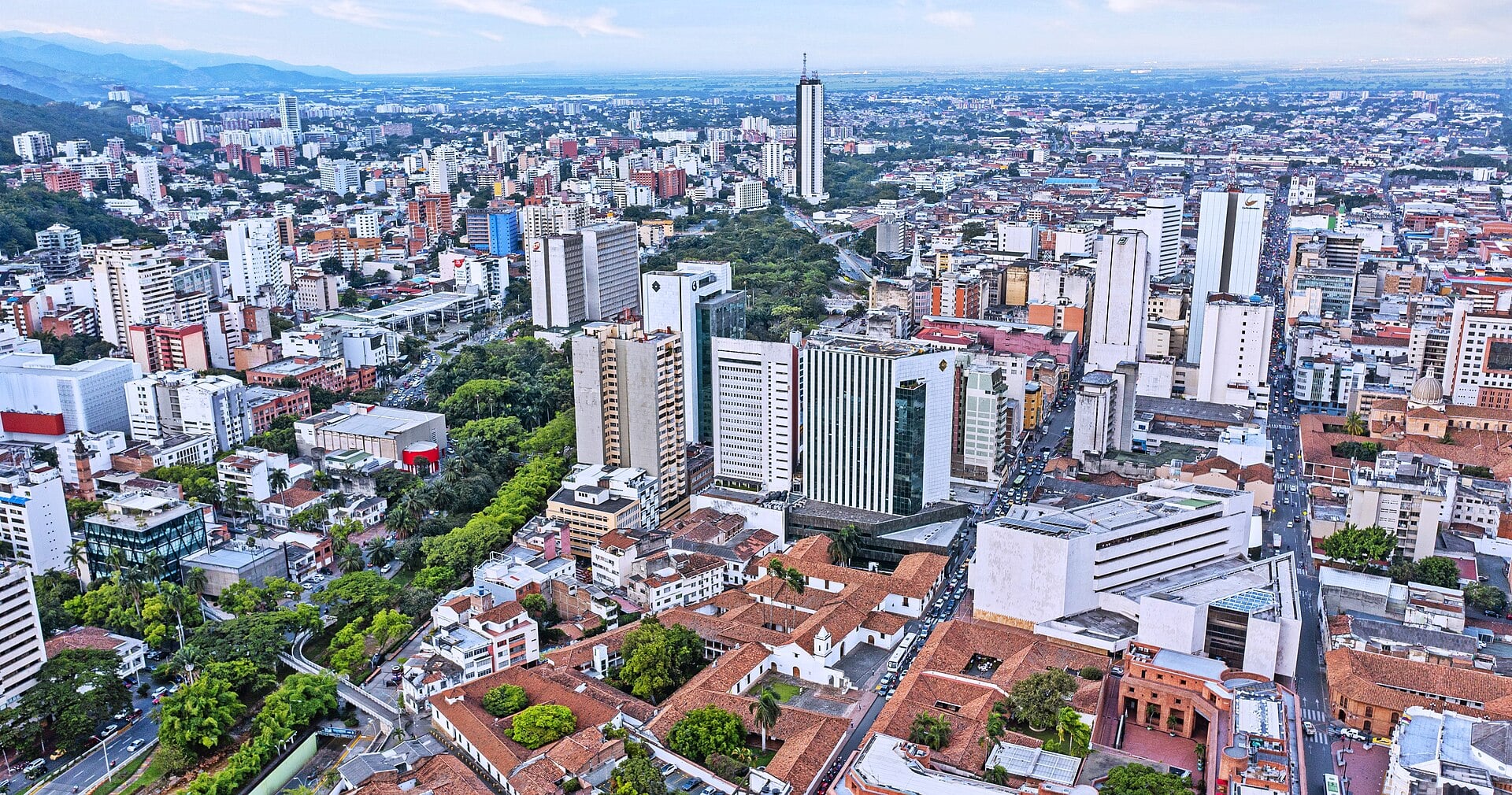
The cost of living in Cali, Colombia turns on one thing most foreigners have never heard of. It is called the estrato, and it belongs to the address rather than to the person.
All dollar figures here use 3,128.46 Colombian pesos to the dollar. That is the official market rate for 17 September 2026, published through the financial regulator.
The estrato belongs to the building, not to you
Colombian law classifies dwellings, not people, into six socioeconomic strata. The 1994 public services act defines it by the physical character of the housing and its surroundings.
A wealthy foreigner renting in an estrato three building pays estrato three tariffs. A Colombian on a low income in an estrato six building pays estrato six tariffs.
The municipality sets it from the street, the frontage and the built environment around it. It is printed on every utility bill.
The law then applies a percentage to the tariff. Estratos one and two are subsidised most, and estrato three by fifteen per cent.
Estrato four pays the full cost of service. Estratos five and six pay a twenty per cent surcharge on top of it.
A second rule catches people out. The subsidy covers only a subsistence allowance of kilowatt-hours; above that, everything is billed at full cost.
What that does to an electricity bill
EMCALI, the municipal utility, published its regulated residential tariffs for January 2026. The subsistence allowance for Cali is 173 kilowatt-hours a month.
That allowance exists because EMCALI records the city at 991 metres above sea level. Municipalities at or above 1,000 metres get only 130 kilowatt-hours at the subsidised rate.
Cali is nine metres below the line and gets a third more cheap power than a town just up the hill. Below the allowance, estrato one pays COP 404.52 a kilowatt-hour, about US$0.13.
Estrato three pays COP 645.10 (about US$0.21) and estrato four COP 758.95 (about US$0.24). Estratos five and six pay COP 910.74, about US$0.29, on everything they use.
Our own arithmetic makes the point. At 250 kilowatt-hours a month, with the fixed charge added, estrato one pays about COP 137,935, or US$44.
Estrato three pays about COP 179,555 (US$57) and estrato six about COP 237,197 (US$76) on identical consumption.
That is a 72 per cent spread for the same flat and the same appliances. Nothing else shapes the cost of living in Cali, Colombia as bluntly as that single classification.
The same estrato factors apply to water and sewerage, with the subsidy limited to a basic band. Current water tariffs and subsidy caps could not be obtained for this article.
A Cali water bill carries a fixed charge and a consumption charge for the aqueduct, then the same pair again for sewerage. Numbeo puts basic utilities for an 85-square-metre home at COP 357,320 a month, about US$114.
What rent costs, barrio by barrio
The figures below are asking prices from live listings on 17 September 2026, not market averages. Fincaraíz showed over 400 flats at an average COP 2,993,500 a month (about US$957) for an average 70 square metres.
In the north, a three-bedroom in Granada was listed at COP 4,500,000, about US$1,438. Santa Mónica was COP 4,200,000 (US$1,343) and Juanambú COP 4,000,000 (US$1,279).
In the far south, a one-bedroom in Pance was COP 3,900,000, about US$1,247. Ciencuadras, a second portal, showed a two-bedroom in Parcelaciones Pance at COP 1,200,000 (US$384).
At the cheaper end, El Jardín was COP 1,000,000 (about US$320) and Guayaquil COP 950,000 (US$304). Ciencuadras showed a 350-square-metre flat in Normandía at COP 12,500,000, or US$3,996.
The line foreigners miss is the administración, the building service charge, quoted separately from the rent. One Granada listing asking COP 5,200,000 carried a further COP 1,979,000 of it, about US$633.
That can be a tenth of the rent or more than a third of it. Ask for the figure before anything else.
Rent increases on urban residential leases are capped at the previous year’s inflation. For 2026 the cap is 5.10 per cent, and it applies at the contract anniversary rather than automatically in January.
Terraes takes median asking prices and cross-references the cadastre, and says its figures are not official valuations. It put the city median at COP 4,000,000 a square metre, about US$1,279, in September 2026.
It gives Parcelaciones Pance at COP 6,000,000 (about US$1,918) and Normandía at COP 5,800,000 (US$1,854). For Granada, San Antonio, El Peñón and Ciudad Jardín it publishes nothing, and neither will we.
Markets, supermarkets and a student city
Numbeo’s Cali basket is crowdsourced from fifteen contributors and was last updated on 4 August 2026. It gave a litre of milk at COP 5,028 (about US$1.61) and a dozen eggs at COP 9,103 (US$2.91).
Chicken worked out at about COP 22,443 a kilo, or US$7.17, and rice at COP 4,839 (US$1.55).
Those are supermarket prices, and Galería Alameda is the cheaper, seasonal alternative. The city government promotes the market hall as a food destination.
Alameda publishes no prices of its own. A January 2026 survey of Cali market halls found prices stable, with avocado at COP 13,500 a kilo (US$4.31).
Eating out is cheap by any foreign standard. An inexpensive meal was COP 24,000 (about US$7.67) and a mid-range dinner for two COP 120,000 (US$38.36).
A draught pint was COP 10,125, about US$3.24. Universidad del Valle alone has more than 30,000 students, which is why the bottom of this market stays cheap.
Getting around, and where the risk sits
The MIO bus fare rose to COP 3,500, about US$1.12, on 10 January 2026, from COP 3,200 (US$1.02). Numbeo puts a monthly pass at COP 96,000, or US$30.69.
A taxi starts at COP 2,600 (about US$0.83) and petrol was COP 4,170 a litre (US$1.33). Ride-hailing apps are widely used, though their pricing could not be verified for this article.
The airport, Alfonso Bonilla Aragón, sits between Cali and Palmira, a short drive to the northeast. It was Colombia’s fourth-busiest in 2019.
Safety is a real cost here, and it has a geography. El Tiempo reported 544 homicides in the city in the first half of 2026, against 496 a year earlier.
El País mapped 205 of them between 1 January and 12 March 2026. They concentrated in comunas 14, 15, 21, 18, 13, 6, 8 and 20.
None of those is where foreigners live. Granada, Santa Mónica and Normandía sit in comuna 2, and San Antonio and El Peñón in comuna 3.
Ciudad Jardín and Pance are in comuna 22. The burden falls on the eastern and hillside comunas, not on the neighbourhoods priced in this article.
Safety here is bought with estrato. The bill arrives as the twenty per cent utility surcharge plus the administración.
The hospitals and an age cliff in private cover
Newsweek ranked Fundación Valle del Lili first in Colombia for the fifth year running in 2026, and 126th globally. Brand Finance placed it second in Latin America the same year.
Clínica Imbanaco is the other hospital foreigners use. It is large and part of the Quirónsalud group, and no ranking for it could be confirmed.
Self-employed foreigners in the public system contribute 12.5 per cent of a calculated income base for health. At the 2026 minimum wage that is at least COP 218,863 a month, about US$70.
Private medicina prepagada sits on top of that public affiliation rather than replacing it. It buys faster access and a choice of specialist.
A 2026 group tariff sheet prices a Colsanitas plan at COP 415,905 a month, about US$133, under 64. It is an affinity rate sold through an alumni association, so individual cover is dearer.
At 64 the same plan is COP 1,347,885, or about US$431. That is 3.2 times the price of the year before, and it is the most important number here for anyone retiring.
There is a trap in the pension visa. Its own resolution says the holder may not join the Colombian social security system, except under a bilateral agreement.
The visa routes and the income they ask for
Colombian visa thresholds are written in multiples of the monthly minimum wage, so they reprice every January. The 2026 wage is COP 1,750,905, about US$560.
The digital nomad visa asks three times that, or COP 5,252,715 a month (about US$1,679), and runs up to two years. It also requires health cover for Colombian territory against all risks.
The pensioner visa asks the same three times, drawn from a lifetime pension, and runs up to three years. The rentista visa asks ten times, COP 17,509,050, or about US$5,597.
Buying property in your own name qualifies for an investor visa at 350 times the wage, COP 612,816,750, about US$195,881. Permanent residence comes from accumulated time on those visas.
The exact accumulation periods sit in a table we could not read from the official text. Confirm the number of years with a consulate.
Visa-exempt nationals working remotely can skip the visa altogether. The resolution allows up to 180 days a year on an entry permit, provided no Colombian company pays them.
Three budgets and the wage underneath them
Start with the floor. Numbeo puts the average net salary in the city at COP 1,849,963 a month, about US$591, barely above the minimum wage.
The three budgets below are our arithmetic from the figures above, not a published survey. Each takes rent as quoted on 17 September 2026.
A single tenant in El Jardín pays COP 1,000,000, about US$320, plus a transit pass at US$31. With US$250 of food, US$70 of health contribution and utilities under the city average of US$114, the month lands near US$785.
A couple in Santa Mónica at COP 4,200,000, about US$1,343, pay a high-estrato surcharge on every bill. Add US$150 of utilities, US$400 of food, US$140 of health contributions and US$298 of private cover for two.
The second member is charged at a higher additional-user rate. That comes to about US$2,330 before the administración, which adds US$130 to US$500 more.
A retired couple aged 64 or over meet the cliff. Two Colsanitas plans at that age cost about US$862 a month between them, which can reshape a comfortable budget.
So the cost of living in Cali, Colombia is a function of an address rather than of a city. Choose the estrato first, and the rest of the budget follows from it.
More: Colombia coverage, every day from The Rio Times.
Sources: EMCALI on residential electricity tariffs for January 2026, DANE on how socioeconomic stratification works, Numbeo on crowdsourced prices in the city, Fincaraíz on asking rents by barrio, Ciencuadras on the 2026 cap on rent increases, Terraes on the price per square metre, Ministerio de Relaciones Exteriores on the visa categories and thresholds, Holland & Knight on the 2026 minimum wage decrees, El Tiempo on homicides in the first half of 2026, Infobae on the 2026 hospital rankings
This article was produced by The Rio Times’ automated newsroom system. How we use AI · Report an error
Read More from The Rio Times