Colombia’s Agriculture Minister Tells Farmers ‘Don’t Plant Rice’, Drawing a Backlash

AGRICULTURE · COLOMBIA
Key Facts
- —The country Colombia, where rice is a staple of the family food basket. Tolima alone has about 4,870 rice growers in 11 municipalities, per departmental figures cited by Caracol Radio on 4 October 2026.
- —What happened Agriculture Minister Indalecio Dangond told farmers in Urumita, La Guajira, “don’t plant rice” and urged cashew instead, El Colombiano and Caracol Radio reported on 4 October 2026.
- —The numbers Huila paddy rice fetched about 193,200 pesos (about US$58) per carga in late September, below a break-even of 208,000 pesos (about US$63), Dignidad Arrocera said on 26 September.
- —What it means for you A remark does not move shelf prices by itself. Growers warn that fewer plantings, plus El Niño, could tighten domestic rice supply in coming harvests.
- —Still open Whether the advice becomes policy, and whether Fedearroz wins the debt refinancing it requested on 29 September. No direct Fedearroz reply to the remark was reported by Sunday evening.
Colombia’s agriculture minister has told farmers on the Caribbean coast not to plant rice, calling the crop too risky and too thirsty. The remark by Indalecio Dangond, reported on Sunday 4 October, drew criticism from growers, lawmakers and former president Gustavo Petro.
Dangond, a minister under President Abelardo de la Espriella, told farmers from La Guajira and Cesar to grow cashew instead. It comes as growers endure a two-year price slump and a dispute with his ministry.
What the Minister Said
“Rice is no longer a business. Don’t plant rice, rice is not a business. It is very risky, it needs a lot of water,” Dangond said in Urumita, according to El Colombiano.
Infobae quoted him saying rice prices “are very volatile”, so farmers can sow on good hopes and harvest into lower prices. He listed cashew, coconut, oil palm, pomegranate and plantain as options for La Guajira.
“Plant once and think in 25 years,” he said, contrasting permanent crops with rice, which needs fresh investment every six months.
Prices Below the Break-Even Point
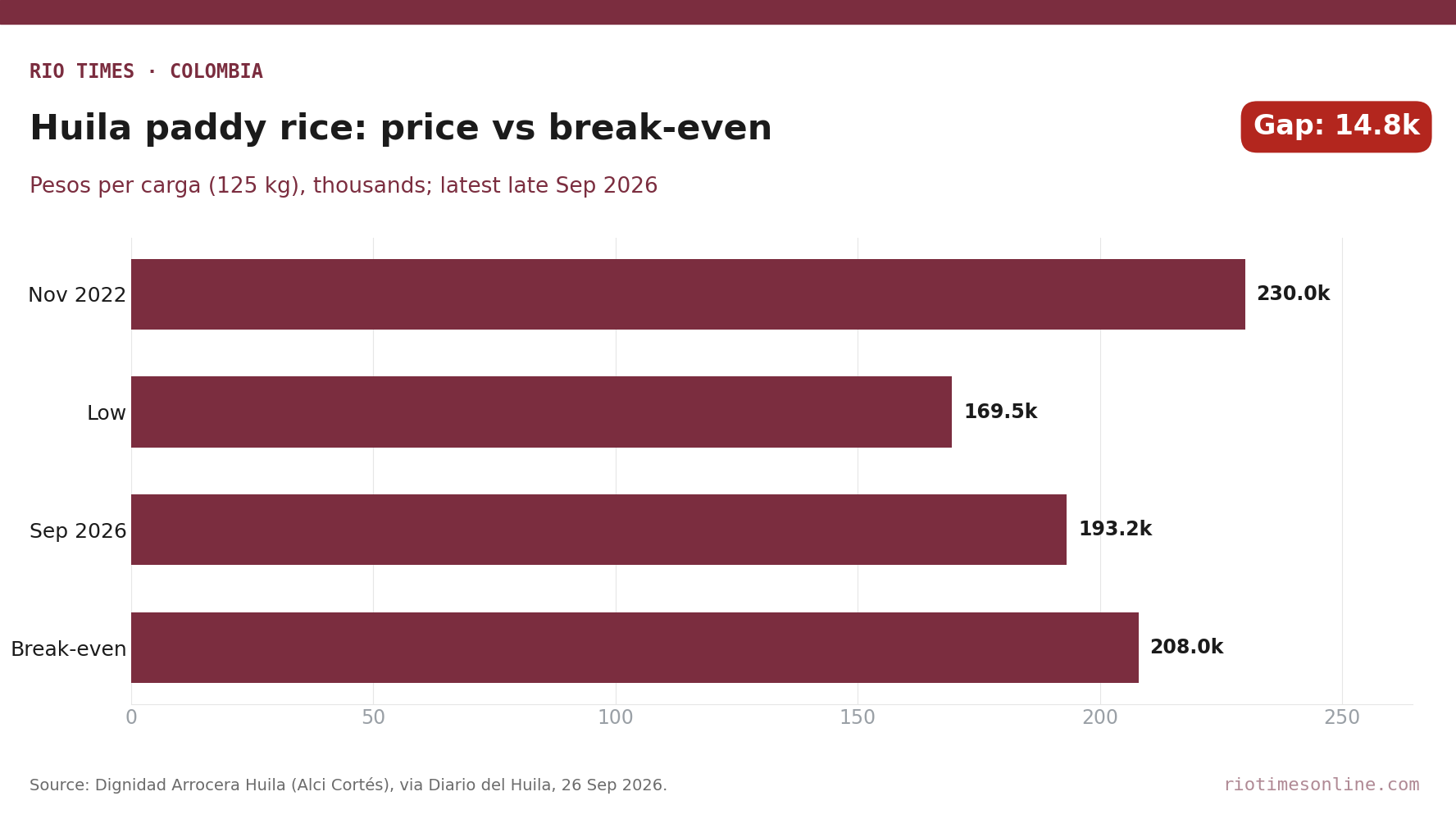
In Huila, paddy rice fetched about 230,000 pesos (about US$69) per carga in November 2022, Alci Cortés of the growers’ movement Dignidad Arrocera told Diario del Huila. A carga is 125 kilograms of unmilled rice.
The price later fell to 169,500 pesos (about US$51) and stood near 193,200 pesos (about US$58) in late September. Cortés put break-even at 208,000 to 209,000 pesos (about US$63). Conversions use 3,312 pesos per US dollar, the 2 October close.
“We have been working at a loss for two years,” he said, estimating that 60 to 70 percent of growers have lost money. Dearer fertiliser has added about 1.2 million pesos (about US$360) to the cost of a hectare this year, he added.
Cortés tied the partial recovery to lower supply, as weather cut output in some areas. Fedearroz, the national growers’ federation, said on 29 September that irrigated sowing had fallen about 30 percent as rivers ran low.
Growers, Congress and Petro Push Back
Huila grower Martín Vargas told Caracol Radio the region has suitable land and mills built for rice. About 2,500 producers there sow some 47,000 hectares each semester, he said.
Julio Roberto Salazar, a Conservative who chairs the lower house farm committee, said producers should not be told to abandon a strategic crop. Senate vice-president Alejandro Ocampo noted that cashew can take five to seven years to mature.
Petro, who left office in August, called the advice “miserable towards the people of Colombia” in a post on X. He argued that cutting cereal output would raise the risk of hunger if devaluation and drought struck together.
A Wider Clash With Fedearroz
Fedearroz asked the ministry on 29 September to help refinance growers’ debts after low prices in the 2025 and 2026 harvests. It said millers in Casanare raised paddy prices only after about 80 percent of the crop had been sold.
The ministry has also ordered a forensic-style review of funds the federation manages, El Colombiano reported. It cited about 552 billion pesos (about US$167 million) from import auctions and a farm levy over 15 years.
Board chair César Augusto Saavedra said the federation is open to any review. The Comptroller General’s office (state audit body) already checks the funds yearly, he noted.
Not every grower rejects change. In Tolima, grower Juan Pablo Rodríguez told Caracol Radio that farmers must rethink crops before rice imports become duty-free in 2030.
Prices are moving the other way next door, where Ecuador’s rice price neared US$50 a quintal after a 39% jump.
What Is Not Yet Known
It is unclear whether the advice not to plant rice will become policy. The ministry has published no plan, and Fedearroz’s refinancing request has had no public answer.
Growers in Huila and Tolima want a round table with the ministry, millers and Fedearroz. No date for such a meeting has been announced.
Sources: Caracol Radio · Caracol Radio (Congress, Petro) · Caracol Radio (Huila growers) · Caracol Radio (Tolima growers) · Caracol Radio (Fedearroz, 29 Sep) · El Colombiano · Infobae · Infobae (Fedearroz, 30 Sep) · Diario del Huila.
This article was produced by The Rio Times’ automated newsroom system. How we use AI · Report an error · Editorial responsibility: Matthias Camenzind, Editor-in-Chief
Read More from The Rio Times