Who Dominates Colombia, Elites and Regions Explained

COLOMBIA · POWER
Key Facts
- —The basics As of October 2026, Colombia power is concentrated in Bogotá, a few political families and business groups, the armed forces and a conservative president who took office on Friday, 7 August 2026.
- —Why it matters Colombia is a major non-NATO ally of the United States, so whoever controls its government, Congress, army and big business shapes cocaine policy, migration, oil supply and US investment.
- —The numbers Bogotá produced about US$148 billion, or 25.4% of national output, in 2025, while Chocó produced about US$2.7 billion; the Gini index was 0.531 and poverty 28.0%, the latest data as of October 2026.
- —Who is who Abelardo de la Espriella, a conservative lawyer, is president; Pacto Histórico, the left-wing coalition of former president Gustavo Petro, is the largest bloc in Congress and leads the opposition.
- —What to watch The 2027 minimum wage, due to be set in December 2026 by business, unions and government or by decree, is the next big test of who holds economic power.
- —Power Index Colombia ranks 6th of 14 in The Rio Times Latin America Power Index, with 51.9 points (October 2026 edition).
- —Prediction markets Kalshi gives a 15.0% chance that Colombia’s 2027 minimum wage rise beats inflation by more than 4.00 percentage points (14 October, 12:08 p.m. ET).
- —What it means for you US investors in Ecopetrol, whose shares trade in New York, and US travellers should watch how the new conservative government handles security, oil policy and ties with Washington as of October 2026.
Colombia power runs through one capital, a few families and firms, and a strong army. Here is who holds it in October 2026, and who is left out.
Colombia power is concentrated in Bogotá, a few political families and business groups, and one of the region’s strongest armies. Abelardo de la Espriella, a conservative lawyer, became president on Friday, 7 August 2026, after narrowly beating the left.
For US readers, Colombia’s balance of power shapes cocaine policy, migration, oil supply and a growing tourist market. This guide explains who dominates the country as of October 2026, using official data and The Rio Times Latin America Power Index.
How Colombia Power Is Organised
Colombia is a unitary republic of 32 departments plus Bogotá, the capital district, under the Constitution of 1991. The president is head of state and government, elected for a single four-year term.
Congress has two chambers, the Senate and the Chamber of Representatives, elected every four years. The last legislative election took place on Sunday, 8 March 2026, and the new Congress opened on 20 July.
Pacto Histórico, the left-wing coalition of former president Gustavo Petro, won the most seats in both houses. It now leads the opposition, because its presidential candidate lost the June runoff.
In the Chamber, Pacto Histórico holds 41 seats, ahead of the conservative Centro Democrático with 30 and the Liberal Party with 24. Those figures come from the seat map La República published when the new Congress opened.
Centro Democrático is the conservative party founded by Álvaro Uribe, president from 2002 to 2010. The Liberal and Conservative parties are the two historic parties that dominated politics for most of the 20th century.
The courts are a separate power centre with real teeth. In 2010, the Constitutional Court blocked a referendum that would have let Uribe seek a third term.
Banco de la República, the central bank, is independent under the constitution and sets interest rates by board vote. The finance minister presides over its seven-member board, whose other members serve staggered terms to shield the bank from day-to-day politics.
Bogotá, Antioquia and the Regions That Lead
Money in Colombia sits in a few places. Bogotá produced COP 471.2 trillion (about US$148 billion) in 2025, or 25.4% of national output, DANE, the statistics office, reports.
Antioquia, the department around Medellín, came second with COP 277.1 trillion (about US$87 billion). Bogotá, Antioquia and Valle del Cauca, around Cali, together produced close to half of the national economy.
Add Santander, Cundinamarca and Atlántico, and six economies accounted for 67.3% of output in 2025. Conversions in this guide use 3,185.26 pesos per US dollar, the open.er-api.com rate of 14 October 2026.
At the other end, Chocó on the Pacific coast produced only COP 8.5 trillion (about US$2.7 billion). Vaupés, in the Amazon, was the smallest economy at COP 520 billion (about US$163 million).
Wealth shows up in living standards too. Medellín had monetary poverty of 16.7% in 2025, and only Manizales, in the coffee region, did better at 13.2%.
Mayors and governors are elected separately from the president, so regional leaders can build their own power bases. Carlos Fernando Galán, mayor of Bogotá since January 2024, runs the capital, profiled on the Bogotá city page.
Medellín is the base of the country’s best-known business network, described below, and of a large foreign community. The Medellín city page covers life there for newcomers.

Political Families and the 2026 Change of Government
A small number of families have shaped national politics for generations. Juan Manuel Santos, president from 2010 to 2018, is a great-nephew of Eduardo Santos, who governed from 1938 to 1942.
The Pastrana family produced two presidents, Misael Pastrana from 1970 to 1974 and his son Andrés from 1998 to 2002. The Lleras family produced Alberto Lleras Camargo and Carlos Lleras Restrepo, both 20th-century presidents.
Bogotá’s mayor, Carlos Fernando Galán, is the son of Luis Carlos Galán, a Liberal presidential candidate assassinated in 1989. Such names still carry weight with voters, donors and party machines.
The 2022 election broke the pattern when Gustavo Petro, a former M-19 guerrilla and Bogotá mayor, became Colombia’s first left-wing president. His term ended on 7 August 2026, and the constitution barred him from running again.
The 2026 runoff on Sunday, 21 June, was decided by less than one percentage point. Abelardo de la Espriella won 12,959,542 votes, or 49.66%, in the preliminary count of the Registraduría, the electoral authority.
Iván Cepeda, a Pacto Histórico senator, took 12,708,712 votes, or 48.70%, a gap of about 250,000 votes. Under the opposition statute, Cepeda received the Senate seat reserved for the presidential runner-up.
De la Espriella, a 48-year-old lawyer, was sworn in on Friday, 7 August 2026, in Cali rather than Bogotá. His vice president is José Manuel Restrepo, a former trade minister; a profile of the president has more.
Because Pacto Histórico is the largest bloc, the government must build majorities with conservative, Liberal and centre parties. That makes party leaders in Congress some of the most powerful people in the country.
The Military, Armed Groups and Security Power
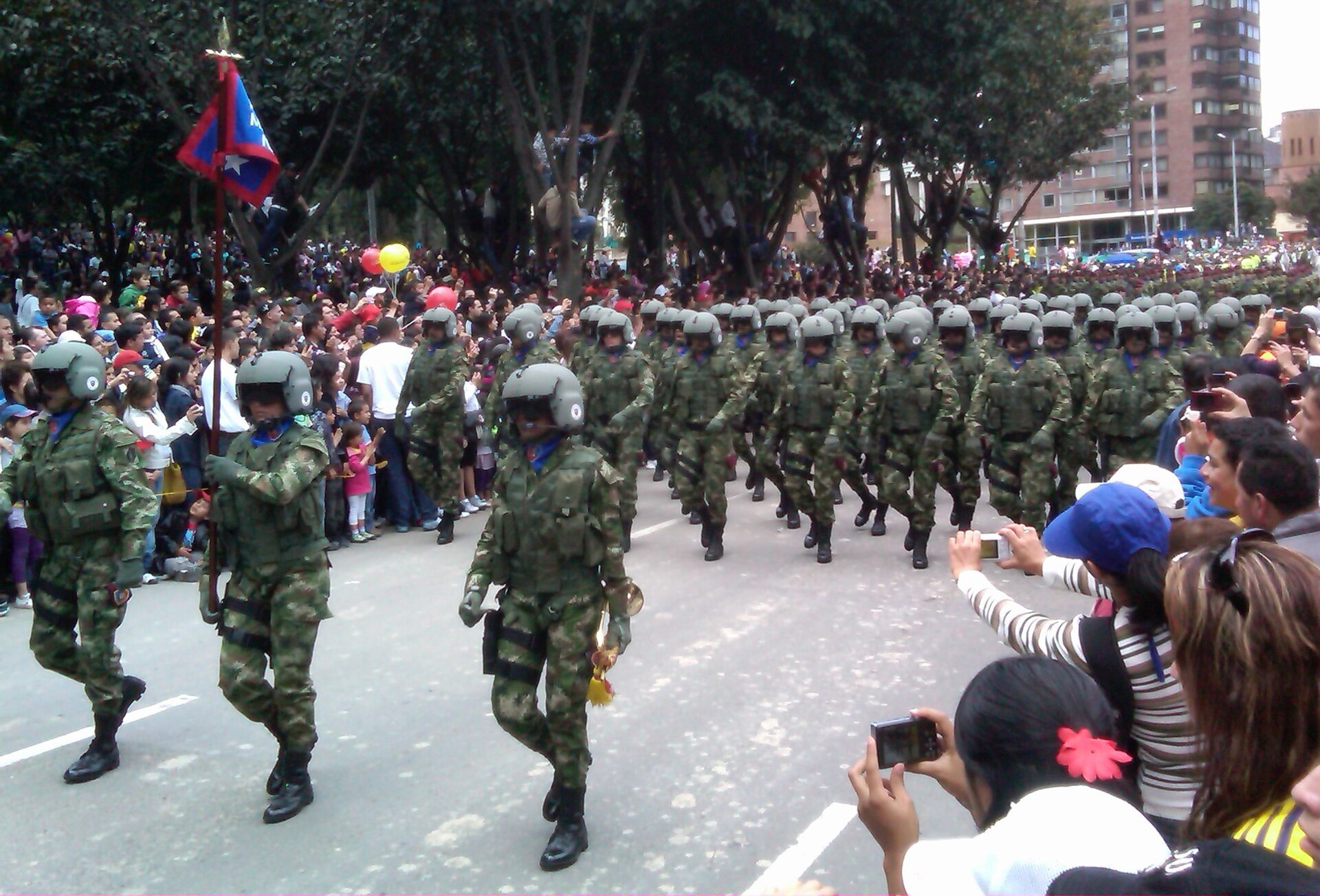
Colombia’s armed forces are a central pillar of state power. The Rio Times Latin America Power Index scores Colombia 90.7 of 100 for military means, second only to Brazil.
The army, navy, air force and National Police all answer to the Ministry of Defence. That structure grew out of decades of internal war against guerrillas and drug cartels.
The state signed a peace agreement with the FARC guerrillas in 2016, under President Santos, and the group became a political party. The deal also created 16 temporary Chamber seats for conflict victims, which continue in the current Congress.
Armed groups still control territory in parts of the country. The main ones are the ELN, a Marxist guerrilla founded in 1964, the Clan del Golfo trafficking network and FARC dissident factions.
These groups draw money from cocaine, illegal gold mining and extortion, especially along the Pacific coast and the borders. Where the state is weak, they can impose curfews and armed strikes on local people.
The United States has been the army’s main foreign partner since Plan Colombia began in 2000. Washington designated Colombia a major non-NATO ally in 2022, a status still listed in the Power Index.
Business Groups, Churches and Unions
A few business groups dominate finance and industry. Medellín is home to Grupo Sura in insurance and Grupo Argos in cement and energy, long linked through the Grupo Empresarial Antioqueño.
Grupo Aval, the Bogotá banking group, owns Banco de Bogotá and three other banks plus the pension fund Porvenir. Its 2026 filing with the US Securities and Exchange Commission shows Luis Carlos Sarmiento Angulo holding 97.9% of common shares.
The state is itself a business power through Ecopetrol, the oil company whose shares also trade in New York. The national government owns 88.49% of Ecopetrol, according to the company’s own 2026 filing with the same US regulator.
Foreign companies and lenders form another layer of influence. A separate guide to foreign powers and investors in Colombia explains who brings what.
The Catholic Church remains the largest religious institution, although the 1991 Constitution ended its status as the official religion. Evangelical churches have gained political weight, and MIRA, a party tied to a Pentecostal church, holds three Senate seats.
Organised labour is concentrated in the public sector, including teachers, and in the oil industry. The Central Unitaria de Trabajadores, or CUT, founded in 1986, is the largest union confederation.
Business and unions meet every December to bargain over the next year’s minimum wage. If they fail to agree, the government sets the wage by decree, which makes the decision a yearly test of power.
Who Is Left Out of Colombia Power
Inequality is high, although it narrowed in 2025. DANE puts the Gini index of household income at 0.531 in 2025, down from 0.551 in 2024.
Monetary poverty fell to 28.0% of the population in 2025 from 31.8% a year earlier. In rural areas, 39.5% of people were poor, against 24.6% in towns and cities.
Afro-Colombians and Indigenous peoples are among the groups most often left out. In the 2018 census, 2,982,224 people identified as Black, Afro-Colombian, raizal or palenquero, or 6.8% of the population.
DANE itself flags that count as incomplete, since it fell 30.8% from the 2005 census. In Chocó, 78.96% of residents identified as Afro-Colombian in 2018.
Quibdó, the capital of Chocó, had the highest monetary poverty of the cities DANE measures, at 61.7% in 2025. Extreme poverty there reached 32.5%, against 9.6% nationwide.
Rural families and victims of the armed conflict also have little access to national power. The 16 peace seats are their main formal channel into Congress, and the guide to Colombia’s population and ethnic groups adds detail.
Colombia on the Power Index
The Rio Times Latin America Power Index ranks Colombia sixth of 14 countries in its October 2026 edition, with 51.9 points. The full table and method are on the Latin America Power Map.
Colombia scores 60.5 for economic weight, 50.3 for state capacity and 90.7 for military means. It scores 33.8 for future resources, 28.3 for influence and 37.8 for economic relationships.
On the index’s alignment rule, Colombia sits in the group closer to Washington, with a score of 72. The United States takes 26.5% of its trade and China 17.9%, although Colombia also joined China’s Belt and Road Initiative.
That mix of a strong army and weaker state capacity explains much of the country’s politics. An explainer on Colombia’s role in Latin America covers its regional weight, and the Colombia hub collects all Rio Times coverage.
What It Means for US Readers
US investors are exposed through Ecopetrol and other Colombian firms listed in New York, whose fortunes depend on oil policy and security. A conservative government changes the outlook for oil exploration, which the Petro administration had tried to wind down.
For Washington, Colombia is a key partner on cocaine, Venezuela and migration in South America. Shifts in the balance between the government, Congress and armed groups affect all three.
US travellers usually find the safest conditions in the big cities of the richer regions, including Bogotá and Medellín. Check the US State Department advisory before visiting Pacific and border areas where armed groups operate.
What Prediction Markets Say
Kalshi, a US exchange regulated by the CFTC, lists bets on Colombia’s 2027 minimum wage rise minus inflation. The bet that the gap exceeds 4.00 percentage points traded at 15.0% on 14 October at 12:08 p.m. ET.
The market tracks the December wage talks, a yearly contest between business and unions. About 123,000 contracts had changed hands by then, and the price was unchanged from the previous day.
Why we show this: prediction markets turn real-money bets into a live probability that moves within minutes of the news, which is why investors, campaigns and newsrooms in the United States now follow them closely. We show them next to polls and official results, never instead of them.
What Is Not Known
Published Senate seat totals for 2026 differ between reports, so this guide does not list them by party. The final scrutiny of the runoff may also differ slightly from the preliminary count.
No national agricultural census has been held since 2014, so current figures on land concentration are not available. The real size of armed groups and their income from cocaine and gold cannot be measured reliably.
It is not yet known how stable the new government’s majority in Congress will be. The size of the 2027 minimum wage rise is also still open.
Frequently Asked Questions
Who has the most power in Colombia?
Formal power rests with the president, Congress and the courts, with Abelardo de la Espriella as president since 7 August 2026. Informal power lies with Bogotá’s elite, big business groups, the armed forces and a few political families.
Who is the president of Colombia in 2026?
Abelardo de la Espriella, a conservative lawyer, took office on Friday, 7 August 2026, for a four-year term. He beat Iván Cepeda of Pacto Histórico in the runoff on Sunday, 21 June.
Which region of Colombia is the richest?
Bogotá produced 25.4% of Colombia’s output in 2025, about US$148 billion, DANE data show. Antioquia, around Medellín, came second with about US$87 billion.
What is Pacto Histórico?
It is the left-wing coalition that brought Gustavo Petro to power in 2022. After losing the 2026 runoff, it leads the opposition as the largest bloc in Congress.
Who is left out of power in Colombia?
Afro-Colombians, Indigenous peoples, rural families and conflict victims have the least access to power. In Quibdó, capital of mostly Afro-Colombian Chocó, monetary poverty reached 61.7% in 2025.
Is Colombia an ally of the United States?
Yes, the United States designated Colombia a major non-NATO ally in 2022. The Rio Times Latin America Power Index places it in the group closer to Washington as of October 2026.
Sources: DANE, departmental GDP 2025 (provisional); DANE, monetary poverty and Gini 2025; DANE, Black, Afro-Colombian, raizal and palenquero population, 2018 census; Ecopetrol, Form 20-F for 2025 (SEC); Grupo Aval, Form 20-F for 2025 (SEC); Alcaldía de Bogotá; Senate of Colombia; The Rio Times Latin America Power Index, October 2026 edition; Forbes Colombia, runoff results; Vanguardia, inauguration; La República, Congress seat map; Asuntos Legales, Senate composition; exchange rate from open.er-api.com (all accessed 14 October 2026).
This article was produced by The Rio Times’ automated newsroom system. How we use AI · Report an error · Editorial responsibility: Matthias Camenzind, Editor-in-Chief
Expat Guide to Colombia
What The Rio Times publishes for foreigners who live in or move to Colombia.
Start here
- Colombia SIM Card and Internet for Foreigners in 2026
- Colombia Rent Increase Limit Is 5.10% in 2026
- Bancolombia Explained, Colombia's Largest Bank in 2026
- Cost of Living in Colombia for Expats in 2026: Rent, Transport and Health in Five Cities
City guides
Medellín, Bogotá, Cartagena, Cali
Coming up in Colombia
- JetBlue Cali Flights From Fort Lauderdale Start 15 October 15 Oct
- Bad Gyal Bogotá Concert Brings Más Cara Tour to Colombia on 18 October 18 Oct
- Fonseca El Campín Concert Set for 24 October 2026 in Colombia 24 Oct
- Ryan Castro El Campín Halloween Show Set for 31 October in Colombia 31 Oct
Understand Colombia