Ecuador Rice Price Nears US$50 a Quintal After 39% Jump

ECONOMY · ECUADOR
Key Facts
- —The country Ecuador uses the US dollar, so food price rises reach household budgets directly. Rice is a staple on the coast and in the Andean highlands.
- —What happened Aged rice sold for about US$49.50 a quintal in early October, up from US$38.50 three weeks earlier, a food distributor told Expreso (3 October 2026).
- —The numbers Official SIPA data show the Guayaquil quintal rose from US$27 in July to US$37.50 in September. In Quito some varieties passed US$60 (Primicias, 1 October).
- —What it means for you A staple costs noticeably more in both main cities. Producers and traders told Primicias there is enough rice and no shortage.
- —Still open The size of national reserves, how much El Niño rains cut the next harvest, and whether power cuts at rice mills add to costs.
The Ecuador rice price has been rising since August, and traders now quote some varieties close to US$50 a quintal. A quintal is a 100-pound sack, about 45 kilograms, the standard unit of the wholesale trade.
Aged rice reached about US$49.50 in early October, against roughly US$38.50 three weeks before, a food distributor told Expreso on 3 October. In Quito, where prices run higher, some varieties have passed US$60, Primicias reported on 1 October.
How far prices have moved
Figures from SIPA, the government’s public farm price information system, show the change over the quarter. In Guayaquil the quintal rose from US$27 in July to US$37.50 in September, an increase of about 39 percent.
Quito started from a much higher base and moved less, from US$54.33 to US$55 over the same months. Aged rice, eaten mainly in the highlands, sells there for US$52 to US$55 depending on quality, Primicias reported.
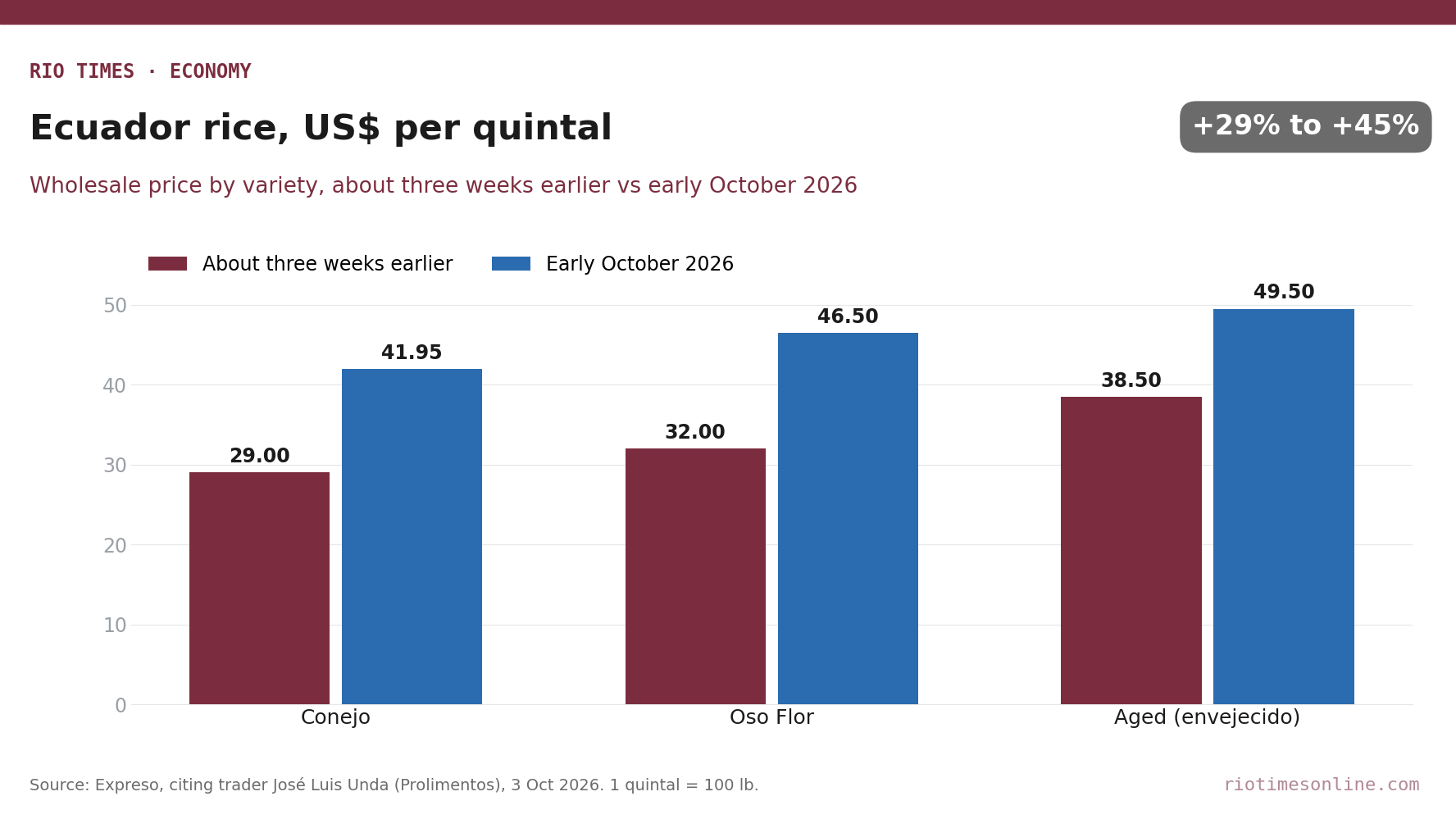
October brought a further jump. José Luis Unda of the food distributor Prolimentos told Expreso that Conejo rice now sells at US$41.95 and Oso Flor at US$46.50.
Three weeks earlier the same two varieties cost about US$29 and US$32. At the mills, Expreso reported, prices are higher still: about US$44, US$48 and US$52 for Conejo, Oso Flor and aged rice.
Why rice is getting dearer
Andrés Campoverde, a trader at Quito’s wholesale market, told Primicias the rise began when the Colombian border reopened. Ecuador resumed rice exports to Colombia on 25 July, after restrictions in force since February.
Sector figures cited by Primicias put shipments to Colombia at 41,000 tonnes by August, 34 percent more than a year earlier. That drew down the large stocks that had held prices below their usual levels.
Rain is the second factor. El Niño showers reached the coast in late September, earlier than the November start producers expected.
Heitel Lozano, former head of the Ecuadorian Rice Growers’ Corporation, told Primicias that crop losses cut yields by up to 20 percent. The same rains have stopped the cane harvest, as reported in Ecuador Sugar Harvest Halted by Rains, Imports Needed on 2 October.
Enough rice, but few winners
Producers and traders insist there is no shortage. Lozano described a nervous market rather than an empty one, and Campoverde said Quito’s wholesale market was well supplied.
José Luis García of Defensa de los Agricultores, a farmers’ group, told Expreso that Ecuador eats about 740,000 tonnes of milled rice yearly. By his figures, national output reaches about 900,000 tonnes.
He put climate losses at about 10,000 hectares out of some 300,000 sown, close to 3 percent. Most of the summer crop, he added, had already passed to middlemen.
That matters for growers, who were paid as little as US$25 a sack of paddy at harvest. In his view, they gain little from the current rise in the Ecuador rice price.
Electricity is another pressure. García said mills stop work on days when they must generate their own power under rationing, described in Ecuador Power Rationing Orders 185 Large Industrial Users to Cut One Day a Week.
What Is Not Yet Known
No official figure for national rice reserves has been published, and García has asked the authorities to release one. It is also unclear how much of the next harvest the El Niño rains will cost.
Rice industry groups did not tell Expreso whether power cuts are raising mill costs. Campoverde expects prices to keep climbing through October, possibly until December.
What is a quintal of rice in Ecuador?
A quintal is a 100-lb sack, about 45 kilograms. It is the standard unit for wholesale rice prices in Ecuador’s markets and mills.
Is there a rice shortage in Ecuador?
Producers and traders say no. A farmers’ leader puts output at about 900,000 tonnes a year against consumption of about 740,000 tonnes. No official reserve figure has been published.
Why is the rice price rising?
Traders point to renewed exports to Colombia since late July, which reduced stocks. Early El Niño rains have also cut yields on the coast.
Sources: Expreso, “El arroz sube y el quintal ya bordea los 50 dólares en algunas variedades” (3 October 2026), including SIPA price data; Primicias, “El precio del arroz supera los USD 60 por quintal en Quito” (1 October 2026).
This article was produced by The Rio Times’ automated newsroom system. How we use AI · Report an error · Editorial responsibility: Matthias Camenzind, Editor-in-Chief
LatAm Markets: Live Signals → — real-time movers, turnover leaders and FX across Latin America.