Published Tuesday, 27 October, 6:05 p.m. ET · Source: Brazilian central bank, B3 stock exchange and Rio Times market data
Key Facts
—The number. The dollar closed at R$5.3488 on Tuesday, down 1.07%, after a jump of more than 8% on Monday.
—Why it moved. Markets calmed after President Lula’s re-election win, and the central bank renewed a scheduled currency auction.
—Still shaky. Citigroup, a US bank, and BCA Research cut their stance on Brazilian assets as risks grew.
—Next. Markets wait for the new economic team and any plan to rein in public debt.
Brazil’s currency spent Tuesday catching its breath after a wild Monday. The dollar fell 1.07% to R$5.3488 at the close, handing back a small slice of a jump of more than 8% the day before.
That matters to anyone in the United States with money in Brazil, from holders of the EWZ exchange-traded fund to tourists planning a trip. The dollar still buys about 7% more reais than it did on Friday, and the story of Brazil’s real and Brazil’s economy is far from settled.
A Calmer Day After a Wild One
Last Friday the dollar sat near R$5.00. On Monday, the first trading day after President Luiz Inácio Lula da Silva beat Senator Flávio Bolsonaro in Sunday’s runoff, it touched about R$5.60.
Brazil’s main stock index, the Ibovespa, fell 13.9% the same day. Tuesday felt different: the dollar eased through the day and settled at R$5.3488.
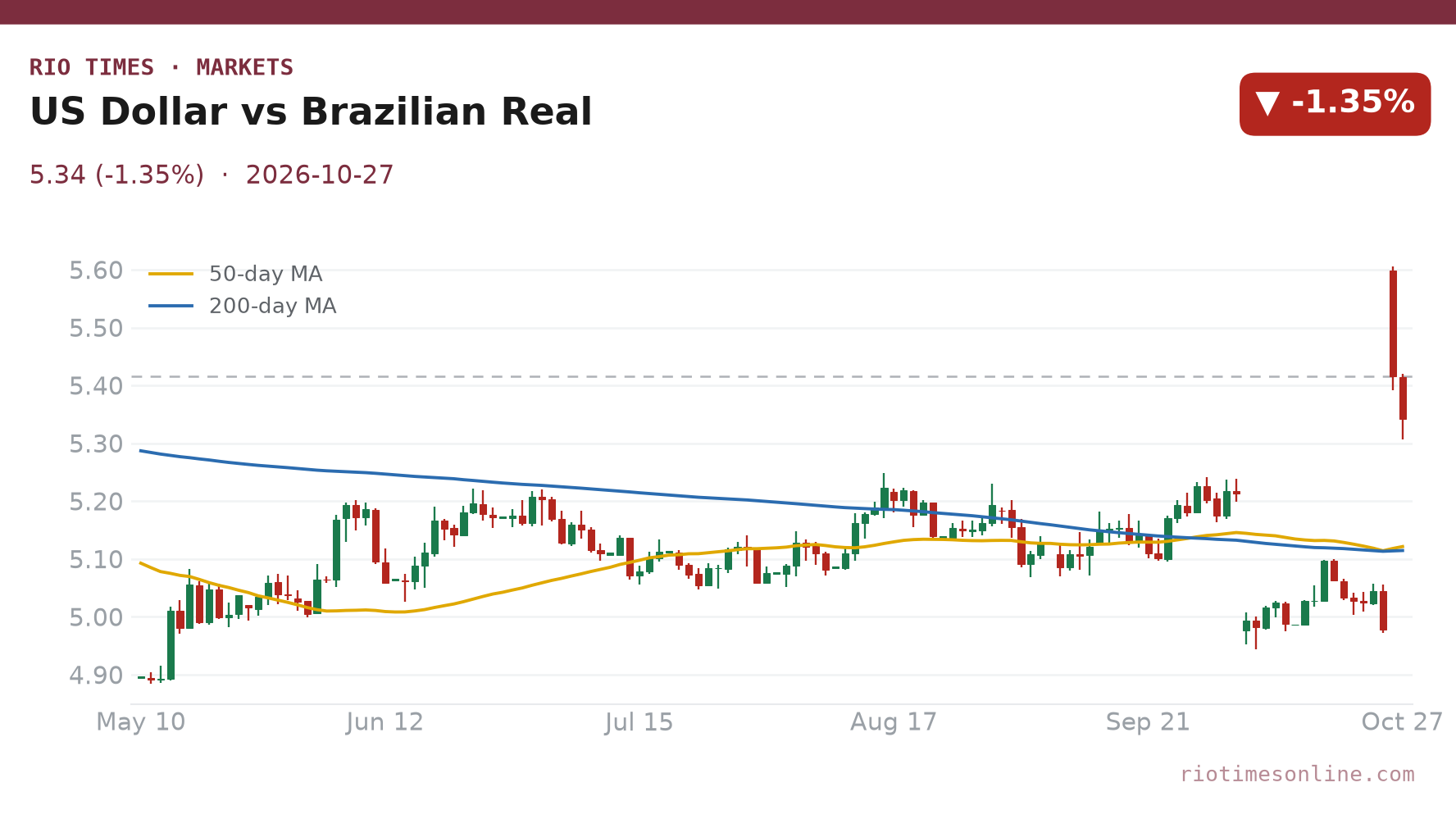
Even after the pullback, the dollar remains far above last week’s level. Traders now watch for signals on fiscal policy.
Why Investors Are Still Nervous
On Tuesday morning, Citigroup, the US bank, and BCA Research, an independent research firm, cut their recommendation on Brazilian assets. Both argued that the balance of risk and reward for stocks, bonds and the currency has worsened.
Their worry is fiscal discipline, meaning whether the government can keep spending and debt under control.Attention now turns to who will join Lula’s economic team.The new government will also need Congress to pass its 2027 agenda.
Live Market IntelligenceBrazil — Live Market Board
Rio Times · Live Market Intelligence
Brazil — Live Market Board
-0.51%
175,710.05
-0.51%
69,734.34
+0.38%
10,766.85
+1.81%
2,848,945
—
2,506.51
+0.06%
| Instrument | Last | Change | YoY | Prev. | High | Low | Volume |
|---|---|---|---|---|---|---|---|
| IBOV | 175,710.05 | -0.51% | +19.56% | 176,608.23 | 178,526 | 175,157 | — |
| USD/BRL | 5.34 | -1.32% | -0.84% | 5.42 | 5.42 | 5.30 | — |
| SELIC | 13.75% | — | — | — | — | — | |
| PETR4 | 53.31 | -1.06% | +77.70% | 53.88 | 53.70 | 52.83 | 43,239,500 |
| VALE3 | 62.88 | -2.33% | +1.98% | 64.38 | 64.43 | 62.80 | 24,652,300 |
| ITUB4 | 41.42 | -0.67% | +11.30% | 41.70 | 42.60 | 41.15 | 28,160,700 |
| BBDC4 | 15.69 | -1.63% | -13.88% | 15.95 | 16.30 | 15.67 | 65,766,400 |
| BBAS3 | 17.59 | +0.69% | -15.59% | 17.47 | 18.31 | 17.51 | 67,844,600 |
| B3SA3 | 15.27 | +1.33% | +21.71% | 15.07 | 15.78 | 15.20 | 75,282,000 |
| ABEV3 | 15.40 | +0.20% | +26.75% | 15.37 | 15.68 | 15.31 | 27,307,400 |
| WEGE3 | 45.78 | +2.81% | +10.06% | 44.53 | 47.08 | 45.06 | 9,823,200 |
| PRIO3 | 69.21 | -2.71% | +87.14% | 71.14 | 70.98 | 69.15 | 6,663,200 |
| SUZB3 | 47.14 | -0.55% | -3.79% | 47.40 | 47.84 | 46.10 | 7,151,800 |
| RENT3 | 31.14 | -1.67% | -20.73% | 31.67 | 32.68 | 31.02 | 19,092,400 |
| AZZA3 | 16.72 | +1.15% | -42.24% | 16.53 | 17.42 | 16.72 | 4,875,400 |
| CSNA3 | 4.76 | -4.99% | -47.09% | 5.01 | 5.14 | 4.76 | 14,327,900 |
| GGBR4 | 24.87 | -2.28% | +36.28% | 25.45 | 26.20 | 24.79 | 7,507,900 |
| ENEV3 | 26.79 | +0.45% | +49.78% | 26.67 | 27.35 | 26.30 | 12,263,000 |
What the Central Bank Did on Tuesday
Gabriel Galípolo, the central bank president, held a press conference at 11 a.m. Brasília time on its Financial Stability Report, a review of risks to the banking system. Half an hour later the bank ran an auction of up to US$4 billion in currency swaps.
A swap is a contract that pays investors if the dollar rises, settled in reais, so the bank does not spend its dollar reserves. This auction renewed contracts that were already scheduled, so it was routine rather than an emergency intervention.
What It Means for US Readers
If you hold Brazilian shares or American depositary receipts such as Petrobras (the oil company) or Vale (the miner), your return depends on two things: the share price and the exchange rate. A weaker real cuts the dollar value of profits earned in reais, even when the share itself holds steady.
For travellers, R$1,000 now converts to about US$187, against about US$200 on Friday. Dollar earners living in Brazil gained purchasing power, while anyone paid in reais lost some.
What Is Not Known
Nobody yet knows whether Tuesday’s pullback will hold, since the market is waiting for the economic team and fiscal plan. How the central bank would respond if trading turned disorderly is also unclear.
We will update the numbers when the next closing prices arrive. For earlier coverage, see our reports on the real’s 8% drop after the election and on the central bank’s response.
Sources
Banco Central do Brasil, Financial Stability Report · Banco Central do Brasil, currency conversion · B3, Brazil’s stock exchange
This article was produced by The Rio Times’ automated newsroom system. How we use AI · Report an error · Editorial responsibility: Matthias Camenzind, Editor-in-Chief
LatAm Markets: Live Signals → — real-time movers, turnover leaders and FX across Latin America.
Brazil runoff, Sunday, October 25: Brazil runoff date. Latest: Brazil runoff polls, Flávio 51%, Lula 49%.
Frequently Asked Questions
Why did Brazil’s real recover on Tuesday?
Markets showed more calm a day after the dollar jumped more than 8%. The central bank also renewed a scheduled US$4 billion swap auction.
What is the dollar worth in reais now?
The dollar closed at R$5.3488 on Tuesday, down 1.07% on the day. On Friday it was near R$5.00.