Flávio Bolsonaro Tops Lula with 45% in PoderData Poll as Brazil 2026 Election Race Tightens
Politics · Brazil
Key Facts
- —The moment A 3 September PoderData poll put Flávio 45% to Lula’s 44%. Datafolha, out the same day, still had Lula ahead — both gaps are inside the margin of error.
- —The man Senator for Rio since 2019, Jair’s eldest son, 45, running because his father is barred.
- —The platform Public security first, conservative economics, and a deliberate softening of the family brand.
- —The baggage He sought US$24 million from the jailed banker in the Banco Master scandal, as film financing.
- —The catch 60% of Brazilians doubt he is the right’s best candidate, even many who would vote for him.
Runoff · Sunday, 25 October
Brazil Runoff 2026: Lula vs Flávio
Date, polls, debates, odds and how the runoff works, updated every day.
Brazil election 2026 · Brazil election polls · Brazil election odds · Brazil runoff date and results start · Brazil election results · All election stories
Prediction markets · who wins the runoff
Implied chance of winning Brazil’s presidency on 25 October, from traders’ prices.
Polymarket
Flávio Bolsonaro 75.9% · Lula 23.5% (US$188 million traded)
Kalshi (regulated in the US by the CFTC)
Flávio Bolsonaro 79% · Lula 20%
As of 19 October, 12:40 pm ET (17:40 Lisbon), updated every 20 minutes. Prices are bets, not polls, and can move fast.
Why we show this: prediction markets turn real-money bets into a live probability that moves within minutes of the news, which is why investors, campaigns and newsrooms in the United States now follow them closely. We show them next to polls and official results, never instead of them.
Brazil’s right spent two years searching for anyone but a Bolsonaro, and ended up nominating one. The paradox tells you everything about both the movement and the candidate.
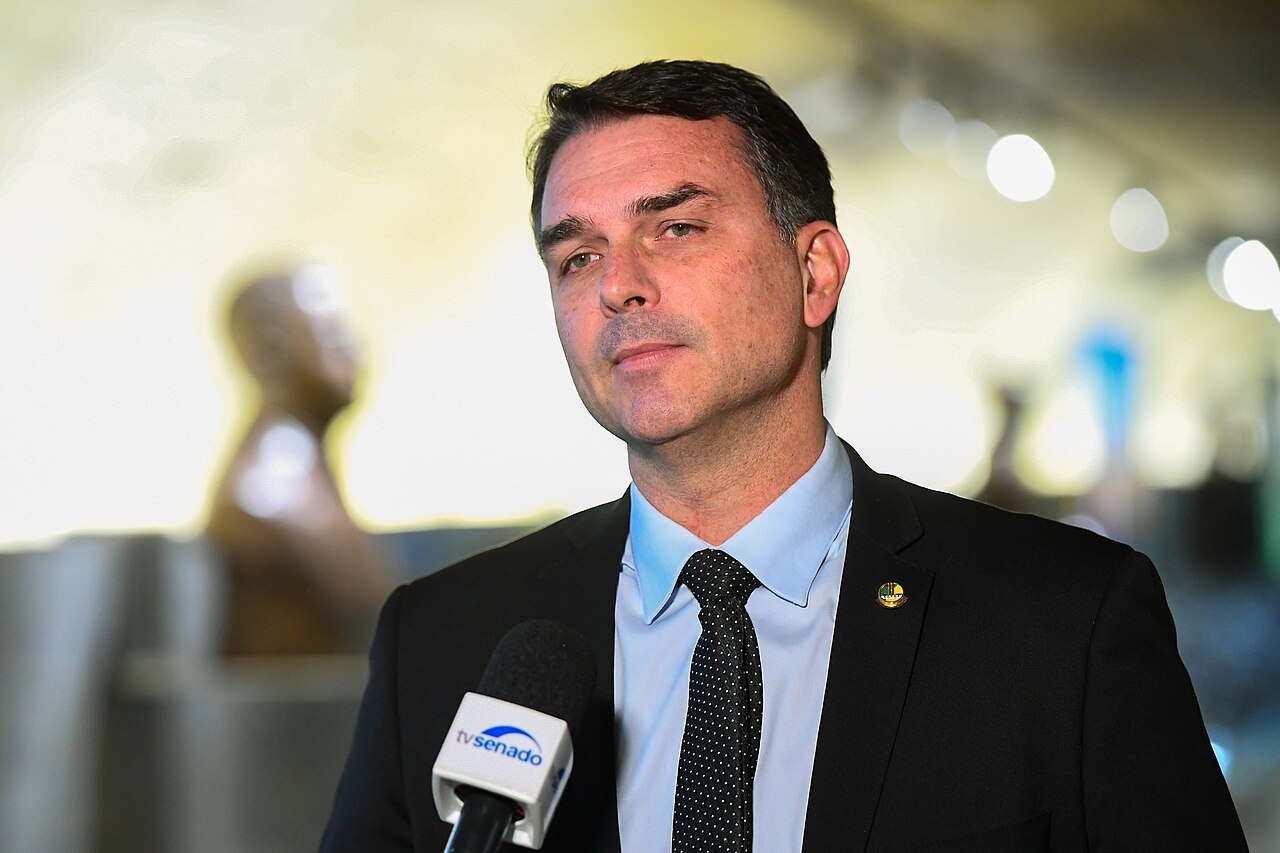
From the shadow of the surname
Flávio was a state deputy in Rio for sixteen years. He won his Senate seat in 2018, the year his father won the presidency.
He was always the political son — the one who read polls, hired consultants and avoided his father’s instincts.
With Jair Bolsonaro ineligible until 2030, the inheritance was never really in doubt. What was in doubt, until this week, was whether the inheritance was worth having.
The campaign he is running
Security is the spine: tougher sentencing, more police autonomy, and a promise to treat organised crime as insurgency. It polls first among voter concerns in the cities where the election will be decided.
He is pro-market on economics. He supports spending caps, privatisation, and central-bank independence.
This month in the Senate, he fought against ending the 6×1 workweek. He sided with business groups his father once courted and sometimes betrayed.
The Banco Master problem
The scandal continues. The Intercept Brasil reported in May 2026 that leaked audio caught Flávio asking jailed banker Daniel Vorcaro for US$24 million (R$134 million).
The money was described as funding for a film about his father.
No charge has been filed against him in this matter. His campaign calls the story a political operation.
But the association links the right’s candidate to the decade’s biggest banking scandal. This happens as he asks voters to trust him with the economy.
Why the right still hesitates
The Quaest poll, published 2 September, found 60% believe he is not the right’s best option. This number stops governors and donors from fully backing him.
Augusto Cury’s rise worried the campaign. Every point Cury gets is a point the right saved for someone else.
Flávio’s answer has been discipline. He has had no outbursts or conspiracies.
He chose a running mate for geography, not loyalty. His campaign aims to prove he is not his father.
What the next month decides
One poll is a headline; three would be a trend.
If his lead lasts until mid-September, party machines that have kept him away will move, and money will follow.
If it does not, the right’s old question returns with four weeks to answer it. Brazil’s runoff is on 25 October — and the surname on the ballot will be his.
The Senate record
In seven years in the Senate, Flávio has built a reputation as a dealmaker, not a street fighter.
He is the Bolsonaro who negotiates with the centre when the family needs votes.
His pragmatism is both his qualification and his problem. The movement’s base wants confrontation.
The donors he needs want reliability. He tries to sell each group the other’s version of him.
The family machine behind him
The Bolsonaro group is Brazil’s most loyal voters. About one-third backed the family in every vote since 2018.
Flávio’s job is not to create a movement. He must take over one that is whole.
His father’s legal situation cuts both ways — it delivers the faithful, and it caps the reachable. Every week spent managing the inheritance is a week not spent expanding beyond it.
The security platform in detail
The platform’s core is sentencing: longer terms for violent crime, limits on release policies, and expanded police legal protection. Its signature promise is to treat the major criminal organisations as national-security threats rather than police matters.
Criminologists say Brazil’s homicide rate has fallen for years under current law. They say the proposal’s real audience is emotional, not statistical.
The campaign answers that voters do not feel the statistics.
The running mate he picked
Flávio named Alfredo Gaspar, a federal deputy from Alagoas, as his running mate on 5 August. Gaspar, 55, spent over 20 years as a state prosecutor and twice ran Alagoas’ security department.
The pick does two jobs at once. Gaspar’s home state sits in the north-east, a region where the right is weak, and his record backs up Flávio’s security message.
He also led a congressional inquiry into fraud in Brazil’s pension system this year. That gives the ticket an anti-corruption face beyond the family name.
The polls’ fine print
First-round numbers and runoff numbers measure different things. Flávio’s first-ever lead comes in a fragmented first-round field.
The runoff simulation remains statistically tied. Votes from eliminated candidates do not automatically flow to him.
His rejection rate — voters who say they would never support him — is the ceiling indicator to watch. Datafolha put it at 47% in September, above Lula’s 45%, and in a two-candidate runoff the lower rejection usually wins.
What the base actually wants
Bolsonaro’s group has different parts. Evangelicals vote for values.
Security voters want order.
Agribusiness wants fewer rules. A digital base wants online fights.
Flávio’s discipline pleases the first three. It quietly bores the fourth.
The campaign bets that boring is okay, because center voters matter more than excited base voters.
Poll lead shows the bet works; Quaest warns it may not last.
His father’s shadow is managed, not escaped. Every rally ends with the same unspoken deal.
The son offers normality. The surname guarantees the faithful.
Both sides know it.
The Rio question
Flávio is a Rio politician to the bone. He spent sixteen years in the state assembly.
Then he took the Senate seat in 2019. He has held it since then.
Rio is his proof of concept. It is also his liability.
Both come in the same package.
The state’s politics mirror the national argument. Security dominates every campaign there.
Criminal groups control land the state enters only with armored columns.
Voters have spent decades choosing between hardline promises and tired resignation.
His campaign treats that biography as credential: he knows the problem from inside the legislature that funds the police. Opponents note that Rio’s security indicators did not transform during his sixteen years in its assembly.
Nationally, Rio is a complicated brand — glamorous, violent, broke and politically radioactive in roughly equal measure. The disciplined, softened Flávio of 2026 is engineered precisely to make a Rio surname sellable in Minas Gerais and the south.
Whether it travels is the campaign’s quietest test. São Paulo decides Brazilian elections, and São Paulo has never been sentimental about Rio.
Connected Coverage
Flávio Bolsonaro Tops Lula in Brazil Poll for First Time
Flávio Bolsonaro Asked Jailed Banker for $24 Million to Fund Movie
Flávio Bolsonaro Campaign Leads Senate Fight to Stop 6×1 Workweek End
The Big Picture
Brazil Elections 2026 — the complete coverage hub
Latest developments
- Brazil Runoff Debates: Dates, Channels and Who Shows Up — 14 October 2026
- Flávio Skips Band Debate as Lula Confirms — 14 October 2026
- Brazil Stocks Fall 1% Before US Inflation Data — 14 October 2026
- Brazil Stocks Drop 1.04% as Poll Shows a Tie — 13 October 2026
This article was produced by The Rio Times’ automated newsroom system. How we use AI · Report an error · Editorial responsibility: Matthias Camenzind, Editor-in-Chief
Expat Guide to Brazil
What The Rio Times publishes for foreigners who live in or move to Brazil.
Start here
- Do US Citizens Need a Visa for Brazil? Yes, US$80.90 E-Visa
- Brazil Education and Healthcare Explained
- Brazil Security and Crime Explained 2026
- Brazil Rent and Power Bills After 4.58% Inflation
City guides
Rio de Janeiro, São Paulo, Florianópolis, Salvador, Belo Horizonte, Curitiba, Porto Alegre, Brasília
Coming up in Brazil
- Copa Sudamericana Semi-Final Return Legs: Times and US TV 20 Oct
- Pussycat Dolls in São Paulo, Brazil: Reunion Show at Nubank Parque on October 20, 2026 20 Oct
- What to Do in Porto Alegre in October 2026 21 Oct
- Brazil Runoff Date and Results Time: 25 October, 4 p.m. ET 25 Oct
Understand Brazil