Brazil Markets: Ibovespa & the Real — July 27, 2026
Key Facts
- The Ibovespa, Brazil’s main stock index, fell 1.52% to 174,042 points, extending its retreat from a 52-week high
- Petrobras, the state-controlled oil giant, led losses with preferred shares down 1.7% and common shares sliding 2.4%
- Mining titan Vale shed 0.6% as global commodity prices weakened, weighing on the resource-heavy index
- The Brazilian real was little changed at 5.0873 per US dollar, holding within its recent tight trading band
- The session’s most-traded stocks turned over $736 million across the eight most-active names, led by Petrobras and Vale
Today’s Focus
The Ibovespa, the main gauge of Brazilian equities traded on the B3 exchange in São Paulo, slid 1.52% to close at 174,042 points, leaving it firmly in negative territory for the session and down more than 12% from its 52-week high of 198,657. The index was dragged lower almost exclusively by its heaviest components—Petrobras, the state-controlled oil major, and Vale, the world’s second-largest iron ore miner.
Petrobras preferred shares, known by the ticker PETR4 and carrying the session’s largest turnover at $242 million, fell 1.7%. The oil giant’s common shares, under the PETR3 ticker, fared even worse with a 2.4% drop, making them one of the day’s worst performers among highly liquid stocks.
Vale’s shares, trading under VALE3, retreated 0.6% on $128 million in turnover, the second-heaviest volume of the day. The iron ore producer’s move mirrored weakness in global metals markets and underscored the dominant influence of commodity exporters on Brazil’s equity benchmark.
The Brazilian real, the country’s currency, was virtually flat at 5.0873 per US dollar, a mere 0.06% weaker than the previous close. The currency remains well within the 4.8909 to 5.5901 range that has defined its 52-week trading band.
What matters today. Brazil’s equity benchmark buckled under the weight of its two largest constituents, Petrobras and Vale, as commodity-linked selling overwhelmed modest gains in a handful of defensive and industrial names.

01 The session in one read
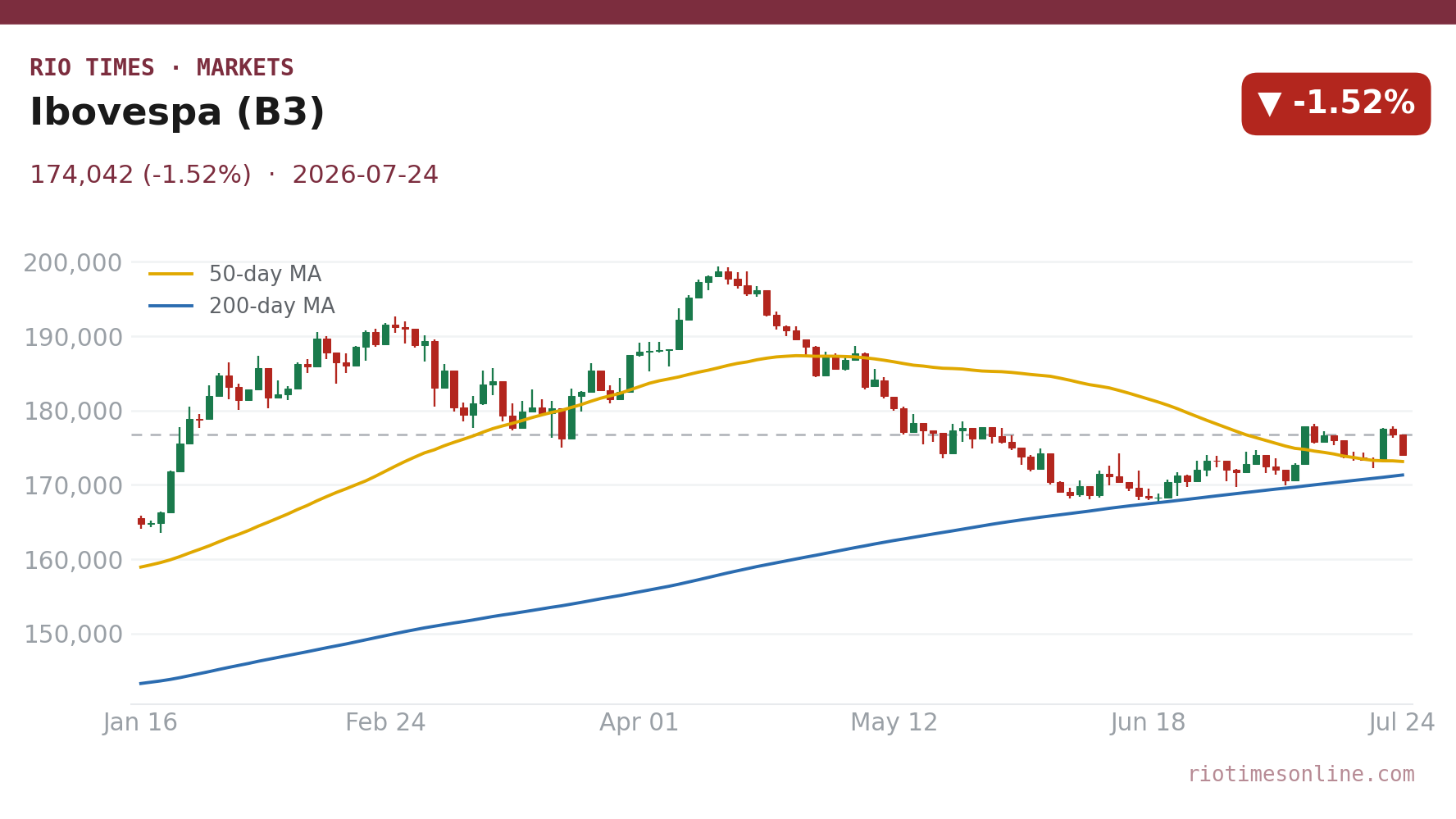
Brazil’s stock market, measured by the Ibovespa index on the São Paulo B3 exchange, slumped 1.52% to 174,042 points on Friday—its worst single-day decline in weeks. The drop was driven by a retreat in the two titans of the local equity universe: Petrobras, the state-controlled oil producer, and Vale, the iron ore mammoth that feeds China’s steel mills.
Petrobras’s preferred shares, easily the most-traded instrument of the day at $242 million, fell 1.7% to lead the losers’ board among big names. Its common shares, which carry voting rights but trade with slightly less liquidity, dropped a steeper 2.4%. The bank-heavy financial sector joined the retreat—Itaú Unibanco, Brazil’s largest private-sector bank, shed 1.1%, while exchange operator B3 fell 1.3%.
On the currency front, the Brazilian real was remarkably serene. One US dollar bought 5.0873 reais at the close, a barely perceptible 0.06% depreciation from the previous session. The currency remains comfortably within its 52-week trading band, keeping the foreign-exchange market in a distinctly different mood from the equity sell-off.
Curiously, not everything fell. Industrial motor-maker WEG eked out a 0.7% gain to feature among the smaller group of domestic advancers, while telecoms stocks like Vivo and TIM posted solid gains of 2.2% and 1.0%, respectively—signalling some rotation into defensive, yield-oriented names.
Friday’s session demonstrated the Ibovespa’s acute vulnerability to its concentrated structure. With Petrobras and Vale accounting for a substantial chunk of the index, weakness in crude oil and iron ore—or simply foreign-investor rotation away from resources—can overwhelm any pockets of domestic resilience. The drop in banking shares—Itaú’s preferred stock lost 1.1% and B3, the exchange operator itself, fell 1.3%—suggested the selling was broad but not panicked. The real’s steadiness, clinging to the 5.09 level, indicated no flight from Brazilian assets broadly, merely a repricing within equities.
02 The day’s numbers
| Measure | Level | Change | Read |
|---|---|---|---|
| Ibovespa | 174,042 pts | −1.52% | 12.4% below its 52-wk high |
| Session range (Ibovespa) | — | — | — |
| USD/BRL (spot real) | 5.0873 | +0.06% | 9% below its 52-wk high |
| S&P 500 (US stocks) | 7,412 pts | +0.05% | Steady global backdrop |
The Ibovespa’s closing level of 174,042 points places the benchmark 12.4% below its 52-week high of 198,657—a substantial retreat that keeps the index firmly below the psychologically important 180,000 mark. The 52-week range offers perspective: from a trough of 132,129 to a peak of 198,657, the index has surrendered more than half its recovery.
The real’s spot rate of 5.0873 per dollar sits 9% below its own 52-week high of 5.5901, a level that would signal acute stress. That the currency held steady while stocks fell 1.5% suggests the selling was narrowly focused on equities—particularly commodity-exposed names—rather than a broad vote of no confidence in Brazilian assets. Rio Times · Live Market Intelligence
Live Market IntelligenceBrazil — Live Market Board
Brazil — Live Market Board
Instrument Last Change YoY Prev. High Low Volume
IBOV
186,516.59
+0.01%
+21.85%
186,502.64
168,310
167,142
—
USD/BRL
5.16
+0.01%
-5.13%
5.16
5.18
5.14
—
SELIC
14.00%
—
—
—
—
—
PETR4
41.64
-0.05%
+35.19%
41.66
41.97
41.15
41,499,400
VALE3
72.97
+0.83%
+30.75%
72.37
73.54
72.66
17,658,000
ITUB4
38.60
-1.03%
+4.57%
39.00
39.34
38.39
29,487,800
BBDC4
16.85
+0.36%
+3.50%
16.79
16.90
16.67
19,416,900
BBAS3
19.37
+0.47%
+0.73%
19.28
19.44
19.16
11,069,200
B3SA3
14.26
-0.21%
+12.73%
14.29
14.47
14.11
33,037,800
ABEV3
14.89
-0.80%
+21.91%
15.01
15.07
14.81
16,453,100
WEGE3
47.59
+0.49%
+29.99%
47.36
48.08
47.36
3,364,600
PRIO3
59.14
-0.19%
+50.67%
59.25
59.81
58.74
3,325,600
SUZB3
41.33
+2.35%
-23.55%
40.38
41.48
40.35
3,914,900
RENT3
34.68
-0.09%
+0.84%
34.71
34.96
34.35
7,979,100
AZZA3
15.89
-2.63%
-53.76%
16.32
16.42
15.82
1,330,300
CSNA3
4.30
+0.47%
-42.65%
4.28
4.41
4.26
10,076,100
GGBR4
24.69
+2.19%
+51.38%
24.16
24.85
24.18
7,047,600
ENEV3
24.21
-1.38%
+70.49%
24.55
24.64
23.99
9,297,000
03 Why it moved — commodity heavies and rate caution
The Ibovespa’s structure is its fate. Petrobras and Vale together represent an outsized share of the index, meaning any global wobble in oil or iron ore ripples instantly through São Paulo trading floors. On Friday, weakness in commodity markets—exacerbated by investor caution ahead of a heavy week of US and Brazilian economic data—prompted foreign funds to trim positions in the two biggest local names.
The macro backdrop is finely balanced. Brazil’s central bank, known as Copom, has delivered three consecutive 25-basis-point cuts to the Selic rate, bringing it to 14.25%. But with inflation running at 4.64%—still well above the 3% target—and election-year fiscal stimulus threatening to add demand pressure, the rate-cutting cycle faces an uncertain path.
Higher rates have historically been a mixed bag for Brazilian equities. They support bank lending margins—helping explain why Itaú and its peers have held relatively steady in recent months—but they increase the discount rate applied to future earnings, punishing growth-dependent sectors such as retail and smaller industrials.
Friday’s session suggested the market is pricing in a cautious, rather than aggressive, monetary easing cycle—a mood that tends to reward defensive positioning and punish the highly-liquid, commodity-heavy names that dominate the index.
04 The day’s movers
| Driver | Level / Move | Change | Note |
|---|---|---|---|
| Petrobras PN (PETR4) | — | −1.7% | $242m turnover, day’s heaviest |
| Vale (VALE3) | — | −0.6% | $128m, iron ore weakness |
| B3 (B3SA3) | — | −1.3% | $107m, exchange operator hit |
| Itaú PN (ITUB4) | — | −1.1% | $86m, broad financial pressure |
| Petrobras ON (PETR3) | — | −2.4% | $72m, common shares underperform |
| WEG (WEGE3) | — | +0.7% | $70m, industrial outlier |
The session’s turnover picture confirmed the concentrated nature of the sell-off. The top eight most-traded names accounted for roughly $736 million in volume, with Petrobras’s two share classes alone generating $314 million—or more than 40% of that total. The most heavily-traded names on B3, Brazil’s exchange, are not merely large-cap stocks; they *are* the market.
Beyond the blue-chip names, some notable gainers emerged from the pack. Telecom firm Vivo (VIVT3) rose 2.2%, software provider TOTVS (TOTS3) gained 1.6%, and mobile operator TIM (TIMS3) added 1.0%. Steelmaker Gerdau (GGBR4) managed a 0.8% advance, bucking the resource-sector gloom. On the losing side, several smaller or cross-listed instruments saw sharp drops—but their thin trading volumes meant they barely registered on the broader index.
05 The regional scoreboard
| Index | Country | Change |
|---|---|---|
| S&P Merval | Argentina | −1.07% |
| MSCI COLCAP | Colombia | −0.38% |
| S&P/BMV IPC | Mexico | — |
| S&P/CLX IPSA | Chile | — |
| S&P/BVL General | Peru | — |
Argentina’s main stock index, the Merval in Buenos Aires, fell 1.07% on Friday in the only other regional move confirmed by end-of-day data. Colombia’s COLCAP, the benchmark for Bogotá-traded equities, slipped a more modest 0.38%. The Colombian peso was virtually flat against the dollar at 3,217 pesos per greenback.
Moves for Mexico’s IPC, Chile’s IPSA and Peru’s General Index could not be independently verified for the July 24 session. The live market board embedded above carries the latest available closes for regional markets.
06 The technical picture
The Ibovespa’s drop to 174,042 points leaves it perched uncomfortably above the lower end of its 52-week range of 132,129 to 198,657. The index has now surrendered more than half the gains it made from the 52-week trough, and the 1.52% single-session decline suggests sellers remain in control. The 180,000-point mark, once a floor, now looks like a ceiling.
The real’s technical picture is calmer. At 5.0873, the currency is trading well below its 52-week high of 5.5901 and only modestly above the lower bound of 4.8909. This tight, range-bound behaviour suggests the foreign-exchange market is awaiting a clearer catalyst—perhaps the mid-month inflation reading due in the coming days—before committing to a directional move.
For equity traders, the variable to watch is the 170,000-point level on the Ibovespa. A breach there would put the index within striking distance of its 52-week lows. On the upside, a reclaiming of 180,000 would signal that Friday’s commodity-led sell-off was a one-session event rather than the start of a deeper correction.
07 What to watch
- Mid-month inflation: Brazil’s IPCA-15 inflation gauge, expected at 0.4% for July, arrives on Monday. A hotter reading would challenge the case for further Selic rate cuts
- Commodity prices: Global crude oil and iron ore benchmarks—the lifeblood of Petrobras and Vale—remain the single most important external driver of Brazilian equities
- US durable goods: July 27 durable goods orders (consensus +1.6%) will shape global growth expectations and risk appetite heading into the new week
- Consumer confidence: Monday’s FGV consumer confidence reading (consensus 88.5) offers a timely window into how Brazilian households are weathering elevated rates
Background: Petrobras Energy Transition Chief Named in Brazil Oil Clash.
Background: Vports Espirito Santo Posts Record First Half.
More: Brazil news in English, every day from The Rio Times.
Frequently Asked Questions
What is the Ibovespa?
The Ibovespa is Brazil’s main stock index, tracking the most-liquid shares on the B3 exchange in São Paulo. It is the primary benchmark used by local and global investors to gauge Brazilian equity performance.
Why does Petrobras matter so much?
Petrobras is Brazil’s state-controlled oil giant and the heaviest component of the Ibovespa. Its shares are sensitive to international crude prices, domestic fuel policy, and Brazilian government decisions.
What is the Selic rate?
The Selic is Brazil’s central bank benchmark interest rate, currently at 14.25%. It sets the floor for borrowing costs and has a powerful influence on bank profitability, consumer spending, and stock valuations.
What does USD/BRL 5.0873 mean?
USD/BRL is the exchange rate between the US dollar and the Brazilian real. A reading of 5.0873 means one dollar buys 5.0873 reais—the lower this number, the stronger the real.
This article was produced by The Rio Times’ automated newsroom system. How we use AI · Report an error
LatAm Markets: Live Signals → — real-time movers, turnover leaders and FX across Latin America.
Read More from The Rio Times