Brazil Stocks Rise 1.23% as Real Gains | Brazil Market Report, Nov 4
Key Facts
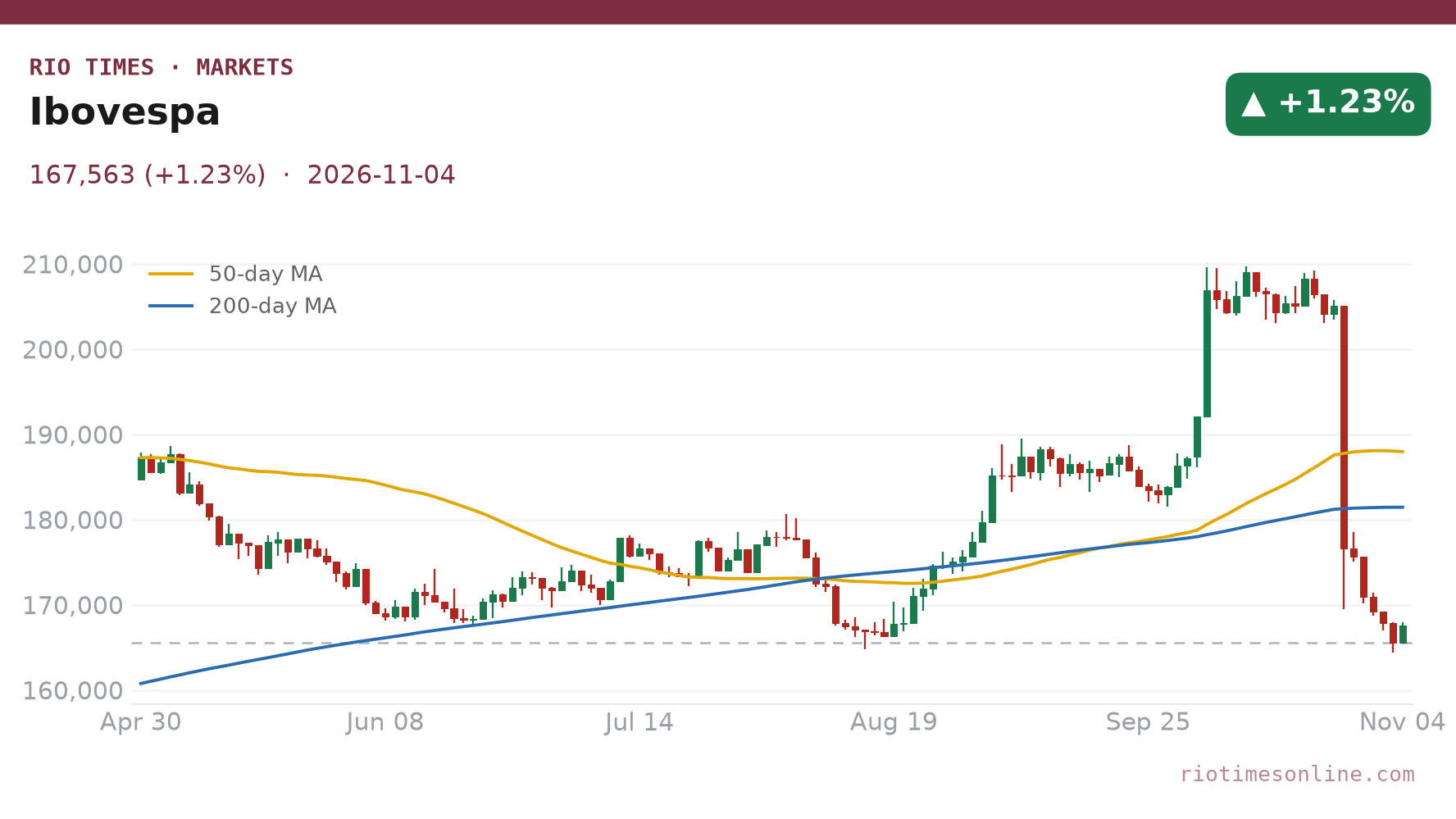
- The Ibovespa, Brazil’s main stock index, rose 1.23% to 167,563 ending a losing run, yet it remains 19.9% below its 9 October peak of 209,067
- The real, Brazil’s currency, strengthened as the dollar fell 0.56% to 5.4594 reais the dollar had hit its highest level in at least six months only a session earlier
- The central bank held its Selic benchmark rate at 13.75% after the close, ending a run of quarter-point cuts, so the decision did not drive Wednesday’s trading.
- Wall Street led the rebound, with the S&P 500 up 1.58% and the VIX fear gauge down 20.26% a global surge in risk appetite that lifted most Latin American markets except Colombia
- Over 20 sessions the Ibovespa is down 19.02% and the dollar is up 8.83% against the real, a far bigger swing than a single good day can undo
- Prediction markets: Polymarket gives a 73.0% chance that Brazil’s central bank leaves the Selic unchanged in December (US$54,613 traded, 7:42 p.m. ET, 4 November).
Today’s Focus
Brazil’s stock market had its first good day in a week, but it was a bounce inside a deep hole. The Ibovespa, the benchmark index of the São Paulo exchange (known as B3), rose 1.23% to 167,563 points.
That still leaves it down 19.02% over 20 sessions and 19.9% below its 9 October peak of 209,067. It sits 12.7% above its 12-month low of 148,633, set on 29 October 2025.
The lift came from abroad. Wall Street surged after the US midterm elections, and the dollar slipped 0.56% to 5.4594 reais as investors felt braver about emerging markets.
Trading had resumed on Tuesday after the Monday holiday for All Souls’ Day, and the index slid for a sixth straight session before Wednesday’s turn. The question now is whether this is a floor or a pause.
What matters today. One good day does not repair a 19.02% fall in 20 sessions — the fiscal debate and the Selic path decide whether the bounce lasts.

01 The session in one read
Brazil’s stock market ended its worst run in weeks on a high note. The Ibovespa rose 1.23% to 167,563, its first gain after six straight falls.
Trading resumed on Tuesday after Monday’s All Souls’ Day holiday, when B3 was shut. That session extended the slide, so Wednesday’s bounce came from a low base.
The real also won back some ground. The dollar fell 0.56% to 5.4594 reais, after touching its highest level in at least six months a session earlier.
Think of it as a stretched elastic band snapping back a little. The move is real, but the band is still stretched far from where it stood a month ago.
The evidence points to a global lift rather than a Brazilian one. Wall Street rose, volatility collapsed and the dollar index eased, so almost every emerging market gained together.
The home-grown worries have not gone away: the central bank paused its rate cuts on Wednesday evening, pointing to inflation above its target ceiling, so the market is now debating how long the pause lasts. Until that debate settles, rallies are likely to stay fragile — the variable to watch is the dollar against the 5.50 reais level.
02 The day’s numbers
| Measure | Level | Change | Read |
|---|---|---|---|
| Ibovespa | 167,563 | +1.23% | First gain after six falls in a row |
| Session range | — | — | Not in our verified scan |
| US dollar vs real | 5.4594 | −0.56% | Real recovers part of its recent loss |
| Distance from 12-month high | 209,067 (9 Oct 2026) | — | Index is 19.9% below that peak |
| Distance from 12-month low | 148,633 (29 Oct 2025) | — | Index is 12.7% above that floor |
| Key level to watch | 170,000 round number | — | Resistance a little above today’s close |
The table tells a story of position, not of progress. The index closed closer to its low than to its high, but the October peak shows how much was lost in one month.
The dollar is 2.3% below its 12-month high of 5.59 reais, set on 22 December 2025. It is 11.6% above its low of 4.89, set on 11 May 2026, so the real remains weak by the standards of the past year. Rio Times · Live Market Intelligence
Live Market IntelligenceBrazil — Live Market Board
Brazil — Live Market Board
Instrument Last Change YoY Prev. High Low Volume
IBOV
167,563.47
+1.23%
+19.56%
165,528.92
178,526
175,157
—
USD/BRL
5.34
-1.32%
-0.84%
5.42
5.42
5.30
—
SELIC
13.75%
—
—
—
—
—
PETR4
53.31
-1.06%
+77.70%
53.88
53.70
52.83
43,239,500
VALE3
62.88
-2.33%
+1.98%
64.38
64.43
62.80
24,652,300
ITUB4
41.42
-0.67%
+11.30%
41.70
42.60
41.15
28,160,700
BBDC4
15.69
-1.63%
-13.88%
15.95
16.30
15.67
65,766,400
BBAS3
17.59
+0.69%
-15.59%
17.47
18.31
17.51
67,844,600
B3SA3
15.27
+1.33%
+21.71%
15.07
15.78
15.20
75,282,000
ABEV3
15.40
+0.20%
+26.75%
15.37
15.68
15.31
27,307,400
WEGE3
45.78
+2.81%
+10.06%
44.53
47.08
45.06
9,823,200
PRIO3
69.21
-2.71%
+87.14%
71.14
70.98
69.15
6,663,200
SUZB3
47.14
-0.55%
-3.79%
47.40
47.84
46.10
7,151,800
RENT3
31.14
-1.67%
-20.73%
31.67
32.68
31.02
19,092,400
AZZA3
16.72
+1.15%
-42.24%
16.53
17.42
16.72
4,875,400
CSNA3
4.76
-4.99%
-47.09%
5.01
5.14
4.76
14,327,900
GGBR4
24.87
-2.28%
+36.28%
25.45
26.20
24.79
7,507,900
ENEV3
26.79
+0.45%
+49.78%
26.67
27.35
26.30
12,263,000
03 Why it moved — Wall Street’s rally and a softer dollar
The first cause, with high confidence, was Wall Street. After the US midterm elections the S&P 500 rose 1.58% to 7,689 and the Dow Jones rose 3.03% to 53,356.
The VIX, the so-called fear gauge that tracks expected swings in US shares, fell 20.26% to 16.61. When fear drains out of New York, money tends to flow towards riskier markets such as Brazil.
The second cause, with medium confidence, was relief on the dollar and bond yields. The dollar index slipped 0.37% to 101.49, and the US 10-year Treasury yield fell 5 basis points to 4.90%, which eases pressure on emerging-market currencies.
The central bank was not a cause of Wednesday’s move. The Copom, the committee that sets Brazil’s rates, announced after the close that it held the Selic at 13.75%, so traders had not yet seen the decision.
The drivers do not all agree. Oil fell sharply, with the USO fund down 8.07%, and cheaper crude normally weighs on Brazil’s oil-heavy index; the best-supported reading is that Wall Street’s mood outweighed it, with about medium confidence.
History offers a sober note. In RT’s own price history since 2007, the dollar rose 8.8% against the real in 20 sessions; in the 26 earlier cases with a move at least that large, it was higher 20 sessions later in 12 of 26 (46%).
The median change in those cases was −1.0%, the worst was −11.4% and the best +30.5%. History is not a forecast, but it says sharp currency moves often fade about as often as they continue.
04 The day’s movers
| Driver | Level / Move | Change | Note |
|---|---|---|---|
| Oil (USO fund) | 145.41 | −8.07% | Biggest cross-asset swing; hurts oil exporters |
| S&P 500 | 7,689 | +1.58% | US midterm relief lifted risk appetite |
| VIX fear gauge | 16.61 | −20.26% | Fear drained out of global markets |
| US dollar index | 101.49 | −0.37% | Softer dollar helps emerging currencies |
| US 10-year yield | 4.90% | −5 basis points | Lower yields ease pressure on Brazil |
| Gold fund (GLD) | US$372.49 | +3.68% | Sharp gain as the dollar fell |
Our scan holds no verified share prices for individual B3 companies today, so this table reads the forces that move them. A basis point is one hundredth of a percentage point.
Oil is the odd one out. A drop of that size normally drags on the energy companies that weigh heavily in the Ibovespa, so the index rising anyway shows how strong the global tide was.
05 The regional scoreboard
| Index | Country | Change |
|---|---|---|
| IPC | Mexico | +1.71% |
| IPSA | Chile | +2.52% |
| COLCAP | Colombia | −0.84% |
| BVL Perú | Peru | +1.88% |
The live market board above carries the full closes for each index. Most of the region rose with Wall Street, led by Chile’s IPSA, while Colombia’s COLCAP fell.
Currencies tell the same story. The Mexican peso strengthened as USD/MXN fell 1.12% to 18.62, and the Chilean peso gained as USD/CLP fell 1.58% to 965.6.
Colombia, an oil exporter, is likely to feel cheaper crude in its public finances, and its peso weakened, with USD/COP up 0.75% to 3,250. For Brazil, a firmer real helps importers and travellers, but it trims the reais value of exporters’ dollar earnings.
06 The technical picture
On the chart, the Ibovespa is climbing out of a sharp drop. The nearest support is the 160,000 round number, then the 12-month low of 148,633 reached on 29 October 2025.
Resistance sits at the 170,000 round number, and far above it the 12-month high of 209,067 from 9 October 2026. The index must clear 170,000 convincingly to suggest the slide is over.
For the dollar, the first test is the 5.50 round number, then the 12-month high of 5.59 from 22 December 2025. On the downside, the real needs to push the dollar well below 5.40 to show a lasting recovery.
This looks like a continuation of a weak phase rather than a new one. The 5-session fall of 4.64% and the 20-session fall of 19.02% in the Ibovespa both dwarf today’s 1.23% gain.
07 What to watch
- The Selic path: After the hold at 13.75% announced after Wednesday’s close, watch how the central bank describes its next move, since it shapes the interest-rate futures that investors price.
- Fiscal debate: Any new government proposal on rate policy or spending can move Brazilian bond yields and the dollar within hours.
- The dollar at 5.50 reais: A close above this round number would put the 12-month high of 5.59 back in view; a close below 5.40 would signal real strength.
- Brazilian activity data: Industrial production and the S&P Global services PMI, a survey of business activity where readings below 50 mean contraction, test how the economy is coping with high rates.
Background: Brazil Stocks Fall 1.42% as the Real Weakens.
Background: Brazil Stocks Fall 0.75% as Dollar Surges.
What Prediction Markets Say
Polymarket, a prediction market where users bet real money, shows a 73.0% chance that Brazil’s central bank leaves its Selic rate unchanged at its December decision, 14.5% for a quarter-point cut and 5.1% for a quarter-point rise, with US$54,613 traded. Prices were read at 7:42 p.m. ET on 4 November 2026. These are bets, not forecasts.
Why we show this: prediction markets turn real-money bets into a live probability that moves within minutes of the news, which is why investors, campaigns and newsrooms in the United States now follow them closely. We show them next to polls and official results, never instead of them.
Frequently Asked Questions
Why did the Brazil stock market rise on Wednesday?
The Ibovespa rose 1.23% to 167,563, mainly because Wall Street rallied after the US midterm elections and global fear eased. The central bank held its benchmark rate, the Selic, at 13.75% after the close, so that decision did not drive the day.
Is the Ibovespa still in a downtrend?
Yes, by the numbers. It is down 19.02% over 20 sessions and 19.9% below its 9 October 2026 peak of 209,067, so one gain does not change the picture.
What does the real’s move mean for travellers?
The dollar fell 0.56% to 5.4594 reais, so a dollar buys slightly fewer reais than the day before. Visitors still get far more reais than at the 12-month low of 4.89 per dollar.
Where are the key levels for the Ibovespa?
Support lies at the 160,000 round number and the 12-month low of 148,633. Resistance lies at 170,000 and then the 12-month high of 209,067.
Market data: The Rio Times; exchange figures from B3
This article was produced by The Rio Times’ automated newsroom system. How we use AI · Report an error · Editorial responsibility: Matthias Camenzind, Editor-in-Chief
LatAm Markets: Live Signals → — real-time movers, turnover leaders and FX across Latin America.
Brazil runoff, Sunday, October 25: Brazil runoff date. Latest: Brazil runoff polls, Flávio 51%, Lula 49%.
Get The Rio Times delivered to your inbox — market intelligence, daily briefs, and breaking analysis across Latin America.
Start for US$1