Brazil Stocks Fall 1.42% as the Real Weakens | Brazil Market Report, Nov 3
Key Facts
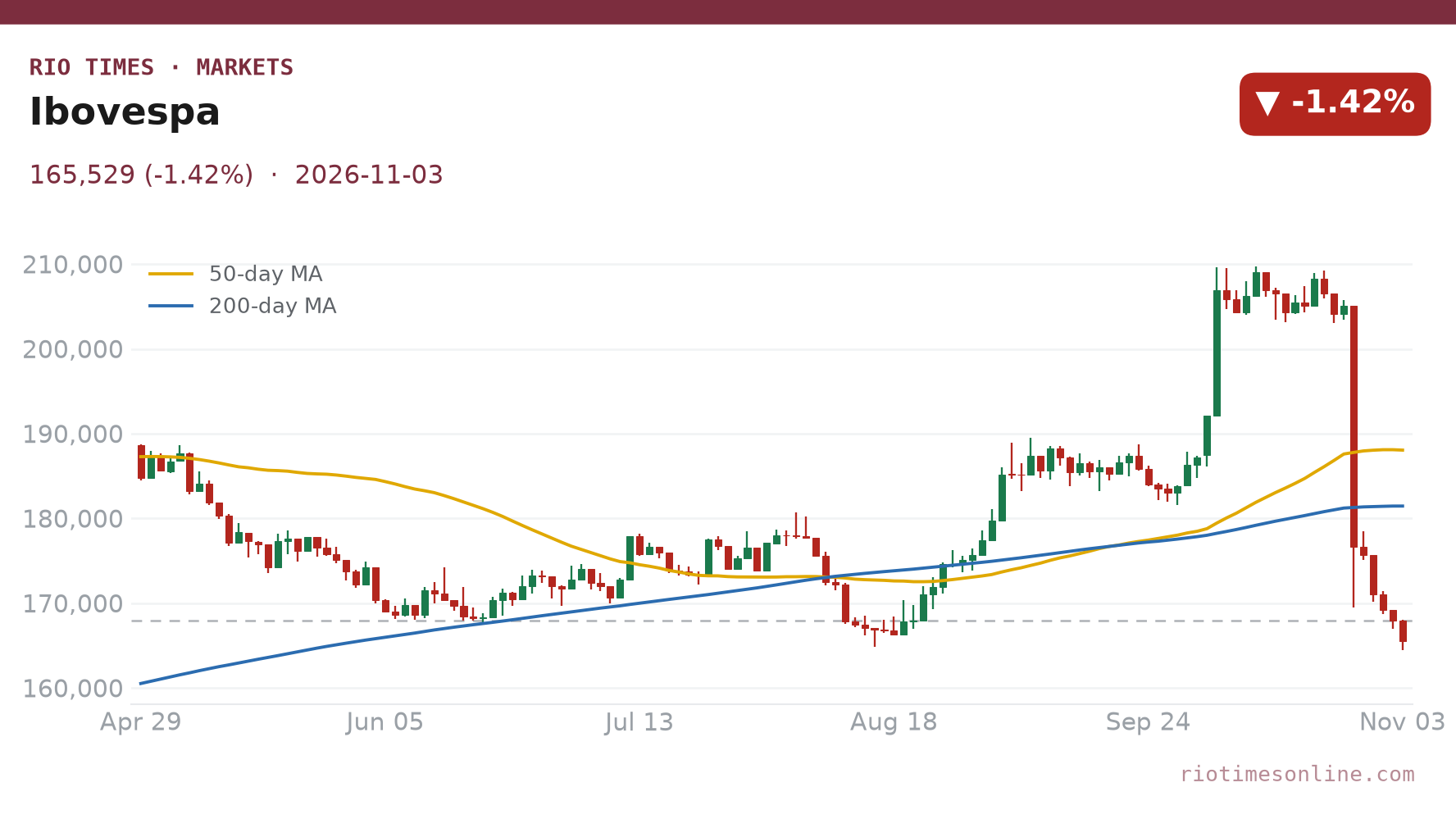
- Brazil’s main stock index, the Ibovespa, closed at 165,529, down 1.42% on the first session after the 2 November holiday, its lowest close in at least six months.
- It was the sixth losing session in a row; the index is down 6.27% over five sessions and down 13.84% over 20 sessions.
- The Ibovespa now sits 20.8% below its 9 October peak of 209,067 and 12.3% above its 12-month low of 147,429, set on 28 October 2025.
- The real, Brazil’s currency, weakened to 5.4926 per US dollar; the dollar is up 1.01% on the day and at its highest close in at least six months.
- Wall Street rose while Brazil fell; the S&P 500 gained 0.36%, so the cause looks mostly domestic, although we could not tie the fall to a single announcement.
Today’s Focus
Brazil’s stock market had a day off on Monday 2 November for Finados, All Souls’ Day, a national holiday. When it reopened on Tuesday, it picked up where it left off — falling.
The Ibovespa, the benchmark of Brazil’s biggest listed companies, closed at 165,529, down 1.42%. That is its sixth straight loss and its lowest close in at least six months.
To feel the size of it: the index is down 13.84% over 20 sessions and sits 20.8% below its 9 October peak of 209,067. The real slid with it, to 5.4926 per US dollar.
The likeliest reason is local. Analysts point to investor doubts about how the re-elected government will handle its budget, but we could not tie the fall to one announcement.
What matters today. This is a Brazil-specific sell-off, because Wall Street rose on the same day, so the next signal on fiscal policy matters more than anything from abroad.

01 The session in one read
Brazil’s exchange, B3, was shut on Monday 2 November for Finados, so there was no trading and no close to report for that day. The exchange lists the date as a non-trading day in its 2026 calendar: https://www.b3.com.br/pt_br/noticias/calendario-de-negociacao-da-b3-confira-o-funcionamento-da-bolsa-em-2026.htm
On Tuesday 3 November the market reopened and the Ibovespa, Brazil’s main stock index, closed at 165,529, down 1.42%. It was the sixth fall in a row and the lowest close in at least six months.
The real, Brazil’s currency, also weakened. It ended at 5.4926 per US dollar, up 1.01% for the dollar on the day and the highest dollar close in at least six months.
Put simply, both stocks and the currency are being sold at once. That pairing usually means investors are worried about the country itself, not about a single company or sector.
The usual outside drivers do not explain the fall. The S&P 500 rose 0.36%, the dollar index rose only 0.14%, and oil moved up, which normally helps Brazil’s oil-heavy index.
The best-supported explanation is domestic: worry about public spending and the cost of government borrowing since the election. Our confidence is medium, because it rests on local commentary and the pattern across assets rather than on one official statement. The variable to watch is any clear fiscal signal from President Luiz Inácio Lula da Silva, together with the central bank’s decision on Wednesday 4 November.
02 The day’s numbers
| Measure | Level | Change | Read |
|---|---|---|---|
| Ibovespa close | 165,529 | −1.42% | Sixth straight loss; lowest close in at least six months |
| Session range | — | — | Not available in our scan |
| USD/BRL (reais per dollar) | 5.4926 | +1.01% | Real at its weakest close in at least six months |
| 52-week positioning, Ibovespa | 20.8% below 209,067 high; 12.3% above 147,429 low | — | Closer to the floor than the ceiling of the past year |
| Key technical level | 147,429 (12-month low, 28 Oct 2025) | — | Next major floor if selling continues |
The table shows a market that has given back most of a rally. The index touched 209,067 on 9 October and is now down 20.8% from that peak, a drop that traders call a bear-market zone.
Yet the index is still 12.3% above its 12-month low of 147,429. The fall is deep, but it has not erased the whole year’s gains. Rio Times · Live Market Intelligence
Live Market IntelligenceBrazil — Live Market Board
Brazil — Live Market Board
Instrument Last Change YoY Prev. High Low Volume
IBOV
165,528.92
-1.42%
+19.56%
167,921.80
178,526
175,157
—
USD/BRL
5.34
-1.32%
-0.84%
5.42
5.42
5.30
—
SELIC
13.75%
—
—
—
—
—
PETR4
53.31
-1.06%
+77.70%
53.88
53.70
52.83
43,239,500
VALE3
62.88
-2.33%
+1.98%
64.38
64.43
62.80
24,652,300
ITUB4
41.42
-0.67%
+11.30%
41.70
42.60
41.15
28,160,700
BBDC4
15.69
-1.63%
-13.88%
15.95
16.30
15.67
65,766,400
BBAS3
17.59
+0.69%
-15.59%
17.47
18.31
17.51
67,844,600
B3SA3
15.27
+1.33%
+21.71%
15.07
15.78
15.20
75,282,000
ABEV3
15.40
+0.20%
+26.75%
15.37
15.68
15.31
27,307,400
WEGE3
45.78
+2.81%
+10.06%
44.53
47.08
45.06
9,823,200
PRIO3
69.21
-2.71%
+87.14%
71.14
70.98
69.15
6,663,200
SUZB3
47.14
-0.55%
-3.79%
47.40
47.84
46.10
7,151,800
RENT3
31.14
-1.67%
-20.73%
31.67
32.68
31.02
19,092,400
AZZA3
16.72
+1.15%
-42.24%
16.53
17.42
16.72
4,875,400
CSNA3
4.76
-4.99%
-47.09%
5.01
5.14
4.76
14,327,900
GGBR4
24.87
-2.28%
+36.28%
25.45
26.20
24.79
7,507,900
ENEV3
26.79
+0.45%
+49.78%
26.67
27.35
26.30
12,263,000
03 Why it moved — budget doubts and a global backdrop
Cause one, with medium confidence: doubt about the budget. Investors want to see how the government will balance spending and revenue, which economists call fiscal adjustment, before buying Brazilian assets again.
We could not tie the fall to one official statement, so this reading rests on the pattern across assets: Wall Street rose and oil rose, yet Brazil fell.
Cause two, with lower confidence: the cost of borrowing. Higher long-term interest rates make shares less attractive and hurt companies that carry debt, although we have no verified figure for Brazilian long-term rates on the day.
The Selic, the central bank’s benchmark interest rate, stands at 13.75%. The central bank decides on Wednesday 4 November at 21:30 Lisbon time; economists in the central bank’s weekly Focus survey lean towards a cut of 0.25 points, while the RT economic calendar still lists a hold, so the outcome is open.
Cause three, with less weight: the global backdrop was mixed, not hostile. The US 10-year Treasury yield, the borrowing cost for the American government, rose 7 basis points to 4.974%, and the dollar index edged up 0.14%.
That helps explain a stronger dollar, but not a Brazil-only fall, since the S&P 500 rose 0.36%. Real-economy investors have not run away: an energy transmission auction on Friday drew bids for all eight projects, worth about R$8.9 billion in planned investment.
04 The day’s movers
| Driver | Level / Move | Change | Note |
|---|---|---|---|
| Ibovespa | 165,529 | −1.42% | Brazil-specific selling |
| S&P 500 | 7,569 | +0.36% | Wall Street rose, so the fall was not global |
| Nasdaq | 25,372 | +0.83% | Tech-heavy US index also gained |
| US dollar index | 101.89 | +0.14% | Small gain; explains little of the real’s slide |
| US 10-year Treasury yield | 4.974% | +7 basis points | Higher US yields pull money away from emerging markets |
| VIX fear gauge | 20.83 | −1.51% | Fear eased slightly on the day |
| Oil (USO fund) | 158.17 | +0.83% | Normally supportive for Brazil |
| Gold fund (GLD) | 359.26 | −0.66% | Little safe-haven buying |
Our scan has no verified share-by-share data for B3 today, so we do not name individual companies. The cross-asset check tells the story instead: nearly every outside driver was neutral or supportive.
When oil rises, Brazil’s index usually benefits, because oil and mining firms weigh heavily in it. That it fell anyway points to domestic worries.
05 The regional scoreboard
| Index | Country | Change |
|---|---|---|
| Ibovespa | Brazil | −1.42% |
| IPC | Mexico | +0.52% |
| IPSA | Chile | −0.09% |
| COLCAP | Colombia | +1.32% |
Latin America split. Mexico and Colombia rose, Chile was flat, and Argentina fell hardest; the live market board above carries the closes.
The mixed picture supports the case that Brazil’s slide is local. For a reader in Mexico City or Bogotá, the region is not in a general sell-off; for Brazilian exporters, a weaker real raises reais earned per dollar sold, but it makes imports and foreign debt costlier for the government and for companies.
06 The technical picture
On the chart, the nearest floor is the 12-month low of 147,429, set on 28 October 2025. Round numbers such as 160,000 and 150,000 may also attract buyers.
Overhead, the first resistance is the round 170,000 area, then the 9 October peak of 209,067. For the dollar, the 5.50 round number and the 12-month high of 5.59, set on 22 December 2025, are the lines to watch.
History offers a mild caution against panic, not a forecast. After 12 earlier cases in our own price history since 2007 where the Ibovespa fell this much in 20 sessions, it was higher 20 sessions later in 6 of the 12 cases, 50%, with a median of −0.1% and a worst case of −29.0%.
For the dollar against the real, after 18 earlier jumps of this size, it was higher 20 sessions later in only 6 of 18 cases, 33%, with a median of −1.3% and a worst case of −11.4%. That favours a pause or pullback over a straight line up, but history is not a forecast.
07 What to watch
- Central bank decision: The Selic decision on Wednesday 4 November at 21:30 Lisbon time; the rate is 13.75% and economists lean towards a 0.25-point cut, so the wording of the statement matters most.
- Fiscal signal: Any concrete spending plan from Lula’s government; this is the main thing investors say they are waiting for.
- Key levels: The Ibovespa at 147,429 on the downside and 170,000 on the upside; the dollar at 5.50 and 5.59.
- US yields: The US 10-year Treasury yield at 4.974%; further rises would add pressure on emerging markets.
- Factory activity: The S&P Global Manufacturing PMI for Brazil, a survey of factory managers, had no published reading in the RT economic calendar when we wrote (forecast 43, previous 44.8); below 50 means shrinking activity.
Background: Brazil Stocks Fall 0.75% as Dollar Surges.
Background: Brazil Stocks Fall 1.06% as Bradesco Drops.
Frequently Asked Questions
Why did Brazil’s stock market fall on 3 November?
Most likely domestic worries about public finances after the election; we could not tie the fall to one announcement. Wall Street rose that day, which points to a Brazil-specific cause.
Was there a stock market session on 2 November?
No. B3, Brazil’s exchange, was closed for Finados, All Souls’ Day, a national holiday, and trading resumed on 3 November.
What does a weaker real mean for travellers?
Your dollars or euros buy more in Brazil, as the dollar closed at 5.4926 reais. Brazilians travelling or shopping abroad pay more.
Is this a good moment to buy Brazilian stocks?
This is not advice. History shows that after similar falls the index was higher 20 sessions later half of the time, but the worst case was a further fall of 29.0%.
Market data: The Rio Times; exchange figures from B3
This article was produced by The Rio Times’ automated newsroom system. How we use AI · Report an error · Editorial responsibility: Matthias Camenzind, Editor-in-Chief
LatAm Markets: Live Signals → — real-time movers, turnover leaders and FX across Latin America.
Brazil runoff, Sunday, October 25: Brazil runoff: date, poll closing times and when results start. Latest: Brazil runoff polls, Flávio 51%, Lula 49%.
Get The Rio Times delivered to your inbox — market intelligence, daily briefs, and breaking analysis across Latin America.
Start for US$1