Brazil Markets: Ibovespa & the Real — July 28, 2026
Key Facts
- The Ibovespa, Brazil’s main stock index, rose 0.74% to close at 175,334 points, lifted by Embraer and broad strength in the big banks
- Embraer shares jumped 5.3%, the day’s biggest large-cap move, extending the re-rating that followed last week’s Farnborough order haul and a record US$34.5 billion backlog
- Petrobras preferred shares fell 2.8%, hurt by a sluggish global crude session and political noise over its capital-allocation plan
- The Brazilian real slipped 0.64% to 5.1168 per US dollar, staying comfortably within its recent trading band
- The index advanced despite the Petrobras drag, a sign the local rate-cut narrative is still driving rotation into cyclicals and domestic value plays
Today’s Focus
Brazil’s main stock index, the Ibovespa, gained 0.74% to close at 175,334 points on Monday, propped up by a powerful rally in aircraft maker Embraer and broad strength among the country’s big banks. The advance was not universal, however—a sharp drop in oil giant Petrobras and a slide in the Brazilian real painted a more complex picture of the session.
The real, Brazil’s currency, slipped 0.64% against the dollar to trade at 5.1168. Dealers noted decent corporate demand for dollars, but the move lacked the panic of previous episodes, keeping the currency comfortably inside its recent trading band.
The spark for the session came from Embraer, whose shares rocketed 5.3% without a single new company announcement. Buyers were still working through last week’s news: 30 firm jet orders at Farnborough on Thursday, led by 20 E195-E2s for Abra Group, and a second-quarter backlog of US$34.5 billion — the largest in the planemaker’s history.
That high-beta export story contrasted with the 2.8% fall in Petrobras preferred shares, which were hurt by a sluggish session for crude oil globally and lingering political noise in Brasília surrounding the company’s capital allocation plan.
What matters today. The market’s ability to rise despite a heavy drag from Petrobras and a weaker currency shows that the local rate-cut narrative is still supporting a broad rotation into cyclicals and domestic value plays.

01 The session in one read
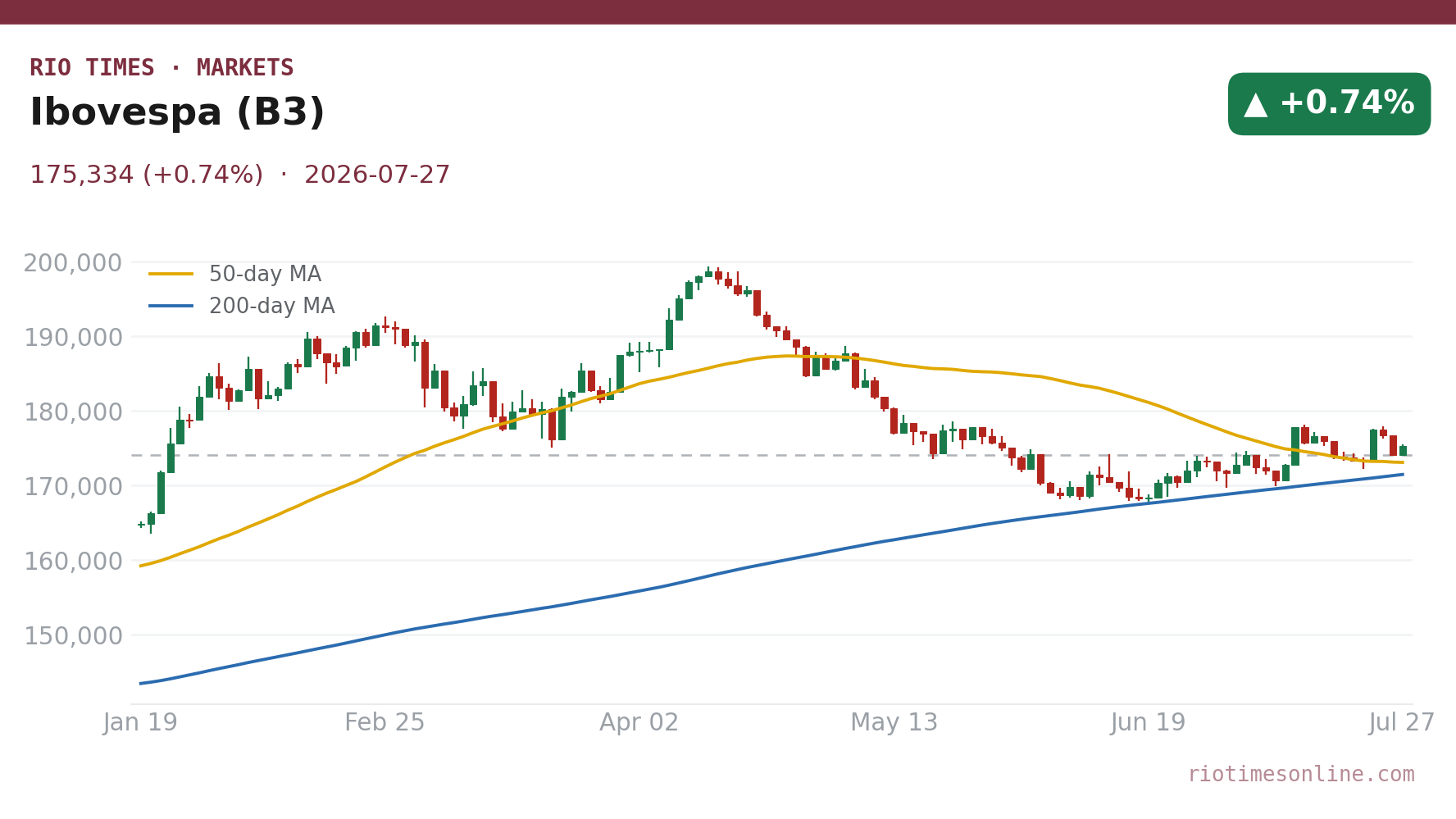
Brazilian stocks started the week on the front foot, with the Ibovespa—the benchmark index that groups the most-traded shares on the São Paulo exchange—rising 0.74% to 175,334 points. The advance was selective: it worked beautifully for aircraft exporters and big banks, but punished anyone holding shares of Petrobras, the state-controlled oil producer.
The real could not hold its ground. Brazil’s currency fell 0.64% to close at 5.1168 per dollar, giving back some of its recent gains in a session where corporate dollar outflows were the dominant technical factor.
The volume leaderboard told the story of the day. Petrobras was the most-traded name as investors rushed to reprice its outlook, but Embraer’s $100 million in turnover stole the spotlight, a heavy print for a stock that had no fresh headline of its own.
Behind the scenes, the market’s backbone remained the same: Brazil’s central bank is lowering the Selic—its benchmark interest rate—from a painfully high peak, and that steady, predictable easing is the gravitational force pulling money toward locally-focused financial and industrial stocks.
Monday’s tape felt like a continuation trade, not a fresh directional bet. The heavy lifting came from specific stock stories—Embraer and JBS—and from the slow-burn domestic bid created by falling interest rates, which mechanically makes future earnings at banks and retailers worth more in today’s money. The biggest counterpoint was the real’s slide, which could complicate the central bank’s path if it accelerates. For now, the currency’s depreciation looks orderly, but the market will watch the next inflation print closely to see if it nudges the Selic outlook in a more hawkish direction.
02 The day’s numbers
| Measure | Level | Change | Read |
|---|---|---|---|
| Ibovespa | 175,334 | +0.74% | Gain led by industrials; held back by Petrobras |
| Session range | — | — | Not yet available from exchange data |
| USD/BRL (Brazil’s real) | 5.1168 | +0.64% | Real weaker on corporate dollar demand |
| 52-week positioning | 11.7% below high | — | Index sits well off its 198,657 peak but far above the 132,129 low |
The Ibovespa’s 0.74% gain nudged it further from the middle of its 52-week range. The index remains 11.7% below its all-time high of 198,657 points, a stark reminder that the market has not fully recovered from the deep sell-off that accompanied the peak of the rate-hiking cycle.
On the currency side, the dollar’s move up to 5.1168 reais leaves it roughly 8.7% below its own 52-week closing high of 5.6016. The real has had a strong few months, but Monday’s price action showed that the corridor between 5.05 and 5.15 remains a battleground between importers taking advantage of the strong real and exporters protecting their budgets. Rio Times · Live Market Intelligence
Live Market IntelligenceBrazil — Live Market Board
Brazil — Live Market Board
Instrument Last Change YoY Prev. High Low Volume
IBOV
186,502.64
+0.54%
+21.85%
185,500.88
168,310
167,142
—
USD/BRL
5.16
+0.01%
-5.13%
5.16
5.18
5.14
—
SELIC
14.00%
—
—
—
—
—
PETR4
41.64
-0.05%
+35.19%
41.66
41.97
41.15
41,499,400
VALE3
72.97
+0.83%
+30.75%
72.37
73.54
72.66
17,658,000
ITUB4
38.60
-1.03%
+4.57%
39.00
39.34
38.39
29,487,800
BBDC4
16.85
+0.36%
+3.50%
16.79
16.90
16.67
19,416,900
BBAS3
19.37
+0.47%
+0.73%
19.28
19.44
19.16
11,069,200
B3SA3
14.26
-0.21%
+12.73%
14.29
14.47
14.11
33,037,800
ABEV3
14.89
-0.80%
+21.91%
15.01
15.07
14.81
16,453,100
WEGE3
47.59
+0.49%
+29.99%
47.36
48.08
47.36
3,364,600
PRIO3
59.14
-0.19%
+50.67%
59.25
59.81
58.74
3,325,600
SUZB3
41.33
+2.35%
-23.55%
40.38
41.48
40.35
3,914,900
RENT3
34.68
-0.09%
+0.84%
34.71
34.96
34.35
7,979,100
AZZA3
15.89
-2.63%
-53.76%
16.32
16.42
15.82
1,330,300
CSNA3
4.30
+0.47%
-42.65%
4.28
4.41
4.26
10,076,100
GGBR4
24.69
+2.19%
+51.38%
24.16
24.85
24.18
7,047,600
ENEV3
24.21
-1.38%
+70.49%
24.55
24.64
23.99
9,297,000
Live Company IntelligenceEmbraer SA ADR — the full investor dossier
Wall Street view
Valuation & profitability
Price & risk
$55.5352-wk high
$66.87
Revenue trend · 6y
Ownership
Dividend
03 Why it moved — a backlog, an earnings clock, and a rates tailwind
The day’s most potent move had no Monday catalyst at all. Embraer closed Thursday’s Farnborough tally at 30 firm jets — 20 E195-E2s for Abra Group, five for Spain’s Binter Canarias, three for Luxair, two E175s for Japan’s Fuji Dream Airlines — and followed it on Friday with a record US$34.5 billion second-quarter backlog. Monday was the market finishing that arithmetic.
Much further down the market-cap ladder, meatpacker JBS screamed 11.6% higher on its B3 line. No results were out: Pilgrim’s Pride, the group’s US-listed chicken arm, does not report second-quarter numbers until after Wednesday’s New York close. Monday’s move was positioning into that print, which makes it the kind of gain that can be handed straight back on Thursday morning.
The financial sector’s 1.4% rise in Itaú Unibanco shares was less dramatic but arguably more important for the index’s direction. Banks make up a huge share of the Ibovespa, and every step lower in the Selic rate reduces their funding costs while typically stimulating credit growth.
That domestic optimism was strong enough to overcome the weight of Petrobras, where preferred shares slumped 2.8%. Traders pointed to a dip in Brent crude prices and a local report suggesting political pressure is building in Brasília for the company to freeze fuel-price adjustments again, a perennial fear for minority shareholders.
04 The day’s movers
| Driver | Level / Move | Change | Note |
|---|---|---|---|
| Petrobras PN (PETR4) | Most-traded | −2.8% | $263m turnover; hit by oil dip and fuel-price freeze talk |
| Vale ON (VALE3) | Steady | +0.6% | $161m turnover; iron ore prices were largely flat in Asia overnight |
| Itaú Unibanco PN (ITUB4) | Bank bellwether | +1.4% | $124m turnover; riding the Selic-cut tailwind |
| Embraer ON (EMBJ3) | Star of the day | +5.3% | $100m turnover; record US$34.5bn backlog still driving the re-rating |
| JBS ON (JBSS32) | Top gainer | +11.6% | —; positioning ahead of Pilgrim’s Pride results due Wednesday |
Petrobras’s $263 million in turnover was the heaviest on the board, a sign that the 2.8% drop was driven by active selling, not just a lack of buying interest. The common shares, PETR3, fell even further, losing 3.2%.
Beyond the blue chips, a series of smaller technology and healthcare names posted outsized gains, led by TOTS3 (+7.0%) and HYPE3 (+4.1%). The sharpest domestic losses came from independent oil producer PRIO3, which dropped 5.3% in sympathy with the broader energy weakness.
05 The regional scoreboard
| Index | Country | Change |
|---|---|---|
| S&P/BMV IPC | Mexico | +1.20% |
| IPSA | Chile | +0.12% |
| Merval | Argentina | +0.65% |
| COLCAP | Colombia | +0.37% |
| S&P 500 | United States | +0.02% |
It was a broadly positive day across Latin America, though none of the moves suggested a coordinated regional blockbuster. Mexico’s IPC index was the standout performer, jumping 1.20%, driven by solid gains in consumer staples and financial shares.
Argentina’s Merval index rose 0.65%, continuing to attract local investors seeking a hedge against the country’s chronic inflation, even as the peso depreciated marginally to 1,497 per dollar on the official market. The flat close on Wall Street, where the S&P 500 finished essentially unchanged, provided no major external directional cue for the region.
06 The technical picture
The Ibovespa’s close at 175,334 did not trigger any major technical alarms or breakouts—and in many ways, that was the point. Traders have become comfortable with the index consolidating in a broad channel between 170,000 and 180,000 points while it digests the start of the monetary easing cycle.
The index is holding comfortably above its 200-day moving average, a bullish signal for trend-following funds, but it needs a weekly close above the 177,500 mark to signal that the next leg higher is genuinely underway. Until then, technicians view this as a constructive but unremarkable uptrend, with the longer-term risk being that the 11.7% gap to the record high will act as a psychological ceiling.
07 What to watch
- Mid-month inflation (IPCA-15): The mid-July inflation print is the week’s main local event. A reading below the 4.67% consensus would validate the central bank’s dovish path and likely lift retail and bank stocks. A surprise to the upside, conversely, could ignite dollar buying and hit the long end of the Brazilian yield curve.
- Fed decision and press conference: Wednesday’s Federal Reserve rate decision and Chair Powell’s language will ripple through every emerging market. The consensus sees no change to the 3.50%-3.75% target range. This meeting publishes no updated projections, so there are no dots to move — the signal will be in Powell’s language alone, which is exactly the kind of setup that can shake the dollar-real pair.
- Embraer order flow: With the US$34.5 billion backlog now public, the Street’s attention moves to conversion — how fast options and purchase rights from Farnborough turn firm. The sustainability of Monday’s 5.3% move depends on whether analysts upgrade their delivery forecasts for 2027 and 2028.
- Petrobras political risk: Brasília watchers note that congressional pressure to revise the company’s fuel-pricing policy tends to intensify when crude oil is volatile. Monday’s dip suggests the market is pricing a non-zero chance of intervention, making every government statement a live risk event for the shares.
Background: Petrobras Energy Transition Chief Named in Brazil Oil Clash.
Background: Vports Espirito Santo Posts Record First Half.
More: Brazil news in English, every day from The Rio Times.
Frequently Asked Questions
What is the Ibovespa?
The Ibovespa is Brazil’s main stock market index, which tracks the performance of the most traded and largest companies listed on the B3 exchange in São Paulo. When people say ‘the Brazilian market was up’, they are typically referring to this index.
Why did the real weaken if stocks rose?
Stock gains and currency moves are driven by different flows. On Monday, equity buying was dominated by foreign and domestic institutional investors picking specific stocks, while the currency market saw higher corporate demand for dollars, possibly to pay dividends or import bills, which pushed the real lower.
How does the Selic rate affect my investments in Brazil?
The Selic is Brazil’s benchmark interest rate. A falling Selic is generally good for stocks because it reduces borrowing costs for companies and makes fixed-income bonds less attractive relative to equities. It also tends to slow ‘carry trade’ inflows that support the real, creating a nuanced push-pull dynamic.
Why does Embraer’s backlog matter so much to the share price?
The backlog is the closest thing a planemaker has to guaranteed future revenue. At a record US$34.5 billion it locks in production slots for years, and because aircraft are paid for in stages, it gives investors unusually clear sight of cash flow — which is what tends to pull analysts’ price targets higher.
This article was produced by The Rio Times’ automated newsroom system. How we use AI · Report an error
LatAm Markets: Live Signals → — real-time movers, turnover leaders and FX across Latin America.
Read More from The Rio Times