
BRAZIL · FOREIGN PLAYERS
Key Facts
- —The country Latin America’s largest economy, with 214.2 million people in 2026.
- —Biggest owner US owners held US$287 billion of Brazilian company equity at end-2025.
- —Biggest buyer China took 28.7% of Brazil’s goods exports in 2025.
- —What happened A 25% US tariff on Brazilian goods, with exemptions, since July 2026.
- —Biggest donor Norway, with 72% of the Amazon Fund’s money by May 2026.
- —Prediction markets Polymarket: Flávio Bolsonaro wins by 4-8 points 40.0%, by under 4 points 34.0% (8 October, 8:49 a.m. ET) Polymarket puts Flávio Bolsonaro’s chance of winning at 84% and Kalshi at 84% (Lula: 16% and 16%), as of 8 October, 10:00 am ET; prices are bets, not polls.
American owners hold the most, Chinese buyers take the most and European donors fund most forest aid. Here is who brings what to Brazil, and what they want back.
Brazil foreign direct investment reached about US$1.42 trillion at the end of 2025, and US owners hold the largest share. China is the biggest buyer of Brazilian goods, while Norway supplies most of the Amazon Fund, the main channel for forest aid.
It matters to US readers because American owners have more money at stake in Brazil than investors from any other country.
Brazil Foreign Investment, Who Owns What
The Banco Central do Brasil, the country’s central bank, counts foreign stakes in its Census of Foreign Capital. Results for 2025 came out on Monday, 28 September 2026.
The 2025 round was a five-yearly census, covering foreign-owned firms with assets as small as 100,000 reais (about US$20,000). So 20,214 companies reported, against 3,814 a year earlier.
The census put the direct investment position at about US$1.42 trillion at the end of 2025. Of that, US$1.14 trillion is equity in Brazilian companies, equal to 49% of the country’s economic output.
The rest, about US$274 billion, is lending between foreign parent firms and their Brazilian subsidiaries.
The census traces each stake to its ultimate owner, looking through holding companies abroad. By that measure, the largest owners at the end of 2025 were:
- United States: US$287.2 billion, or 25.1% of foreign equity
- France: US$81.9 billion (7.2%)
- Spain: US$74.0 billion (6.5%)
- Germany: US$51.9 billion (4.5%)
- China: US$44.2 billion (3.9%)
- United Kingdom: US$40.9 billion (3.6%)
- Japan: US$39.5 billion (3.5%)
Two oddities sit near the top. Uruguay is credited with US$87.1 billion, nine-tenths of it in finance and insurance, a category that includes holding companies.
Brazil itself appears with US$80.9 billion. That is money controlled from Brazil that comes back through companies registered abroad.
Counted by the immediate investor instead, the Netherlands ranks second with US$169.2 billion, behind the United States at US$329.2 billion. Traced to final owners, the Dutch share shrinks to US$23.7 billion.
Foreign-owned firms employed 4.05 million people in 2025. They also handled 38% of Brazil’s exports of goods and services, the census shows.
Net direct investment inflows were US$85.0 billion in 2025, the central bank says. In the 12 months to August 2026 they reached US$86.6 billion, about 3.4% of output.
That is more than the US$63.0 billion current account deficit over the same 12 months. The details are in how direct investment covers Brazil’s external deficit.

The United States, Biggest Owner and Toughest Partner
American money is spread widely. Of the US$287 billion, US$78.8 billion sits in finance and insurance and US$68.6 billion in manufacturing.
Another US$55.1 billion is in information and communications, the sector that includes technology and media companies. Wholesale and retail trade adds US$25.3 billion.
Trade runs in Washington’s favour. The US Census Bureau counted US$54.3 billion of US goods exports to Brazil in 2025, against imports of US$39.9 billion.
In 2024, five products made up about 40% of Brazil’s sales to the United States, the central bank found. They were oil, semi-finished iron and steel, pig iron, coffee and aircraft.
A trade dispute dating from 2025 came to a head in 2026. On Wednesday, 15 July 2026, the Office of the US Trade Representative (USTR) announced a 25% tariff on goods from Brazil.
The action followed an investigation opened on 15 July 2025 under Section 301. That US law lets Washington act against foreign trade practices it judges unfair.
USTR cited Brazil’s rules on digital trade and electronic payments, preferential tariffs, anti-corruption enforcement and intellectual property. It also named ethanol market access and illegal deforestation.
The duty has applied since 12:01 a.m. ET on Wednesday, 22 July, the Federal Register notice says. It covers all Brazilian goods except listed exemptions.
Those include civil aircraft and parts, certain pharmaceuticals and goods under separate Section 232 tariffs, such as steel and aluminium. Pig iron and unflavoured instant coffee were added in the final notice.
USTR says the tariff is meant “to create leverage and obtain the removal” of those practices. By 8 October 2026 it had announced no change to the rate.
Brazil’s goods exports to the United States fell 6.5% to US$27.5 billion in January to September 2026, trade ministry data show. For Brazil’s first reaction, see Brazil Holds Fire as US Tariff Takes Effect.
China, the Biggest Customer
China bought US$99.9 billion of Brazilian goods in 2025, 28.7% of all exports, according to Comex Stat, the trade ministry’s database. Brazil bought US$70.9 billion of Chinese goods in return, a quarter of its imports.
Sales to China rose 12% to US$84.7 billion in January to September 2026. That is about three times the figure for the United States.
Five products made up 90% of 2024 sales to China, the central bank found: soybeans, oil, iron ore, meat and pulp. China’s demand is for food, fuel and raw materials.
As an owner of Brazilian companies, China is far smaller, with US$44.2 billion of equity. Some 43% of that sits in electricity and gas.
Chinese carmaker BYD opened a factory in Camaçari, Bahia state, on Thursday, 9 October 2025. BYD says it can build 150,000 vehicles a year in a first phase and 300,000 later.
Chinese state lending has been tied to oil. In November 2009 Petrobras, Brazil’s state-controlled oil company, signed a 10-year, US$10 billion loan with China Development Bank, a state-owned lender.
The loan triggered a deal to export 150,000 to 200,000 barrels of oil a day to Unipec Asia, Petrobras said. Unipec is a subsidiary of Sinopec, the Chinese state oil group.
In 2016 Petrobras signed terms for another US$10 billion from the bank, again alongside oil supply to Chinese companies.
China’s pull also runs through BRICS, a bloc of large emerging economies that includes Brazil. For the wider contest, see Brazil Geopolitics Explained 2026 and how China’s currency is building a home in Brazil.
Embassies, Troops and Security Ties
The United States runs its embassy in Brasília and consulates general in Rio de Janeiro, São Paulo, Recife and Porto Alegre. Since 6 July 2026 the embassy has been led by a career diplomat, Kimberly Kelly, as chargé d’affaires.
The embassy lists no ambassador in post. In 2019 Washington designated Brazil a Major Non-NATO Ally, a status for close security partners, the State Department notes.
Brazilian law limits what foreign governments can own. Under a 1942 decree-law on legal norms, they may not buy property in Brazil except buildings for embassies and consulates.
Foreign troops need permission to enter. Under a 1997 law, the president may allow training, official visits, ship and aircraft repairs and rescue missions.
Any other entry needs approval from Congress. Stays are only temporary, normally with a set duration and route.
Space is another area of cooperation. A technology safeguards agreement with the United States, signed on 18 March 2019, was promulgated in Brazil on 5 February 2020.
It protects US technology used in launches from the Alcântara Space Center in Maranhão state, near the equator. Brazil’s regional ties are covered in Brazil in Latin America, Its Role, Weight and Alliances.
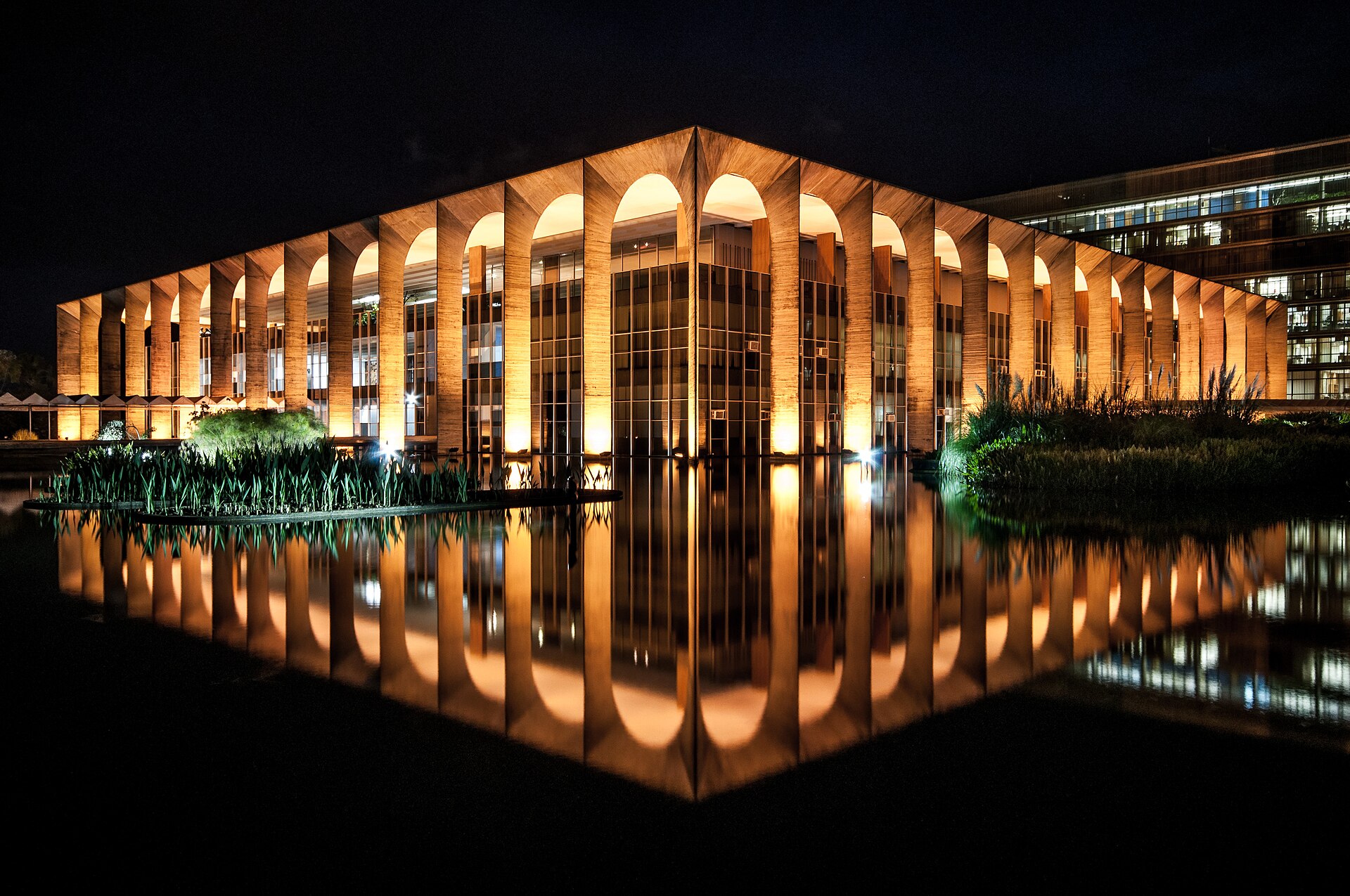
Europe’s Companies and the New Trade Deal
Taken together, European owners outweigh the Americans. The nine largest European owners hold about US$387 billion of equity, led by France, Spain and Germany.
German money is mostly in factories, at US$35.0 billion. Spanish owners lean towards finance, communications and electricity, while French stakes spread across mining and oil, finance and manufacturing.
One major European name is Stellantis, the maker of Fiat and Jeep. It says it sold more than 750,000 vehicles in Brazil in 2025, a 29.3% market share.
Its Brazilian plants are in Betim, Porto Real and Goiana, in the states of Minas Gerais, Rio de Janeiro and Pernambuco.
Norway’s stake is smaller, at US$15.5 billion, but 60% of it sits in oil, gas and mining. Equinor, the Norwegian energy group, operates the offshore Bacalhau field and calls Brazil a key area for growth.
Trade rules are changing too. The European Union and Mercosur, the South American trade bloc that includes Brazil, signed a partnership agreement on 17 January 2026.
The European Commission says an interim trade agreement has applied provisionally since 1 May 2026. It will give way to the full agreement once that is ratified.
Lenders, From the IMF to the BRICS Bank
Brazil has had 16 lending arrangements with the International Monetary Fund since joining it in 1946. In December 2005 it announced it would repay its entire IMF debt early, about US$15.46 billion.
The Fund’s role today is a regular health check of the economy, known as an Article IV review. The last one listed on its Brazil page was concluded by its board on 14 July 2025.
The World Bank’s main lending arm, the IBRD, manages 64 projects in Brazil worth US$13.66 billion. Its country page, updated on 6 October 2026, places them under a plan for fiscal years 2024 to 2028.
MIGA, the World Bank arm that insures investors against political risk, had US$1.7 billion of exposure in Brazil as of September 2026.
The New Development Bank, set up by the BRICS countries in 2015, offers a non-Western option. Its president is Dilma Rousseff, who was twice elected president of Brazil.
The bank lists 139 approved projects worth US$42.9 billion across its members, according to its website in October 2026.
Aid Donors, NGOs and the Amazon Fund
The main channel for foreign green money is the Amazon Fund, set up by decree on 1 August 2008. It is run by BNDES, Brazil’s national development bank, and pays grants for forest protection.
By 30 May 2026 it had received 5.26 billion reais (about US$1.05 billion). Norway supplied 72% of that, followed by the United Kingdom with 10.6% and Germany with 7.4%.
The United States supplied 5.5% and has contracted US$53.5 million in total. Denmark, Switzerland, Ireland, the European Union, Japan and Petrobras gave smaller sums.
Donors want measurable results. The fund says falling deforestation in the Amazon must be demonstrated before new donations can be raised.
Conversions in this guide use the central bank’s PTAX selling rate of 7 October 2026, 4.99 reais per US dollar.
Foreign charities work under Brazilian rules. A foreign foundation or association needs government approval of its founding documents before opening a branch in Brazil.
Since 2000 the justice minister has decided those authorisations, under a decree that bars passing the task further down. International environmental groups such as WWF and Greenpeace work through Brazilian arms, WWF-Brasil and Greenpeace Brasil.
The Diaspora and What Investors Take Home
The flow of people runs mostly outward. The foreign ministry estimated that about 4.6 million Brazilians lived abroad in 2022, up 4% from 2021.
About 1.9 million of them lived in the United States, followed by Portugal, Paraguay, Britain and Japan. The consulates in New York, Boston, Miami, Lisbon and London alone covered more than 1.6 million people.
To serve them, Brazil ran 196 embassies and consulates with consular services, the ministry said in its August 2023 report.
Investors, for their part, come for returns. Foreign-owned companies earned US$72.6 billion in Brazil in 2025 and paid out US$55.1 billion, the central bank reported.
They also declared US$84.7 billion in dividends, more than they earned, after a 2025 tax law let firms defer payment until 2028. Unpaid dividends owed abroad rose to US$37.1 billion.
What It Means for US Readers
US investors hold the largest foreign stake in Brazil, about US$287 billion in company equity. Changes in Brazilian tax, dividend or currency rules therefore weigh on American balance sheets.
For US importers, the 25% tariff is the main new cost. Aircraft, certain pharmaceuticals, pig iron and unflavoured instant coffee are exempt, so checking the list matters.
Politics is the swing factor. Conservative senator Flávio Bolsonaro, son of former president Jair Bolsonaro, faces President Luiz Inácio Lula da Silva on Sunday, 25 October.
Flávio, of the conservative Liberal Party (PL), took 47.03% of valid votes in the first round on Sunday, 4 October. Lula, of the left-wing Workers’ Party (PT), took 45.16%, the electoral court reported.
The main actors are profiled in Brazil Politics Explained, Who Holds Power in 2026. More is on the Rio Times Brazil page.
What Prediction Markets Say
Polymarket runs a market on the size of the runoff win. At 8:49 a.m. ET on 8 October, bets priced a Flávio Bolsonaro win by 4 to 8 points at 40.0%.
A Flávio win by under 4 points stood at 34.0%, and by 8 to 12 points at 16.4%. A Lula win by under 4 points was at 11.5%.
The market had drawn about US$156,000 in bets since it opened on 5 October.
Over the previous 24 hours the under-4-points bracket fell about 15 points, while the 8-to-12 bracket rose about 14. In Polymarket’s separate winner market, Flávio stood at 84% and Lula at 15.5%.
Prediction markets · who wins the runoff
Implied chance of winning Brazil’s presidency on 25 October, from traders’ prices.
Polymarket
Flávio Bolsonaro 84% · Lula 15.5% (US$176 million traded)
Kalshi (regulated in the US by the CFTC)
Flávio Bolsonaro 84% · Lula 16%
As of 8 October, 10:00 am ET (15:00 Lisbon), updated every 20 minutes. Prices are bets, not polls, and can move fast.
Why we show this: prediction markets turn real-money bets into a live probability that moves within minutes of the news, which is why investors, campaigns and newsrooms in the United States now follow them closely. We show them next to polls and official results, never instead of them.
Why we show this: prediction markets turn real-money bets into a live probability that moves within minutes of the news, which is why investors, campaigns and newsrooms in the United States now follow them closely. We show them next to polls and official results, never instead of them.
What Is Not Known
The census does not say who stands behind the US$87.1 billion credited to Uruguay. It also leaves US$15.6 billion unallocated, because the final owners of investment funds are not reported.
The figures stop at the end of 2025, so they cannot show how the July 2026 tariff changed investment plans. How long the tariff will last is also not known.
Official estimates of Brazilians abroad after 2022 could not be checked against a primary document. The runoff result, and any policy shift that follows, will only be known after 25 October.
Frequently Asked Questions
Who is the biggest foreign investor in Brazil?
The United States, by a wide margin. US owners controlled US$287.2 billion of Brazilian company equity at the end of 2025, a quarter of the foreign total.
Is China or the United States more important to Brazil?
China is the bigger customer, buying 28.7% of Brazil’s goods exports in 2025. The United States is the bigger investor, with more than six times China’s equity stake.
What is Brazil’s relationship with the IMF?
Brazil announced in December 2005 that it would repay its entire IMF debt early, about US$15.46 billion. Today the Fund mainly reviews the economy, most recently in July 2025.
What is the Amazon Fund?
It is a fund run by BNDES, Brazil’s national development bank, that turns foreign donations into forest-protection grants. Norway has supplied 72% of the money received.
Can foreign troops be stationed in Brazil?
Only temporarily. A 1997 law lets the president approve training, official visits, repairs and rescues, while any other stay needs approval from Congress.
How many Brazilians live in the United States?
About 1.9 million, on the foreign ministry’s estimate for 2022. That was roughly two in five of the 4.6 million Brazilians it counted abroad.
What does the 25% US tariff cover?
It applies to Brazilian goods entering the United States since 22 July 2026, minus listed exemptions. Civil aircraft and parts, certain pharmaceuticals, pig iron and unflavoured instant coffee are among them.
Sources: Banco Central do Brasil, Census of Foreign Capital, direct investment position tables (base year 2025); Banco Central do Brasil, external sector press note, 28 September 2026; Banco Central do Brasil, box on trade with the US and China (June 2025); Banco Central do Brasil, PTAX rate of 7 October 2026; Ministry of Development, Industry, Trade and Services, Comex Stat; IBGE, population estimate 2026; World Bank, GDP data 2025; US Census Bureau, trade in goods with Brazil; USTR, Section 301 action on Brazil, 15 July 2026; Federal Register, notice of action, 20 July 2026; US Embassy and Consulates in Brazil; US State Department, relations with Brazil; Complementary Law 90 of 1997 on foreign forces; Decree 10,220 of 2020, Alcântara technology safeguards agreement; Decree-Law 4,657 of 1942, Article 11; Decree 3,441 of 2000; European Commission, EU-Mercosur; IMF, Brazil country page; IMF, press release 05/275; World Bank, Brazil overview; New Development Bank, president; New Development Bank, about; Amazon Fund (BNDES), donations; Decree 6,527 of 2008 creating the Amazon Fund; Ministry of Foreign Affairs, Comunidades Brasileiras no Exterior, base year 2022 (August 2023); Petrobras, Form 6-K on China Development Bank loan, 4 November 2009; Petrobras, Form 6-K, 26 February 2016; BYD Brasil, Camaçari factory; Stellantis, 2025 sales release; Equinor, Brazil; Superior Electoral Court (TSE), first-round result; Constitution of Brazil, Article 77 (all accessed 8 October 2026).
This article was produced by The Rio Times’ automated newsroom system. How we use AI · Report an error · Editorial responsibility: Matthias Camenzind, Editor-in-Chief