
ECONOMY · ARGENTINA
Key Facts
- —The country Argentina, whose government is seeking hard currency to strengthen its fiscal and financial position, according to the Economy Ministry.
- —What happened On 2 October 2026 Economy Minister Luis Caputo announced in Paris a citizenship by investment programme, opening to applications in the fourth quarter of 2026.
- —The numbers US$350,000 as a non-refundable gift to the Treasury, or a US$800,000 purpose-made government bond. A couple with two minor children pays US$500,000 in total (Economy Ministry, 2 October).
- —What it means for you Foreign investors gain a passport route with no residence requirement. Applicants face checks by intelligence, financial and security agencies before any approval.
- —Still open Whether a 30 June 2026 Electoral Chamber ruling, which barred the government from handing citizenship decisions to the migration office by decree, will block the final approval step.
Argentina citizenship by investment now has a price list. Economy Minister Luis Caputo said on Friday that foreigners can buy a passport for US$350,000 paid straight to the Treasury.
He made the announcement in Paris on 2 October, alongside Cabinet Chief Diego Santilli, on the last day of the government’s Argentina Week investor event. Applications are due to open during the fourth quarter of 2026.
Two ways to pay, and a family rate
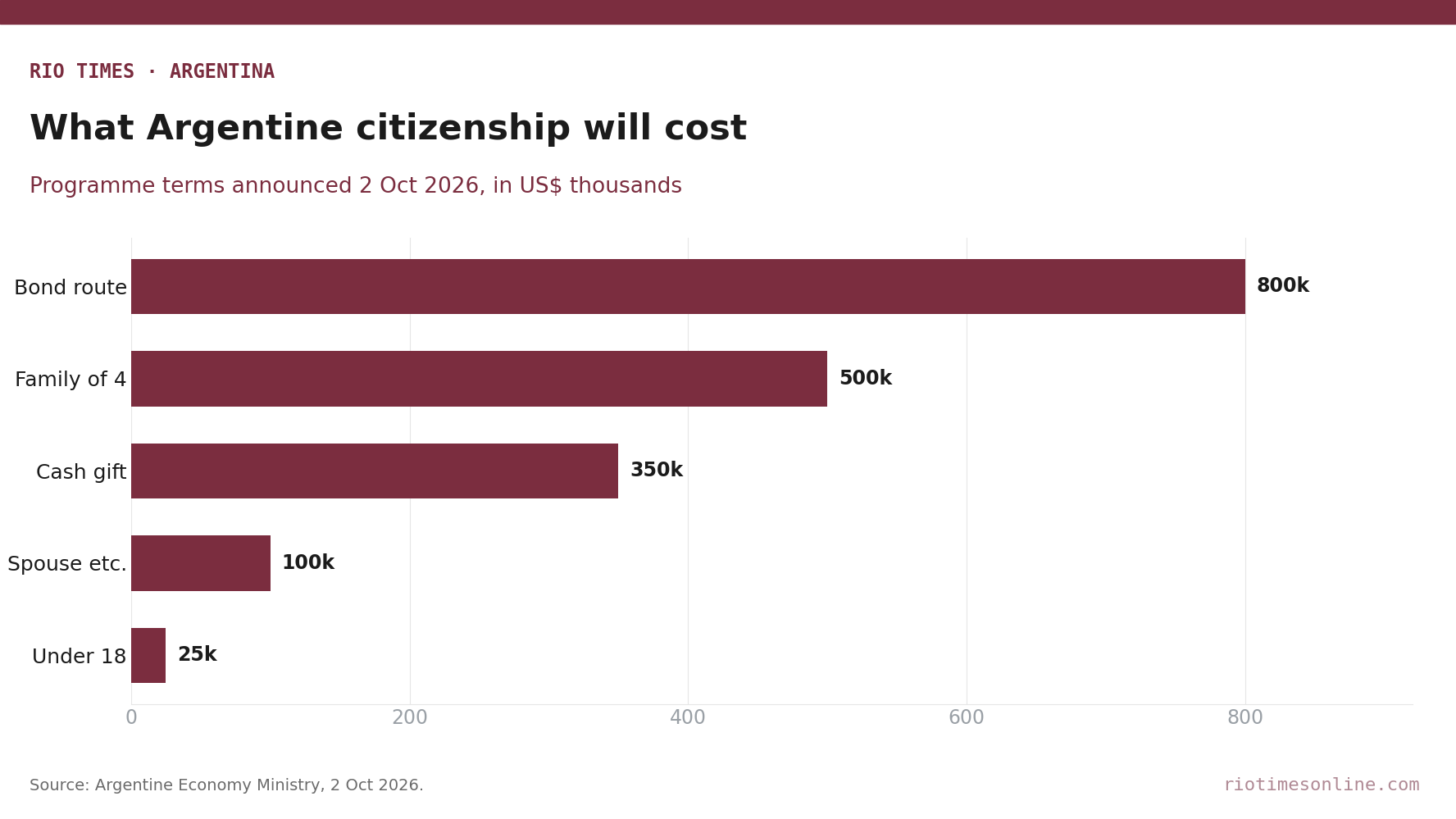
The ministry’s statement sets two routes for the main applicant. One is a direct, non-refundable payment of US$350,000 to the Treasury; the other is buying a US$800,000 government bond created for the scheme.
Spouses and unmarried children aged 18 to 25 without children of their own pay US$100,000 each. Children under 18 cost US$25,000, so a couple with two minors pays US$500,000.
All money must move through the formal banking system and meet anti-money-laundering rules. The ministry says the proceeds will go towards strengthening Argentina’s fiscal and financial position.
Who checks the applicants
A dedicated body, the Agency for Citizenship by Investment Programmes, will lead the review. The State Intelligence Secretariat (SIDE), the financial intelligence unit (UIF) and the security and interior ministries take part.
Checks cover identity, the origin of the funds, criminal and reputational records and migration history. The agency then sends a recommendation to the National Migration Directorate, which approves or rejects each case.
The ministry says the screening follows standards of the OECD, the rich-country policy club, and the Financial Action Task Force. It did not name the international advisory firms it says are helping it.
The legal question over who decides
The route itself is not new. Decree 524/2025, published in the Official Gazette on 31 July 2025, let foreigners naturalise after a “relevant investment” regardless of residence time.
That built on Decree 366/2025, an emergency decree that rewrote the citizenship law and moved naturalisation from federal judges to the migration office. On 30 June 2026 the National Electoral Chamber annulled that decree.
Infobae and Perfil reported that the court found the change breached Article 99 of the Constitution, which bars presidents from legislating on electoral matters by decree. Citizenship, the judges said, opens the door to political rights such as voting.
Friday’s plan still names the migration office as the body that grants approval. The ministry statement did not address the ruling, and no new decree for the programme had been published by Friday afternoon.
Why the government wants it
Caputo presented the scheme as part of a drive to draw foreign capital, during a Paris trip that also produced energy pledges. Milei’s visit included TotalEnergies plans for nearly US$10 billion in Argentine oil and gas.
Supporters see a fresh source of dollars that adds no debt in the cash route. Critics, in coverage such as Sitio Andino’s, note that the payments carry no duty to invest locally or create jobs.
Foreigners seeking to live in the country rather than buy a passport have other options. A separate guide on how to get residency in Argentina in 2026 sets out the routes and fees.
What Is Not Yet Known
For Argentina citizenship by investment, the ministry set no opening date beyond the fourth quarter and no revenue target. It gave no terms for the US$800,000 bond, nor how many passports it expects to issue.
The government is contesting the June ruling. La Nación reported on 1 July that it would appeal to the Supreme Court.
The weekly Semanario Nuestra Gente reported on 22 July that the appeal had been filed. No Supreme Court ruling had been reported by Friday afternoon.
Sources: Argentine Economy Ministry statement, 2 October 2026; El Cronista, 2 October 2026; Diario de Cuyo, 1 August 2025; Official Gazette, Decree 524/2025, 31 July 2025; Sitio Andino, 2 October 2026; Infobae, 30 June 2026; Perfil, 30 June 2026; La Nación, 1 July 2026; Semanario Nuestra Gente, 22 July 2026.
More: Argentina news in English, every day from The Rio Times.
In depth
This article was produced by The Rio Times’ automated AI newsroom. Editorial responsibility: Matthias Camenzind, Publisher and Editor-in-Chief. The Rio Times also runs Ask Rio Times, which answers from 100,000+ of our own articles, the daily Latin America Power Map, and prediction-market odds on elections and markets.. How we use AI · Report an error
LatAm Markets: Live Signals → — real-time movers, turnover leaders and FX across Latin America.