Argentina’s Caputo Denies Recession, Says Economy Is ‘Growing Less’ After July Drop

ECONOMY · ARGENTINA
Key Facts
- —The country Argentina, South America’s second-largest economy, has cut inflation sharply under President Javier Milei. Consumer prices rose 1.7 percent in August 2026, INDEC data show.
- —What happened In a Clarín interview from Paris published on Saturday 3 October, Economy Minister Luis Caputo said Argentina is “growing less than before”, and is “far” from recession.
- —The numbers INDEC reported on 24 September that activity fell 2.9 percent in July from June, seasonally adjusted. Its smoother trend-cycle measure still rose 0.2 percent.
- —What it means for you Slower growth shows up first in shops, factories and hiring. Easing inflation and a steady peso remain the government’s main gains for households.
- —Still open Whether August and September recover. INDEC publishes August activity on Wednesday 21 October; third-quarter GDP, which settles the recession question, follows in December.
Argentina’s economy is growing more slowly, not shrinking, Economy Minister Luis Caputo said in a Clarín interview from Paris published on Saturday 3 October. Caputo denies recession even though official data showed activity falling 2.9 percent in July, the largest monthly drop of 2026.
He spoke to reporters, including from the Buenos Aires daily Clarín, as the government’s Argentina Week investor event in Paris closed. The national outlet Perfil carried his remarks again on Sunday.
What Caputo Said in Paris
“We are now growing at a trend-cycle rate of 0.2 percent a month, which is lower than before,” Caputo told Clarín. “But that is different from saying we are in recession, far from it.”
He blamed “the international shocks and the political issue”. By the second, he meant investors’ fear that kirchnerismo, the movement of former president Cristina Fernández de Kirchner, could return.
“When you invest long term and are not 100 percent sure, investments stall,” he said. He added that August and September “seem to be coming in better”, pointing to stronger September tax revenue.
What the Official Data Show
INDEC, the national statistics institute, reported on 24 September that activity fell 2.9 percent in July after seasonal adjustment. It was 1.4 percent below July 2025, as reported in Argentina Economic Activity Falls 2.9% in July, Worst Month Since 2020.
The same report shows the trend-cycle, a smoothed series that filters out monthly noise, rising 0.2 percent in every month of 2026. From January to July, activity was 1.7 percent above the same period of 2025.
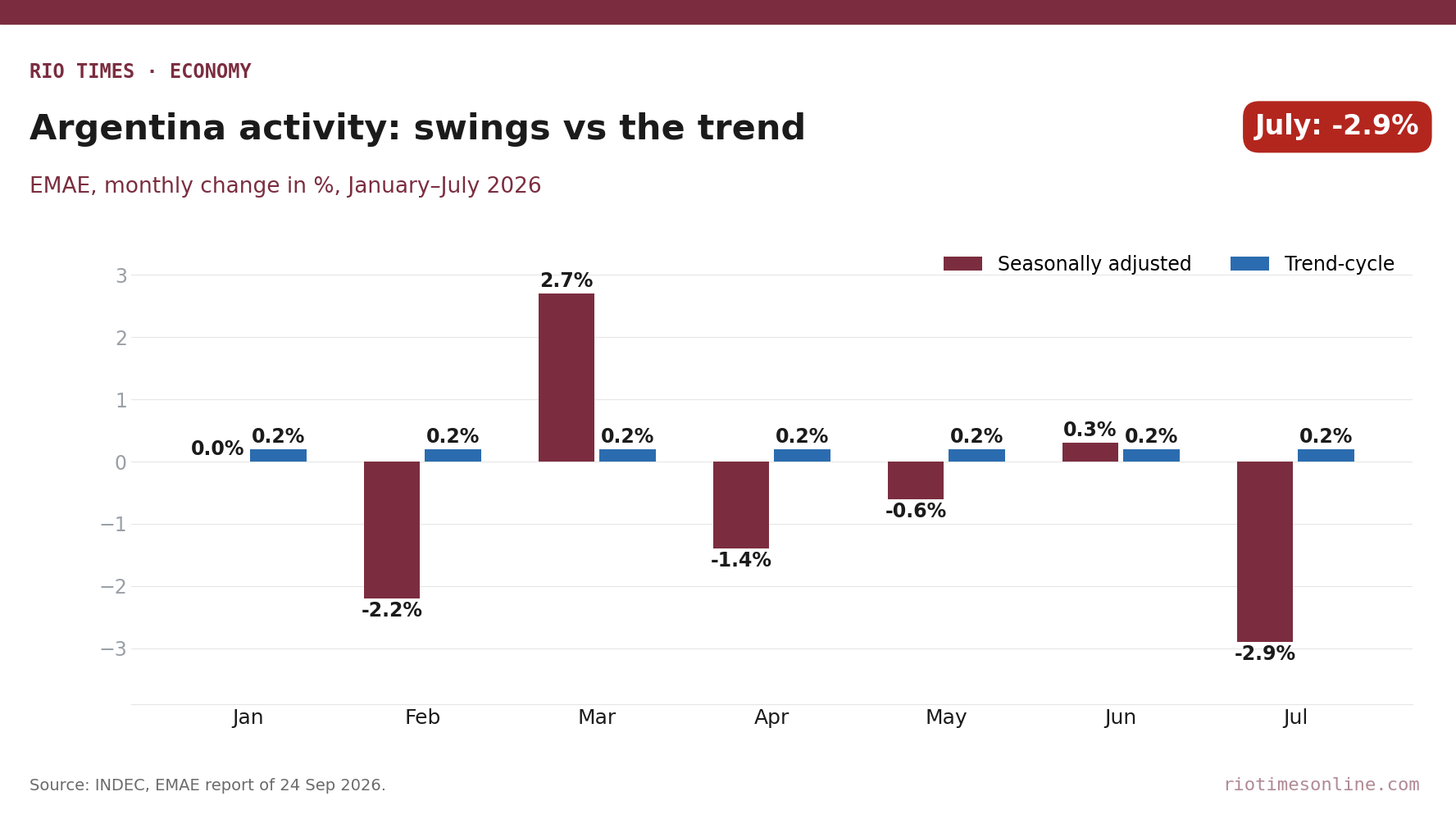
The adjusted series fell in four of the first seven months: February, April, May and July. March brought the strongest gain, 2.7 percent.
Why Caputo Denies Recession Despite the July Fall
Caputo argued that the adjusted index shows volatility “that is not reasonable” and that “obviously there is a measurement issue”. The ministry tracks the trend-cycle instead, which he said has shown growth for 29 months.
Private forecasters are less upbeat. JPMorgan now expects a third-quarter contraction, as reported in Argentina Slides Toward Recession as JP Morgan Cuts 2026 Growth to 1.5%.
Official figures show GDP shrank 0.6 percent in the second quarter. Another fall in the third would meet the usual definition of a technical recession: two straight quarters of contraction.
Economist Marina Dal Poggetto says a tightly held peso is slowing growth, in Argentina Getting Pricey in Dollars, Dal Poggetto Says. On the other side of the ledger, inflation keeps easing.
Caputo also noted that country risk, the extra yield investors demand on Argentine bonds, stands near 600 points. He said it once reached 2,500 to 3,000, though it had fallen as low as 400 to 450.
Milei’s Bet on 2028, Not on This October
President Javier Milei has asked for patience and promised strong growth from 2028 if re-elected, El Día of La Plata reported. The paper called it the government’s electoral bet.
Argentina holds no national vote this October. Its midterm elections took place in October 2025, and the next presidential election is due in 2027.
El Día, citing an Infobae analysis, said next year’s priority is containing pressure on the peso and slowing inflation further. Caputo said work on 9,000 kilometres of road concessions and new mortgage lending should support activity from October.
What Is Not Yet Known
INDEC publishes its August activity estimate on Wednesday 21 October, the first official test of Caputo’s claim. The third-quarter GDP figure, which settles the technical recession question, is not due until December.
Caputo gave no figures for August or September. It is also unclear whether July will be revised, as June was cut to 0.3 percent from an initial 0.8 percent.
Is Argentina in a recession?
Not officially. Activity fell 2.9 percent in July and GDP shrank 0.6 percent in the second quarter. A third-quarter fall, due to be reported in December, would meet the technical definition.
What did Caputo say about the economy?
In a Clarín interview from Paris published on 3 October, Luis Caputo said the economy grows at a trend rate of 0.2 percent a month. He called that growing less than before, and far from recession.
Does Argentina have an election this October?
No. Argentina held midterm elections in October 2025, and the next presidential vote is due in 2027. Milei is promising strong growth from 2028 if re-elected.
Sources: Clarín, interview with Luis Caputo, 3 Oct 2026 · Perfil, 4 Oct 2026 · El Día, 4 Oct 2026 · INDEC, EMAE July 2026, 24 Sep 2026
This article was produced by The Rio Times’ automated newsroom system. How we use AI · Report an error · Editorial responsibility: Matthias Camenzind, Editor-in-Chief
In depth
LatAm Markets: Live Signals → — real-time movers, turnover leaders and FX across Latin America.