Zinc Miners Sink as Wall Street Rout Hits Metals
Key Facts
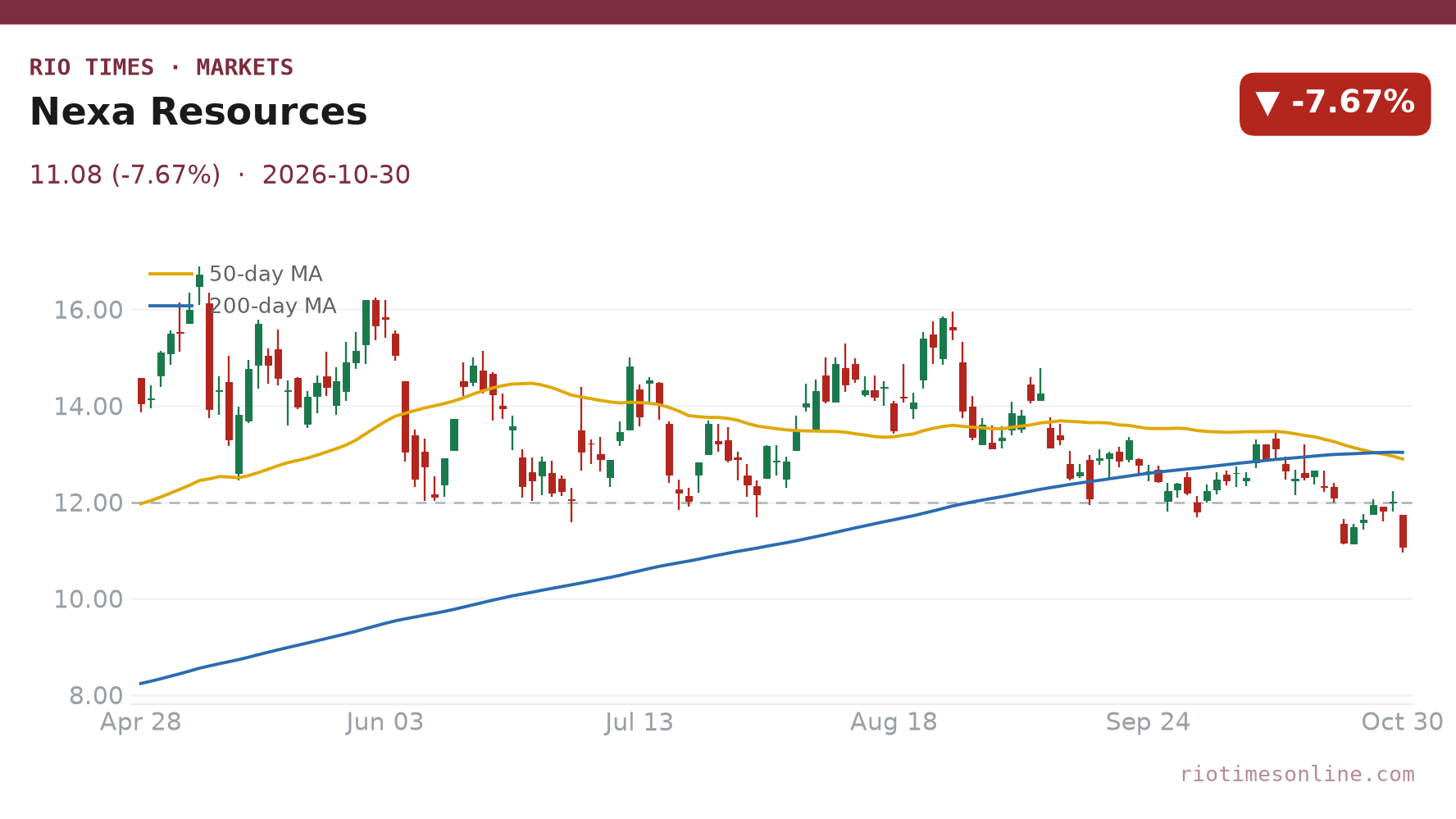
- Nexa Resources fell 7.67%. The Peru and Brazil zinc miner closed at US$11.08, its lowest finish in at least six months.
- Buenaventura lost 4.24%. The Peruvian miner closed at US$26.42, 39.5% below its 27 February peak, after quarterly results.
- London zinc barely moved. The three-month price on the London Metal Exchange stayed within about 1% of US$3,870 a tonne.
- Wall Street led the fall. The S&P 500 (US stock index) dropped 1.82% and gold fell 2.00%, hitting miners.
- Nexa’s profit hid a loss. Adjusted EBITDA (operating earnings) rose 62% to US$301 million, yet a non-cash charge left a US$47 million loss.
- The zinc squeeze is not over. Available London stocks fell 14% in a week, and cash zinc trades US$106 a tonne above the three-month price.
Today’s Focus
Friday’s sell-off in zinc shares was about the stock market and company news, not about the metal itself. Nexa Resources, which mines zinc in Peru and Brazil, fell 7.67% to US$11.08, while Buenaventura, Peru’s gold-and-silver miner, lost 4.24% to US$26.42.
The trigger was a rout on Wall Street, where the S&P 500 fell 1.82% after results and AI-spending plans from chipmaker Intel and online retailer Amazon. Metals were dragged along: gold dropped 2.00% to US$3,928 an ounce, and London zinc stayed within about 1% of US$3,870 a tonne.
Both miners also had their own news. Nexa reported a net loss of US$47 million after a non-cash charge even though adjusted EBITDA rose 62% to US$301 million, and the Peruvian gold-and-silver miner lifted profit 50% to US$268.4 million but reported lower silver and gold output.
For US investors, the lesson is that these shares trade as risk assets first and zinc proxies second. The physical zinc market stayed tight, with available London stocks down 14% in a week, so the metal moved far less than the shares.
What matters today. Zinc shares fell far harder than zinc itself, which tells you the cause was the equity sell-off and company results rather than a collapse in demand for the metal.
01 The Session in One Read
Zinc miners had a hard day on Friday 30 October as a global sell-off reached the metals market. Nexa Resources fell 7.67% to US$11.08 and Buenaventura fell 4.24% to US$26.42, both their lowest closes in at least six months.
Nexa is now 33.7% below its 12-month high of US$16.72 set on 6 May, and it has fallen 22.5% over 60 sessions. The Peruvian miner is 39.5% below its 27 February peak of US$43.67 and has lost 15.83% in 20 sessions.
The metal held up better, with London three-month zinc staying within about 1% of US$3,870 a tonne. That gap between a small move in the metal and a large move in the shares is the story of the day.
We rank the causes by weight: the Wall Street rout (HIGH confidence), weaker gold for Buenaventura (HIGH) and Nexa’s loss and higher spending plans (MEDIUM, because the timing matches but investors gave no explanation). The metal itself explains very little of the fall.
The variable to watch is whether London zinc holds above US$3,800 a tonne. If it does, the miners’ fall is a sentiment event that can reverse; if not, the metal itself is turning.
02 The Board
Nexa Resources settled at US$11.08 and Buenaventura at US$26.42, and neither stock is a pure play on the metal. Nexa mines zinc in Peru and Brazil, while Buenaventura earns most of its money from gold, silver and copper.
The backdrop was uniformly weak: the S&P 500 closed at 7,580, down 1.82%, and the US dollar index was steady at 101.96, so currency was not the cause. The 10-year Treasury yield stayed at 4.93%, down 7 basis points (hundredths of a percentage point) over five sessions, which rules out a bond-market shock.
| Asset | Level | Change |
|---|---|---|
| Nexa Resources | US$11.08 | -7.67% |
| Buenaventura | US$26.42 | -4.24% |
Source: RT close, 2026-10-30. Where a commodity has no spot feed, an exchange-traded tracker or leading producer is shown as a labelled proxy.
Live Market IntelligenceThe live market board
Rio Times · Live Market Intelligence
Latin America — Cross-Market Board
| Instrument | Last | Change | YoY | Prev. | High | Low | Volume |
|---|---|---|---|---|---|---|---|
| IBOV | 167,921.80 | -0.75% | +19.56% | 169,186.42 | 178,526 | 175,157 | — |
| IPSA | 10,253.96 | -2.76% | — | 10,545.26 | 10,722 | 10,633 | — |
| IPC MEX | 69,705.03 | -0.12% | +12.74% | 69,787.41 | 70,008 | 69,383 | 49,372,306 |
| MERVAL | 92,079 | -2.59% | +12.65% | 2,859,051 | — | — | — |
| COLCAP | 2,490.92 | +0.04% | — | — | — | — | — |
| USD/BRL | 5.34 | -1.32% | -0.84% | 5.42 | 5.42 | 5.30 | — |
| EUR/BRL | 5.95 | +7.53% | -4.87% | 5.54 | 6.04 | 5.92 | — |
| USD/MXN | 18.69 | +0.62% | +1.45% | 18.57 | 18.69 | 18.54 | — |
| USD/CLP | 983.47 | -0.57% | +5.64% | 989.13 | 991.87 | 979.07 | — |
| USD/COP | 3,149 | +3.06% | -18.02% | 3,056 | 3,173 | 3,111 | — |
| USD/PEN | 3.45 | +0.17% | +3.85% | 3.44 | 3.45 | 3.44 | — |
| USD/ARS | 1,537 | -0.28% | +3.77% | 1,541 | 1,541 | 1,537 | — |
| USD/UYU | 40.21 | +3.57% | +2.29% | 38.83 | 40.21 | 40.08 | — |
| USD/PYG | 5,803 | +3.78% | -16.54% | 5,592 | 5,803 | 5,735 | — |
| USD/BOB | 11.97 | +4.93% | +77.92% | 11.41 | 11.97 | 11.82 | — |
| USD/DOP | 60.54 | +1.83% | -4.34% | 59.45 | 61.14 | 59.85 | — |
| USD/CRC | 451.24 | +2.13% | -7.80% | 441.83 | 451.40 | 450.04 | — |
| USD/GTQ | 7.64 | +3.23% | +2.18% | 7.40 | 7.64 | 7.64 | — |
03 Why Zinc Miners Fell on Friday
The biggest cause was the stock-market rout, because investors sold risk after Intel and Amazon updated their results and AI-spending plans. The S&P 500 fell 1.82%, its worst day since June, and the VIX fear gauge jumped 12.91% to 19.42 as traders paid up for protection.
Gold added to the pressure on the Peruvian miner, since gold fell 2.00% to US$3,928 an ounce and the gold fund GLD lost 3.47%. Because it earns most of its revenue from gold and silver, a weaker gold price hurts its earnings more than zinc helps them.
Company news explains why Nexa fell harder than its Peruvian peer. Its third-quarter report showed revenue up 23% to US$937 million and adjusted EBITDA up 62% to US$301 million, but also a net loss of US$47 million from a non-cash charge, a 10% rise in 2026 capital-spending guidance to US$420 million and an unplanned September stoppage at its Juiz de Fora roaster, a zinc-processing plant in Brazil.
The Peruvian miner reported on Thursday that third-quarter profit rose 50% to US$268.4 million, yet direct silver output fell 21% and gold output 6% from a year earlier. Strong profit did not protect the shares because investors were selling the whole sector, so we put MEDIUM confidence on the company-news explanation and HIGH confidence on the market-wide one.
04 The Trend Behind It
This is a continuation, not a new phase, for both shares. Over 20 sessions the zinc producer is down 9.48% and the Peruvian miner is down 15.83%, and the Peruvian miner has now closed lower three sessions in a row.
Our own price history gives a base rate: after a 20-session fall of 9.5%, the zinc producer was higher 20 sessions later in 22 of 51 earlier cases (43%), with a median change of minus 1.9%. After a 20-session fall of 15.8%, the Peruvian miner was higher in 27 of 51 cases (53%), and history is not a forecast.
The metal tells a calmer story: London available stocks fell 14% in a week, and the cash premium over the three-month price widened to US$106 a tonne (the extra paid for immediate delivery) from US$45. Tight stocks like these usually support the zinc price even when miners’ shares fall.
05 What It Means for Latin America
For Peru, the world’s second-largest zinc producer, and for Mexico and Bolivia, the metal price matters more than the share price: it sets mining royalties and tax receipts, and it held near US$3,870 a tonne. The shares’ fall hurts investors and pension funds, but it does not cut government revenue.
For Nexa, with mines in Peru and Brazil, the risk is cost and cash rather than price, because US$420 million of capital spending and a net loss narrow its room for error. For Buenaventura, the gold price decides more than zinc does, so a weaker gold market hurts Peruvian producers more than a softer zinc market.
For US readers, the practical meaning is that these New York-listed shares move with the Nasdaq and with gold before they move with zinc. Anyone using them as a zinc bet should expect days like this one, when a share falls 7.67% and the metal falls about 1%.
06 The Names to Watch
Nexa Resources is the cleanest listed zinc proxy for US investors, and it now trades at US$11.08. The next test is whether it can hold US$11, the round number it closed just above.
At US$26.42, the Peruvian miner sits 24.9% above its 12-month low of US$21.16 set on 4 November 2025. A close below US$25 would extend the slide and bring that low into view.
Beyond the shares, the London stock level and the cash premium are the numbers to follow. They show whether the physical squeeze is easing or tightening.
07 What Would End It
The selling in miners should ease once the Wall Street sell-off stops, which depends on the next US earnings and data. The US jobs report on Friday 6 November is the next big test of appetite for risk.
In the metal, support sits at the US$3,800 round number and resistance sits near US$3,900, so a close above it would restart the squeeze rally. A fall below US$3,800 would show the tightness is easing.
The honest answer is that the fall will probably stop when equities steady, but a second leg down is possible if gold keeps sliding. Chinese factory data for October and new mine supply would change the physical picture.
08 What to watch
- London stocks and cash premium: With available stocks down 14% in a week and the cash premium at US$106 a tonne, a rise in stocks or a premium below US$50 would show the squeeze easing.
- Gold at US$3,928: A further fall would keep pressure on Buenaventura, while a rebound would relieve it.
- US jobs report, 6 November: A strong or weak reading will set the tone for risk assets and for miners’ shares.
- Nexa at US$11: Holding the round number would mark a floor, while a close below it would put the next low in view.
Frequently Asked Questions
Why did zinc miners fall on Friday?
A Wall Street sell-off hit risk assets and gold fell 2.00%. Nexa also reported a net loss despite higher EBITDA.
Did the zinc price crash?
No, London zinc stayed within about 1% of US$3,870 a tonne. Stocks of available metal remain low, which supports the price.
Why did Nexa fall more than Buenaventura?
Nexa reported a US$47 million loss and higher spending plans, which hit a company that depends on zinc. The Peruvian miner earns mostly from gold and silver and reported a 50% profit rise.
Does this affect Latin America?
Peru, Bolivia and Mexico earn royalties on the metal price, which held up. The shares’ fall hits investors more than government budgets.
Market data: The Rio Times
This article was produced by The Rio Times’ automated newsroom system. How we use AI · Report an error · Editorial responsibility: Matthias Camenzind, Editor-in-Chief
LatAm Markets: Live Signals → — real-time movers, turnover leaders and FX across Latin America.