The mining issue that puts President Petro on the ropes in Colombia
Since March 2, the informal mining sector has been on strike, demanding the Colombian government legalize their activities.
President Gustavo Petro traveled to the area and proposed a series of solutions to counteract the dominance of the Clan del Golfo (Gulf Clan) in the region.
To understand the mining strike in Bajo Cauca Antioquia (northeast), which generated critical situations such as the burning of at least six vehicles on March 19 and, incidentally, the annoyance of President Gustavo Petro with the Clan del Golfo, a group outside the law which the president blamed for these actions, it is necessary to understand the context of the area, its water wealth and, therefore, the ease of extracting gold from the water.
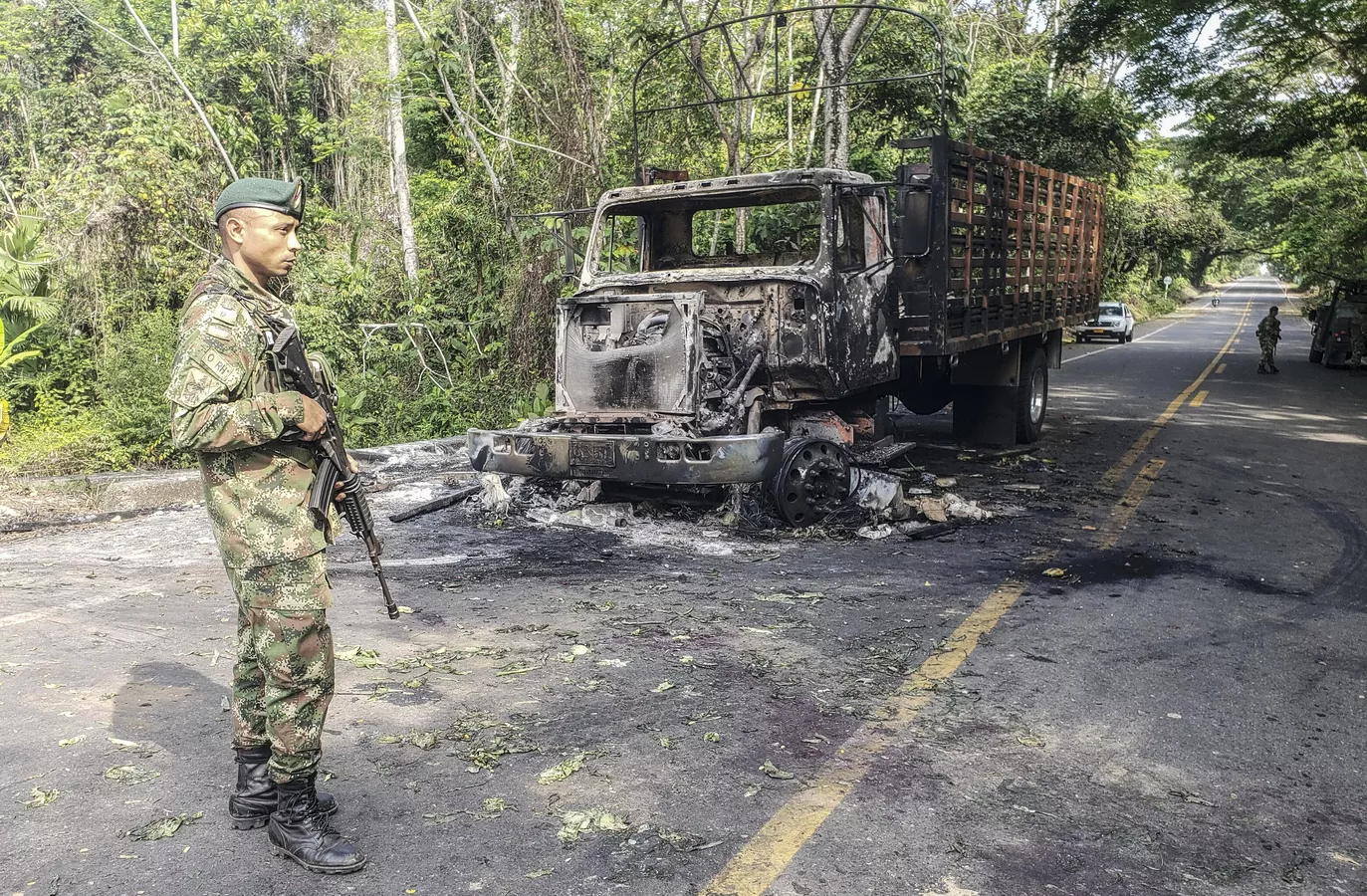
Although a census has never been carried out, it is estimated that a large part of the population of the six municipalities that make up this region – Caucasia, El Bagre, Nechí, Cáceres, Zaragoza, and Tarazá – lives from informal mining.
Criminal groups have taken advantage of it to exert pressure on the inhabitants.
This is reiterated by the social leader of Tarazá, Carlos Andrés Areiza, who spoke to Sputnik to give an overview of what is happening.
“We are a mining sub-region by vocation. And as the business grew, big machines appeared to make the extraction process easier.”
“This happened because when there is no defined economy, due to the absence of the State, people have to dedicate themselves to what there is. And here, there is gold,” Areiza points out.
Hence the anger of the informal miners on March 2 when the government destroyed five large dredges, claiming that, in addition to causing damage to the environment out of proportion – the Antioquia government speaks of between 10 and 15,000 hectares of nature – they were being controlled for illegal mining by the Gulf Clan.
This clan is a residual structure of the former United Self-Defense Forces of Colombia, the largest paramilitary group in the country’s history, which demobilized in 2006 in the middle of Alvaro Uribe Velez’s government.
“At the beginning, it was a peaceful protest, but bad messages from the authorities generated the chaos we are experiencing: burned buses, incinerated food trucks, and families, who have nothing to do with mining, without food”, adds Areiza.
Although Petro’s administration has repeatedly said that these actions are the responsibility of the Clan of the Gulf, and that is why it suspended the bilateral ceasefire with this organization, Areiza assures that in the area, it is not only this structure that can be talked about, as there is also the National Liberation Army (ELN) and dissidents of the Revolutionary Armed Forces of Colombia (FARC).
“The people are not to blame. The panorama is as follows: if you are a small miner or merchant, you have to pay a fee to the violent people to work. If you don’t, they don’t let you do your work and even threaten your family. That’s how life is here, with them permeating everything,” he denounces.
“And that is the State’s fault for being an absent State. The fact that the illegal groups profit from this activity does not mean that all the miners are part of their ranks.
The social leader emphasizes that if in Tarazá the economy revolves around gold extraction, it is because there are no job opportunities for the community, beyond the positions in the mayor’s office, in the only hospital, and commerce.
“It can be said that 80% of the population depends on mining, from the small miner who goes to the river basin to wash the land to get what he can for the day to the owners of the grocery stores. That is why people are so upset and why they are calling on the government to structure this activity”, Areiza explains.
Regarding the environmental crisis in the territory, the community leader believes that the solution is control over the area and production, understanding control as regulation. In this way, small, medium, and large-scale miners can be required to develop plans to reforest near the riverbanks.
“Legalize, have databases, and understand the dynamics. This will allow co-responsibility and help to end criminals’ dominance.”
PETRO RESPONDS TO BAJO CAUCA MINERS
On March 20, President Gustavo Petro traveled to the region to hold a Security Council to evaluate the situation in Bajo Cauca.
After hours of meeting, the president emphasized that the work done by the authorities is not against small-scale miners but against those who have other interests and take advantage of the population to achieve their goals.
“They destroy the land in a dreadful way and use this activity to launder drug money,” Petro accused.
Likewise, the president made it clear that the security work against the Clan del Golfo will continue and that the Armed Forces already have clear indications not to allow this group to manipulate the needs of the mining population.
“The Public Forces have the order to take over the territory and not to abandon it”.
It should be recalled that after the suspension of the bilateral ceasefire, W Radio picked up a communiqué from the Clan del Golfo in which it denies being behind the disturbances in the area, for which it blames the ELN, a guerrilla group active in Colombia.
For now, the first decision taken by the executive branch is to legalize the machinery in the region and construct a mining district with the help of the State.
“It is what we have been asking for. Hopefully, it will be fulfilled,” Areiza concludes.
With information from Sputnik
More: Colombia news in English, every day from The Rio Times.
Read More from The Rio Times