
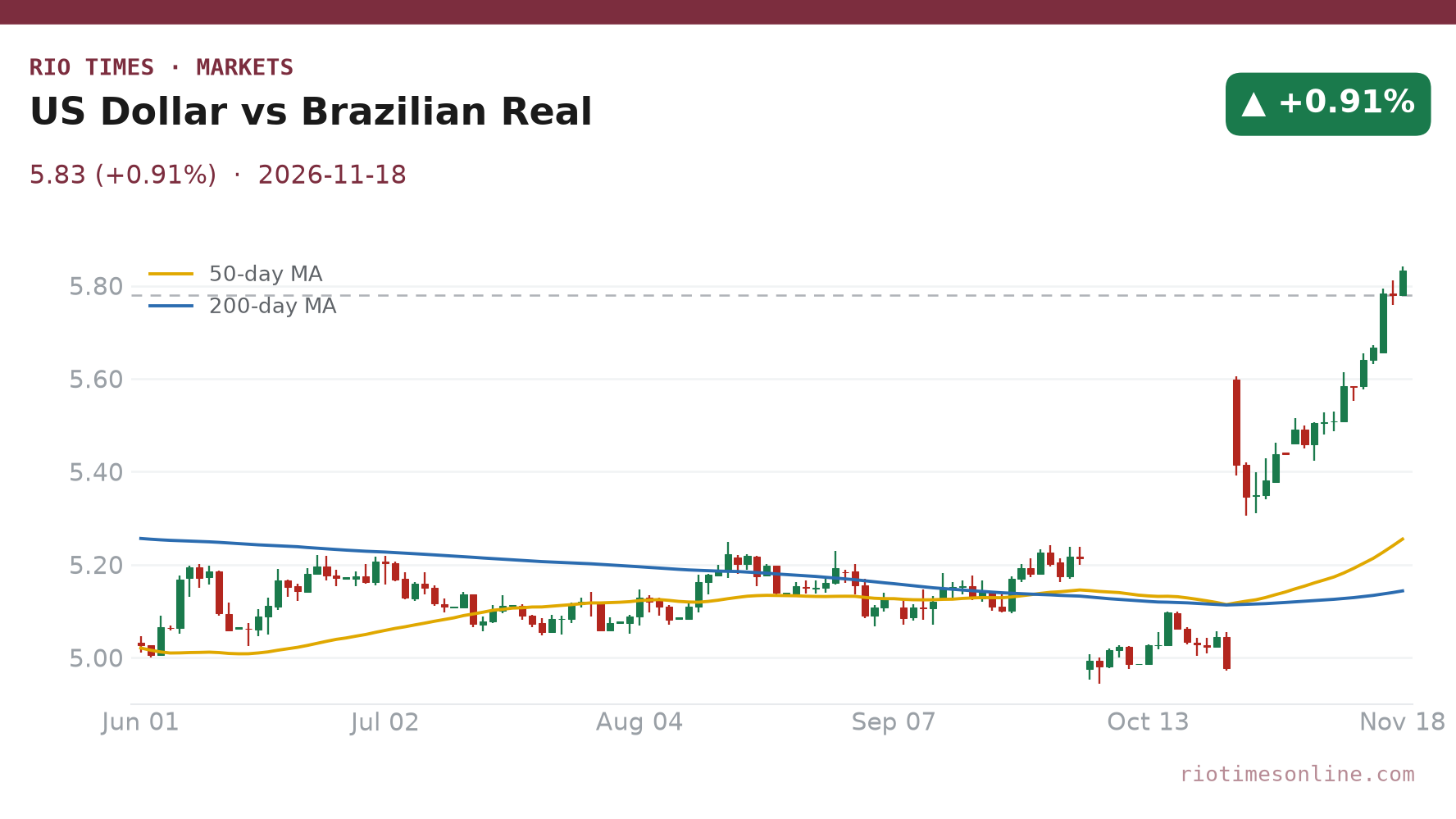
Brazil’s Senate finished a spending-curbs bill on Wednesday 18 November 2026, approving it by 69 votes to 2 and sending it to the Chamber of Deputies, the lower house of Congress. The government estimates the package would improve the 2027 budget result by R$45.1 billion to R$56.1 billion (about US$7.8 billion to US$9.7 billion at R$5.78 per US dollar, the 17 November close), according to Agência Senado, the Senate’s news service.
For US holders of Brazilian bonds and the real, the bill matters because the budget path feeds into interest rates and the currency.
Key Facts
- Final vote. The Senate approved the bill 69 to 2 on 18 November; the Chamber of Deputies votes next.
- Gain. The government expects R$45.1 billion to R$56.1 billion (US$7.8 billion to US$9.7 billion) in 2027.
- Dollar flows. A net US$1.293 billion entered Brazil from 9 to 13 November, central bank data show.
- Prediction markets. Polymarket, a prediction market, prices no December Selic change at 83.5% (19 Nov, 1:20 a.m. ET).
- Power Index. Brazil ranks 1st of 14 in The Rio Times Latin America Power Index, with 74.2 points (November 2026 edition).
Brazil’s Senate sent its spending-curbs bill to the lower house on Wednesday 18 November 2026, while the real kept sliding against the dollar.
In Plain English
- Destaque: A request in the Senate to vote one part of a bill separately, which can strip that part out.
- Chamber of Deputies: The lower house of Brazil’s Congress, which must also approve the bill.
- Lei Kandir: A law under which the federal government compensates states for exempting exports from a state sales tax.
- Selic and Copom: The Selic is Brazil’s benchmark interest rate, and Copom is the central bank committee that sets it.
How the Senate Finished the Spending Curbs Bill
Brazil’s Senate approved the bill in a final round on Wednesday 18 November 2026 by 69 votes to 2, according to Agência Senado, the chamber’s news service. The text now goes to the Chamber of Deputies.
Before that vote, senators dealt with four destaques, requests to vote parts of the text separately. They rejected three: a proposal by Senator Rogério Marinho of the Liberal Party for a lower cap on real spending growth (47 to 30), a Liberal Party bid to remove a R$3 billion (about US$520 million) yearly cap on payments between pension systems (45 to 32, with one abstention), and a request by Senator Alan Rick of the Republicanos party to strike limits on using tax credits against federal taxes (49 to 31).
The fourth destaque concerned the Lei Kandir, the law under which Brasília compensates states for exempting exports from a state sales tax. The rapporteur, Senator Eduardo Braga, who wrote the committee report, struck a deal with the opposition that raises the yearly transfer floor from R$1 billion to R$2 billion (about US$350 million) and completes the payments in 2030, so the opposition withdrew the request.
What the Package Would Change
In years when the government adopts containment measures, real growth in federal spending would be capped at 2% instead of the 2.5% set in a 2023 law, according to Agência Senado. The change applies only to the year in which the measures are used.
The Executive, the president’s branch of government, estimates the measures would improve the 2027 primary result by R$45.1 billion to R$56.1 billion, according to Agência Senado. The primary result is the budget balance before interest payments.
Senators also accepted an amendment by Senator Alessandro Vieira that shortens from 120 to 60 days the deadline for Congress to regulate a ceiling on public-service salaries. Agência Senado says 15 amendments were filed in the final round and the rapporteur accepted two in full and one in part.
Why Dollars Flowed In While the Real Fell
Brazil took in a net US$1.293 billion from 9 to 13 November, the Central Bank of Brazil said in preliminary data published on Wednesday 18 November. The week before, a net US$2.059 billion had left the country.
The real still weakened. The dollar rose about 2% against it between Friday 13 and Tuesday 17 November, to roughly R$5.78, according to our market data.
The central bank’s rate committee, Copom, next decides on Wednesday 9 December 2026. It held the Selic at 13.75% on Wednesday 4 November.
What Prediction Markets Say
On Polymarket, a prediction market where users trade real money on outcomes, the “Bank of Brazil decision in December” market (US$113,950 traded across the event) priced no change in the Selic at 83.5% at 1:20 a.m. ET on 19 November. A quarter-point cut was priced at 5.9%, a cut of half a point or more at 4.0%, a quarter-point rise at 2.8% and a larger rise at 1.4%.
For January 2027 the “no change” price is 62.5% (US$16,300 traded). These prices are bets, not polls or official forecasts.
Why we show this: prediction markets turn real-money bets into a live probability that moves within minutes of the news, which is why investors, campaigns and newsrooms in the United States now follow them closely. We show them next to polls and official results, never instead of them.
Yesterday’s Story: The US Chip Rule
The United States named Brazil on Monday 16 November 2026 among five countries where advanced AI chips need export licences, as we reported in <a style=”color:#8b2332;” href=”https://www.riotimesonline.com/the-big-read-brazil-18-november-2026/”>yesterday’s Big Read</a>. The Bureau of Industry and Security, the US export-control agency, issued the rule. The others named are Indonesia, Malaysia, Singapore and Thailand.
The reports behind this Big Read
What It Means for US Readers
The 69 to 2 vote shows wide support for the bill in the 81-seat Senate, but the Chamber of Deputies has not yet voted. Investors in Brazilian bonds and the real can watch how much of the R$45.1 billion to R$56.1 billion gain survives there.
A weaker real raises the cost of imports, which can push up inflation and make interest-rate cuts harder.
What to Watch Next
The Chamber of Deputies must vote on the bill, and if it changes the text, the bill returns to the Senate. Copom decides on Wednesday 9 December 2026, and Polymarket’s no-change price will move with the data before then.
What Is Not Known
The date of the Chamber vote is not confirmed: Agência Senado gives none.
The budget gain is a government estimate, and the sources we found give no revised total after the Senate’s changes.
Sources
Agência Senado, 18 November 2026 · Senado Federal, PLP 299/2026 · Polymarket, Bank of Brazil decision in December
This article was produced by The Rio Times’ automated AI newsroom. Editorial responsibility: Matthias Camenzind, Publisher and Editor-in-Chief. The Rio Times also runs Ask Rio Times, which answers from 100,000+ of our own articles, the daily Latin America Power Map, and prediction-market odds on elections and markets.. How we use AI · Report an error
Brazil runoff, Sunday, October 25: When is the Brazil runoff election. Latest: Brazil runoff polls, Flávio 51%, Lula 49%.
Frequently Asked Questions
Did Brazil’s Senate pass the spending curbs bill?
Yes. On Wednesday 18 November 2026 the Senate approved Complementary Bill 299/2026, the spending-curbs bill, in a final round by 69 votes to 2. It now goes to the Chamber of Deputies.
How big is the budget gain?
The government estimates an improvement of R$45.1 billion to R$56.1 billion (US$7.8 billion to US$9.7 billion) in Brazil’s 2027 primary budget result, according to Agência Senado.
What happens next?
The Chamber of Deputies must vote on it, and if it changes the text, the bill returns to the Senate. No vote date is confirmed.