CSN Sinks 8% as Wall Street Rout Hits Steel Stocks
Key Facts
- CSN (Companhia Siderúrgica Nacional) fell 8.31%. Brazil’s flat-steel maker closed at US$0.72 in New York, its fifth straight loss and a 12-month low.
- Gerdau slipped 1.69%. Brazil’s long-steel maker closed at US$4.66, down from its 20 October high of US$5.24.
- Ternium lost 2.39%. The Mexico-focused steelmaker closed at US$52.77 as US steel tariffs stay in force.
- CSN’s cement sale is moving. Chinese cement group Huaxin gets ten exclusive days to buy its cement unit for US$2.3 billion (R$12.7 billion).
- Brazil’s tariff shield is under pressure. A 25% tariff applies above import quotas, yet steelmakers still call imports a threat.
- The SLX steel fund hit a three-month low. The exchange-traded fund fell 1.88% to US$99.40, 12.5% below its June high.
Today’s Focus
Latin American steel shares fell with Wall Street on Friday, and Brazil’s CSN suffered most. Its New York shares dropped 8.31% to US$0.72, the fifth loss in a row, leaving them 39.4% lower over five sessions.
Two forces collided. A US stock-market rout, led by results and AI-spending plans from chipmaker Intel and online retailer Amazon, took the S&P 500 (the main US stock index) down 1.82%, and CSN’s heavy debt turned a market dip into a rout after S&P Global Ratings, a credit-rating agency, cut its credit grade deeper into junk territory on 20 October.
Gerdau fell 1.69% and Ternium 2.39%, far less than CSN, because their earnings are tied to construction and cars rather than to a heavy debt load. That gap shows the sell-off was broad but that debt decided the size of the loss.
For US readers, the 50% US tariff on imported steel and Brazil’s own import tariffs decide who earns money, not global demand. Ternium and Gerdau sell into protected markets, while CSN carries the debt.
What matters today. In steel, balance sheets decide who falls hardest: CSN’s debt, not demand for steel, most likely drove an 8.31% one-day loss.
01 The Session in One Read
Steel stocks across Latin America fell on Friday 30 October as the US sell-off spread, and CSN fell hardest with an 8.31% loss to US$0.72. It was the fifth consecutive down session for the Brazilian flat-steel maker and its lowest close in at least six months.
The SLX exchange-traded fund, a basket of steel stocks, slid 1.88% to US$99.40, its third straight decline. Producers with debt were punished, and producers with steady local demand held up better.
CSN is now 66.3% below its 28 January high of US$2.12, and it has lost 38.3% over 20 sessions and 23.9% over 60 sessions. Gerdau, by contrast, fell 1.69% to US$4.66 and Ternium 2.39% to US$52.77, both far smaller losses than CSN’s.
We rank the causes by weight: the US stock-market rout (HIGH confidence) as the common cause, CSN’s debt and credit downgrade (MEDIUM) as the reason it fell almost five times as hard as Gerdau, and the cement-sale terms (LOW). The exclusivity announcement came the same day, but we cannot tell whether investors judged the price disappointing.
The variable to watch is whether CSN signs the cement sale within the ten-day window, because the proceeds would cut net debt of R$42.1 billion at the end of June. A signed deal would help the shares, while a collapse of talks would hurt them.
02 The Board
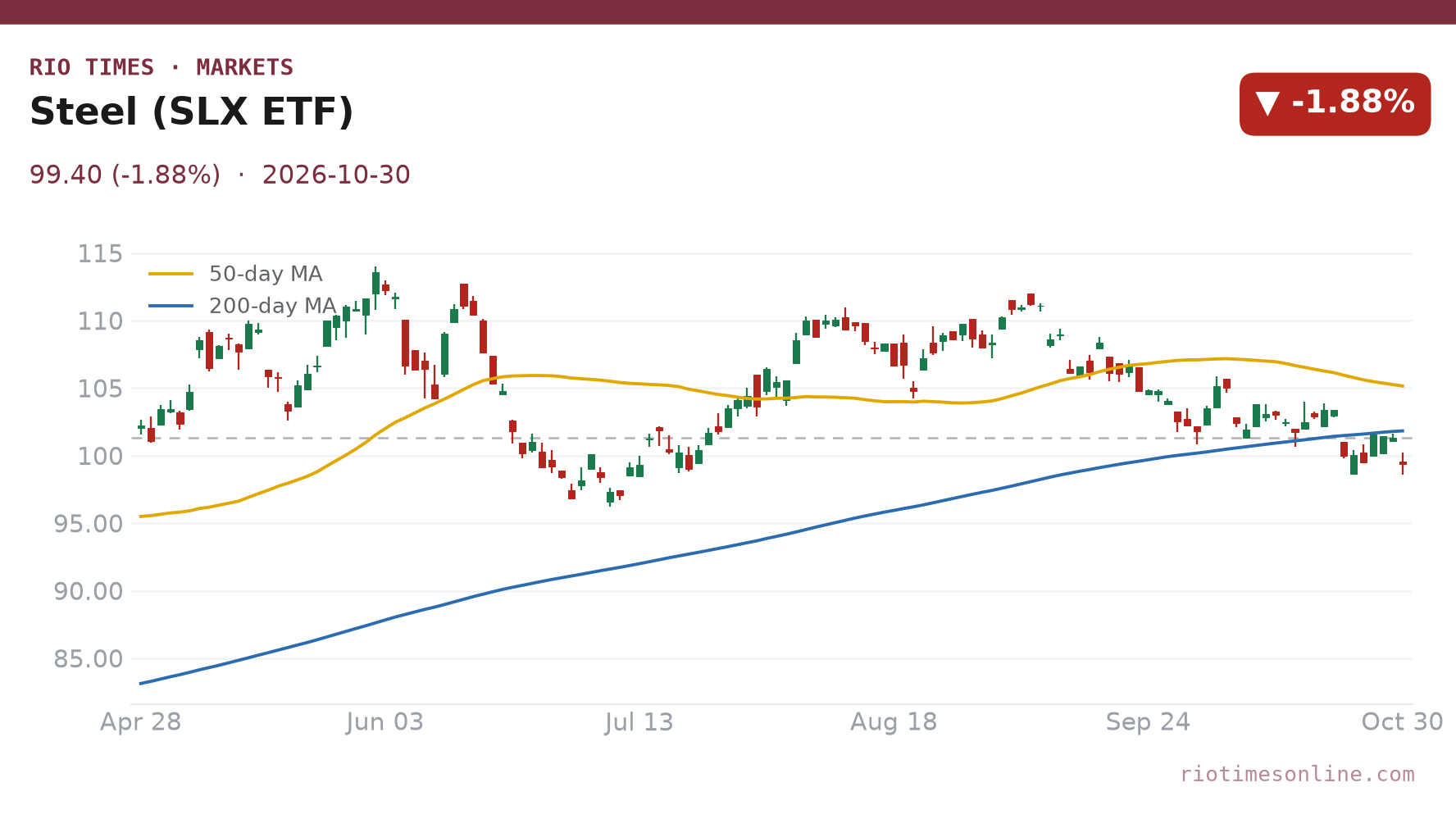
SLX settled at US$99.40, which is 12.5% below its 2 June high of US$113.57 and 31.1% above its November 2025 low of US$75.82. Over 20 sessions it has fallen 4.0%, and over 60 sessions 8.6%.
Brazil’s long-steel maker closed at US$4.66, down 8.6% over five sessions and 11.1% below its 20 October high of US$5.24. Ternium, which sells to Mexican carmakers and appliance makers, closed at US$52.77.
The backdrop was a risk-off day: the S&P 500 closed at 7,580, down 1.82%, the VIX fear gauge rose 12.91% to 19.42 and the dollar index was little changed at 101.96. The 10-year Treasury yield stayed at 4.93%, so interest rates were not the cause.
| Asset | Level | Change |
|---|---|---|
| Steel (SLX ETF) | US$99.40 | -1.88% |
| Gerdau | US$4.66 | -1.69% |
| CSN (ADR) | US$0.7152 | -8.31% |
| Ternium | US$52.77 | -2.39% |
Source: RT close, 2026-10-30. Where a commodity has no spot feed, an exchange-traded tracker or leading producer is shown as a labelled proxy.
Live Market IntelligenceThe live market board
Rio Times · Live Market Intelligence
Latin America — Cross-Market Board
| Instrument | Last | Change | YoY | Prev. | High | Low | Volume |
|---|---|---|---|---|---|---|---|
| IBOV | 167,921.80 | -0.75% | +19.56% | 169,186.42 | 178,526 | 175,157 | — |
| IPSA | 10,253.96 | -2.76% | — | 10,545.26 | 10,722 | 10,633 | — |
| IPC MEX | 69,705.03 | -0.12% | +12.74% | 69,787.41 | 70,008 | 69,383 | 49,372,306 |
| MERVAL | 92,079 | -2.59% | +12.65% | 2,859,051 | — | — | — |
| COLCAP | 2,490.92 | +0.04% | — | — | — | — | — |
| USD/BRL | 5.34 | -1.32% | -0.84% | 5.42 | 5.42 | 5.30 | — |
| EUR/BRL | 5.95 | +7.53% | -4.87% | 5.54 | 6.04 | 5.92 | — |
| USD/MXN | 18.69 | +0.62% | +1.45% | 18.57 | 18.69 | 18.54 | — |
| USD/CLP | 983.47 | -0.57% | +5.64% | 989.13 | 991.87 | 979.07 | — |
| USD/COP | 3,149 | +3.06% | -18.02% | 3,056 | 3,173 | 3,111 | — |
| USD/PEN | 3.45 | +0.17% | +3.85% | 3.44 | 3.45 | 3.44 | — |
| USD/ARS | 1,537 | -0.28% | +3.77% | 1,541 | 1,541 | 1,537 | — |
| USD/UYU | 40.21 | +3.57% | +2.29% | 38.83 | 40.21 | 40.08 | — |
| USD/PYG | 5,803 | +3.78% | -16.54% | 5,592 | 5,803 | 5,735 | — |
| USD/BOB | 11.97 | +4.93% | +77.92% | 11.41 | 11.97 | 11.82 | — |
| USD/DOP | 60.54 | +1.83% | -4.34% | 59.45 | 61.14 | 59.85 | — |
| USD/CRC | 451.24 | +2.13% | -7.80% | 441.83 | 451.40 | 450.04 | — |
| USD/GTQ | 7.64 | +3.23% | +2.18% | 7.40 | 7.64 | 7.64 | — |
Live Company IntelligenceGerdau S.A — the full investor dossier
Price & risk
$16.5052-wk high
$28.72
03 Why Steel Shares Fell on Friday
The common cause was the US stock-market rout, because investors sold cyclical shares after Intel and Amazon updated their results and AI-spending plans. The S&P 500 fell 1.82%, its worst day since June, and steel producers are among the most sensitive to a slowing economy.
CSN fell almost five times as far as Gerdau because of its debt. S&P Global Ratings cut its credit grade from B to B- on 20 October with a negative outlook, citing weaker mining results and a heavy debt load, and net debt was R$42.1 billion (about US$7.7 billion) at the end of June.
On Friday CSN also announced ten days of exclusivity for Huaxin, a Chinese cement group, to buy CSN Cimentos at an enterprise value (price including debt) of R$12.7 billion (about US$2.3 billion). The sale would cut debt, though the deal is not yet signed.
Import competition is the slow-moving cause. China supplies about half of Brazil’s rolled-steel imports, and the industry body Aço Brasil expects them to fall about 15% to 4.9 million tonnes in 2026 after new anti-dumping duties (penalties on below-cost imports), yet it still sees imports as a threat.
We have HIGH confidence in the market-wide cause, MEDIUM in the debt explanation for CSN and LOW in the cement-sale reading. The conflicting signal is that the cement sale is good news for debt, so Friday’s fall looks more like market-wide selling than a verdict on the deal.
04 The Trend Behind It
This is a continuation for CSN and a new low for the sector ETF. CSN fell 8.31% on Friday and has now lost five sessions in a row, a slide of 39.4% that erased the rebound on hopes of the cement sale.
Our own price history shows how rare this is: after CSN’s earlier falls of this size, it was higher 20 sessions later in only 3 of 9 cases (33%), with a median change of minus 2.8%. History is not a forecast, and nine cases is a small sample.
The long-steel maker shows the opposite pattern: it fell 7.0% over 20 sessions but remains 42.9% above its 20 March low of US$3.26. In its own history, falls of that size were followed by gains in 64 of 124 cases (52%), which is close to a coin flip.
05 What It Means for Latin America
For Brazil, steel is a story of protection: a 25% tariff applies above import quotas on 19 products, renewed in May through June 2027, and anti-dumping duties cover Chinese coated and cold-rolled steel. That keeps domestic prices above import parity, which helps Gerdau and hurts Brazilian builders and carmakers who buy steel.
For Mexico, the US tariff of 50% caps steel exports and weighs on Ternium. Mexico’s Economy Secretary Marcelo Ebrard wants Washington to lower the rate, but no deal or legal text has been published.
For US readers, the 50% Section 232 tariff (a US trade-law duty on steel imports) means American buyers pay more for Brazilian and Mexican steel, and it raises costs for manufacturers who buy it. It also keeps Latin American mills focused on their home markets, where Chinese imports are the main threat.
06 The Names to Watch
CSN, which trades in New York as SID, is the high-risk name: at US$0.72 it trades like a stressed-debt bet, and the cement sale is the one event that could change that. Investors should read its next quarterly report for the net-debt figure after the sale.
Gerdau at US$4.66 is the better-protected producer, with Brazilian construction demand and the 25% above-quota tariff behind it. It reported third-quarter adjusted profit of about R$1.5 billion (about US$276 million) on 26 October, with its highest margin since the second quarter of 2023.
Ternium at US$52.77 is the Mexico bet and depends on the outcome of the US tariff talks. For a bet on the whole group, the steel ETF is the simplest tool.
07 What Would End It
The slide in CSN would stall if it signs binding cement-sale documents inside the ten-day window, which runs to about 9 November. Even a price near R$12.7 billion would remove a large part of the debt worry, because it equals roughly 30% of the June net debt.
For the group, SLX needs a close back above Thursday’s US$101.30 to show the sell-off is over, while resistance is the US$113.57 June high. The next dated tests are the interest-rate decision of Copom, Brazil’s central-bank rate committee, on Wednesday 4 November and the US jobs report on Friday 6 November.
The honest answer is that the market-wide part of the fall should fade when Wall Street steadies, while CSN’s part will not until its balance sheet improves. A change in Brazil’s import quotas or a US-Mexico tariff deal would shift the picture for the whole group.
08 What to watch
- CSN cement sale: Binding documents with Huaxin inside ten days, to about 9 November, would cut debt and could end the slide.
- Copom, 4 November: Brazil’s central bank decision on the Selic, its benchmark interest rate now at 13.75%, sets financing costs for CSN and Gerdau.
- US-Mexico steel talks: Any cut from the 50% tariff would help Ternium, while no change keeps the ceiling on Mexican exports.
- Brazil import quotas: Any tightening of quotas or anti-dumping rules would protect CSN’s flat products.
Frequently Asked Questions
Why did CSN shares fall 8.31%?
A Wall Street sell-off hit cyclical stocks, and CSN’s heavy debt and S&P Global Ratings downgrade made it the most exposed. Its cement-sale news did not lift the shares.
Why did Gerdau fall less?
Gerdau earns from construction steel behind a 25% above-quota tariff and has far less debt pressure. It also reported its best margin since 2023 on 26 October.
How does the US steel tariff matter?
The 50% Section 232 tariff caps Mexican and Brazilian exports to American buyers. Mexico wants it lowered, but no deal exists yet.
What would end the slide?
A signed CSN cement sale would cut its R$42.1 billion debt. A steadier Wall Street would ease the wider sell-off.
Market data: The Rio Times
This article was produced by The Rio Times’ automated newsroom system. How we use AI · Report an error · Editorial responsibility: Matthias Camenzind, Editor-in-Chief
LatAm Markets: Live Signals → — real-time movers, turnover leaders and FX across Latin America.