Brazil Stocks Rise 0.3% as Wall Street Falls | Brazil Market Report, Nov 17
Key Facts
- Ibovespa: Brazil’s main stock index rose 0.31% to 169,817, still 18.8% below its 9 October peak.
- Real: One US dollar cost 5.7797 reais, 0.07% fewer, near the real’s weakest level in 12 months.
- Wall Street: The S&P 500 fell 1.03% and the VIX fear gauge jumped 11.13% to 25.46.
- Next: The budget bill returns to Congress’s lower house; the US 10-year yield stands at about 5.1%.
- Prediction markets: Polymarket, a real-money prediction market, prices no change in the December Selic (Brazil’s benchmark rate) decision at 81.0% (US$110,904 traded, 7:40 p.m. ET, 17 November).
Today’s Focus
Brazil’s stock market clawed back a little ground on Tuesday. The Ibovespa, the main index of the São Paulo exchange (known as B3), rose 0.31% to 169,817 points.
The real, Brazil’s currency, firmed slightly too. One US dollar cost 5.7797 reais, 0.07% fewer than the session before.
It is a small bounce after a very large fall. The index is down 17.19% over 20 sessions and sits 18.8% below its 9 October peak of 209,067.
Two things held the rebound back. Investors regard the government’s budget-adjustment bill as a correct but insufficient step, and a nervous Wall Street (the S&P 500 fell 1.03%) kept global money cautious.
What matters today. The bounce is real but fragile: the Ibovespa still sits just under the 170,000 line and the real is still near its weakest level in 12 months.

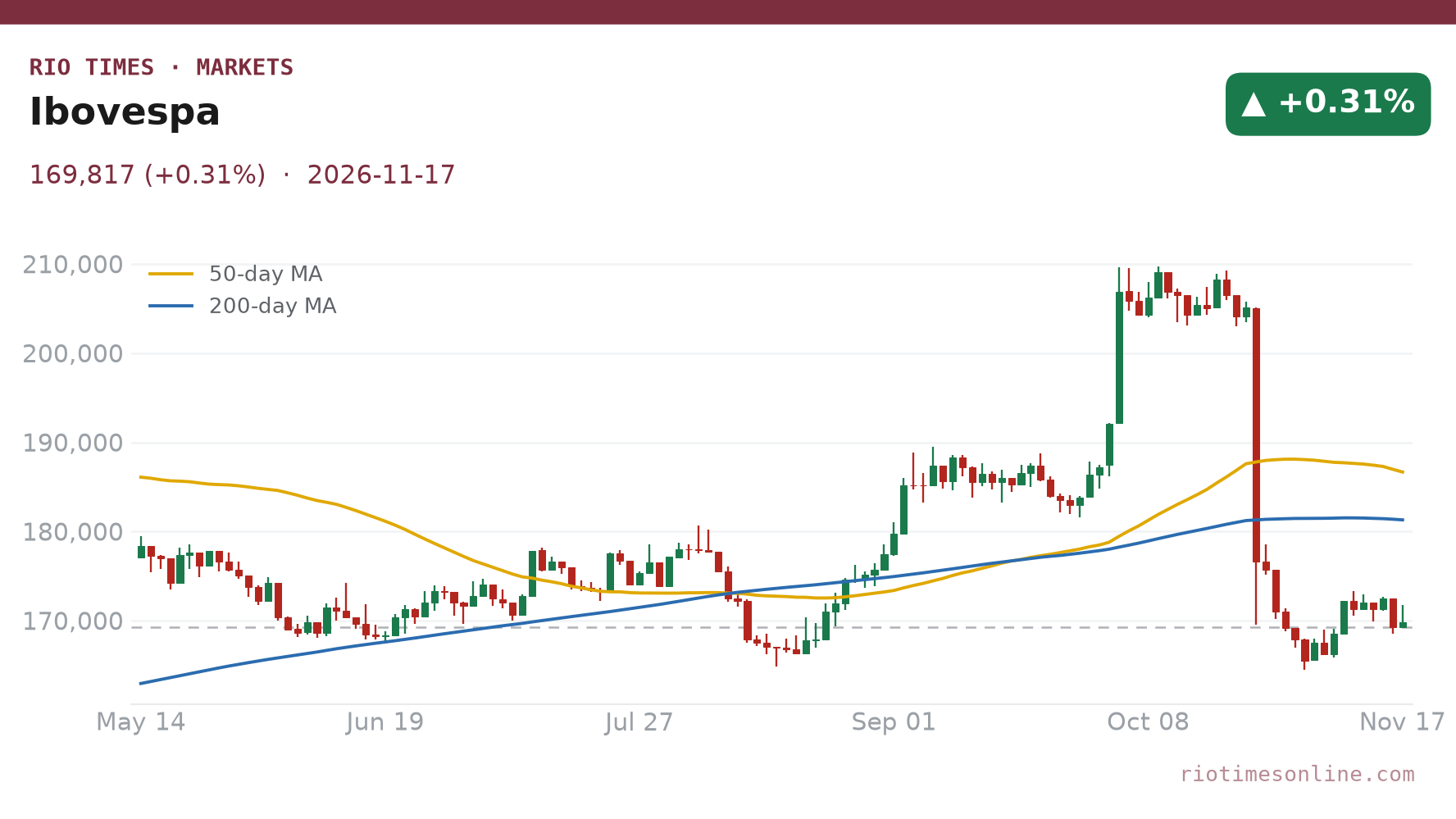
01 The session in one read
Tuesday brought a small relief after a miserable start to the week. On Monday 16 November the dollar had touched its 12-month high of 5.78 reais, the real’s weakest close in a year.
The Ibovespa, Brazil’s main stock index, sagged during the day but ended at 169,817, up 0.31%. It was the first gain after a run of losses.
For anyone outside Brazil, the real strengthened a touch. It took 5.7797 reais to buy one US dollar, 0.07% fewer than before.
Think of it as a patient who sat up in bed rather than walked out of hospital. The direction is better, but the recovery has barely started.
The evidence favours relief rather than recovery. The Ibovespa rose on a day when the S&P 500 fell 1.03% and the VIX, Wall Street’s fear gauge, jumped 11.13% to 25.46, which points to bargain-hunting after a heavy fall rather than a fresh wave of optimism.
The real’s moves tell the same story: it firmed 0.07%, but the dollar is still 14.85% dearer in reais over 20 sessions. Our best-supported reading is that fiscal worry, not global forces alone, set the tone, and the variable to watch is how the budget-adjustment bill fares when it returns to the lower house of Congress.
02 The day’s numbers
| Measure | Level | Change | Read |
|---|---|---|---|
| Ibovespa close | 169,817 | +0.31% | Small bounce after a deep sell-off |
| USD/BRL (reais per dollar) | 5.7797 | −0.07% | Real firmer, still historically weak |
| 12-month high (9 October 2026) | 209,067 | −18.8% | Index sits 18.8% below its peak |
| 12-month low (21 November 2025) | 154,770 | +9.7% | Index sits 9.7% above its low |
| Key level to clear | 170,000 | — | Round-number resistance, within reach |
The table shows a market closer to its lows than its highs. The Ibovespa is 9.7% above its 12-month low of 154,770 and 18.8% below its 12-month high of 209,067.
The longer picture is less gloomy than the short one. Over 60 sessions the index is up 1.1%, so the damage is mostly the work of the last four weeks, in which it fell 17.19% over 20 sessions.
The currency has moved the same way. The dollar is 18.1% above its 12-month low of 4.89 reais, set on 11 May, and it has risen 14.85% over 20 sessions.
Put plainly, Brazilian assets did not drift lower; they dropped, and then paused. Rio Times · Live Market Intelligence
Live Market IntelligenceBrazil — Live Market Board
Brazil — Live Market Board
Instrument Last Change YoY Prev. High Low Volume
IBOV
169,816.64
+0.31%
+8.17%
169,295.41
171,750
169,300
—
USD/BRL
5.78
-0.10%
+8.41%
5.78
5.78
5.77
—
SELIC
13.75%
—
—
—
—
—
PETR4
43.98
-0.09%
+33.76%
44.02
44.75
43.90
23,688,600
VALE3
60.34
-0.59%
-7.48%
60.70
61.35
60.34
17,081,600
ITUB4
40.89
-0.99%
+4.51%
41.30
41.66
40.52
32,247,000
BBDC4
14.41
+1.26%
-25.41%
14.23
14.50
14.24
40,276,800
BBAS3
14.62
-2.21%
-35.02%
14.95
15.03
14.56
65,832,100
B3SA3
14.65
-1.08%
+3.46%
14.81
15.13
14.51
42,491,000
ABEV3
15.93
+0.38%
+15.77%
15.87
16.01
15.81
28,604,400
WEGE3
51.15
+1.49%
+16.33%
50.40
52.07
50.22
7,540,000
PRIO3
63.96
+2.12%
+60.50%
62.63
64.73
62.78
7,096,200
SUZB3
55.39
-0.20%
+14.21%
55.50
56.49
55.31
6,107,500
RENT3
29.66
+1.19%
-31.29%
29.31
30.34
29.15
8,782,900
AZZA3
15.64
-3.10%
-46.14%
16.14
16.47
15.64
3,935,800
CSNA3
3.77
+2.45%
-54.85%
3.68
3.94
3.68
23,433,400
GGBR4
24.69
+0.37%
+32.03%
24.60
25.06
24.52
6,165,300
ENEV3
26.69
+1.10%
+37.65%
26.40
27.04
26.36
8,026,500
03 Why it moved — fiscal doubts and a nervous Wall Street
The first cause, with medium-to-high confidence, is fiscal worry. The government’s budget-adjustment bill, rushed through the Senate last week, is due to return to the lower house, and local analysts called it a correct step that is still insufficient.
The market’s reaction to date, with the dollar holding near 5.78 reais, is what ‘insufficient’ looks like in practice. Fiscal means the government’s budget: when investors doubt it will balance, they ask for a higher price to hold Brazilian assets.
The second cause, with medium confidence, is a global chill. The S&P 500 fell 1.03%, the Dow Jones fell 1.64%, and the VIX rose 11.13% to 25.46 as US investors waited for Nvidia’s results.
The US 10-year Treasury yield, the return on American government debt, stands at about 5.1%, up from about 4.8% in early November. Higher US yields pull money out of emerging markets.
US data were mixed. October retail sales rose 0.2%, in line with the consensus, while industrial production fell 0.4% against a 0.1% rise expected (RT economic calendar).
The third cause is Brazil itself. The usual drivers disagree with the move: the dollar index was almost flat at +0.05%, oil was up 0.15%, and yet the Mexican peso strengthened while the real lagged.
That points to a Brazil-specific story rather than a general emerging-market one. Our best explanation, with medium confidence, is that investors bought the dip after Monday’s fall but refused to chase it while the fiscal question is open.
Politics adds noise. Brazil’s labour minister said President Lula is due to sign a decree on Thursday ending the six-days-a-week work schedule, moving towards a 42-hour week.
04 The day’s movers
| Driver | Level / Move | Change | Note |
|---|---|---|---|
| S&P 500 | 7,341 | −1.03% | Wall Street weak, 6.1% below its 12-month high |
| Dow Jones | 50,759 | −1.64% | Steepest of the three US indices |
| Nasdaq | 24,328 | −0.74% | Tech steadier, focus on Nvidia results |
| VIX fear gauge | 25.46 | +11.13% | Higher reading means more nervous investors |
| US 10-year yield | about 5.1% | — | Up from about 4.8% in early November |
| US dollar index | 103.60 | +0.05% | Dollar broadly flat against major currencies |
| Oil (USO fund) | 140.24 | +0.15% | Little help for oil-linked Brazilian shares |
Company-by-company figures for São Paulo were not verified for this session, so we do not rank individual shares. The live board above carries them.
The table therefore shows the weather rather than the individual trees. Brazil rose against a falling US market, which is why the bounce looks like relief and not conviction.
Oil is the one commodity worth a line. The US Energy Information Administration’s weekly report (eia.gov) put commercial crude stocks at 414.4 million barrels, up 4.7 million on the prior week, a supply cushion that limits oil’s upside.
05 The regional scoreboard
| Index | Country | Change |
|---|---|---|
| S&P/BMV IPC | Mexico | −1.15% |
| IPSA | Chile | −0.46% |
| Merval | Argentina | +0.40% |
| COLCAP | Colombia | −2.17% |
Brazil and Argentina rose; Colombia’s COLCAP fell the most, down 2.17%, Mexico’s IPC fell 1.15% and Chile’s IPSA lost 0.46%.
The currencies split from Brazil’s. The Mexican peso gained (USD/MXN 18.4225, down 0.52%), the Chilean peso gained (992.33, down 0.72%) and the Colombian peso was flat (3,317, down 0.03%), so the real’s weakness is a local story. The live market board above carries the full closes.
For a Mexican or Chilean investor, the lesson is that Brazil’s problem is not yet contagious. For Colombia, the worry is at home: third-quarter output fell 0.8% on the quarter (−0.8% against a forecast rise of 1.6%) and grew 0.5% on the year after 3.5% before, and its COLCAP index fell 2.17%.
A weak real helps Brazilian exporters who earn dollars and hurts importers and anyone with dollar debts. Brazilian travellers abroad and expats paid in reais feel it first. For a US investor, the Ibovespa’s 0.31% gain and the real’s 0.07% rise add up to roughly 0.4% in dollars on the day, so the bounce was small but positive.
06 The technical picture
The chart now has a ceiling and a floor. Resistance, the level where sellers tend to appear, is the round number of 170,000, and beyond it the 12-month peak of 209,067 on 9 October.
Support, where buyers tend to step in, starts at 160,000 and then the 12-month low of 154,770 from 21 November 2025. A close above 170,000 would suggest the sell-off is over; a close below 160,000 would suggest it is not.
For the real, the ceiling is the psychological level of 6.00 reais per dollar, with the 5.78 high from 16 November as the first hurdle. A move back towards 5.50 would suggest the pressure is easing, and the dollar is up 3.42% over five sessions, so it has not eased yet.
History offers a hint, not a promise. In our own price records since 2007, the Ibovespa fell at least this far in 20 sessions in 6 earlier independent cases, and it was higher 20 sessions later in 4 of the 6, a median gain of 5.4% but a worst case of a further 13.9% loss.
The dollar tells a more evenly split tale. After 6 earlier rises this large, it was higher again 20 sessions later in 3 of 6 cases, with a median move of −0.8%; history is not a forecast.
07 What to watch
- Fiscal bill: The budget-adjustment bill returns to the lower house after the Senate vote; a clean passage would ease the main worry, while delay or dilution would keep the real under pressure.
- Foreign exchange flows (18 November): Brazil’s flow data, previous reading −2.059, shows whether foreign dollars are leaving or returning.
- Labour decree (Thursday): The planned decree ending the six-day work week will show how costly business may find the 42-hour transition.
Background: Brazil’s XP Profit Up 4%, Inflows Down 26%.
Background: Brazil Stocks Fall 1.8% as Real Hits a Low.
What Prediction Markets Say
Polymarket, where users bet real money, lists a market on the Central Bank of Brazil’s December decision on its Selic benchmark rate, with US$110,904 traded as of 7:40 p.m. ET, 17 November 2026. It prices no change at 81.0%, a 0.25-point cut at 5.9%, a 0.5-point or larger cut at 4.0%, a 0.25-point rise at 2.6% and a 0.5-point or larger rise at 1.9%.
These prices are bets, not polls. They show traders expect the central bank to hold the Selic in December.
Why we show this: prediction markets turn real-money bets into a live probability that moves within minutes of the news, which is why investors, campaigns and newsrooms in the United States now follow them closely. We show them next to polls and official results, never instead of them.
More: Brazil news, every day from The Rio Times.
Frequently Asked Questions
What is the Ibovespa?
It is Brazil’s main stock index, tracking the most traded companies on the São Paulo exchange, B3. It closed at 169,817 on Tuesday, up 0.31%.
Why did Brazilian stocks rise while Wall Street fell?
Investors bought after a deep fall, but doubts over the government’s budget-adjustment bill kept the gain small. Our confidence in this reading is medium.
What does 5.7797 mean for a traveller?
It is how many Brazilian reais one US dollar buys, so a dollar goes further in Brazil than a year ago. The dollar is 18.1% above its 12-month low of 4.89 reais.
Does history say the market will bounce?
In 4 of 6 earlier falls this large, the Ibovespa was higher 20 sessions later, but the worst case was a further 13.9% loss. History is not a forecast.
Market data: The Rio Times; exchange figures from B3
This article was produced by The Rio Times’ automated AI newsroom. Editorial responsibility: Matthias Camenzind, Publisher and Editor-in-Chief. The Rio Times also runs Ask Rio Times, which answers from 100,000+ of our own articles, the daily Latin America Power Map, and prediction-market odds on elections and markets.. How we use AI · Report an error
LatAm Markets: Live Signals → — real-time movers, turnover leaders and FX across Latin America.
Brazil runoff, Sunday, October 25: When is the Brazil runoff election. Latest: Brazil runoff polls, Flávio 51%, Lula 49%.
Get The Rio Times delivered to your inbox — market intelligence, daily briefs, and breaking analysis across Latin America.
Start for US$1