Brazil · Business
Key Facts
—Portonave Navegantes Portonave will invest R$2 billion (~US$392 million) to expand the Navegantes container terminal in Santa Catarina.
—Capacity target Annual container handling capacity to rise from 1.5 million TEU to 2 million TEU after completion.
—Depth target Access channel and berthing depth to move from under 14 meters to 17 meters, dependent on a separate federal concession.
—Timeline Works began in January 2024, with the first stage completed in September 2025 and the second stage running through the second half of 2026.
—Ownership The terminal is controlled by Terminal Investment Limited (TiL), the ports arm of Swiss-based shipping giant Mediterranean Shipping Company (MSC).
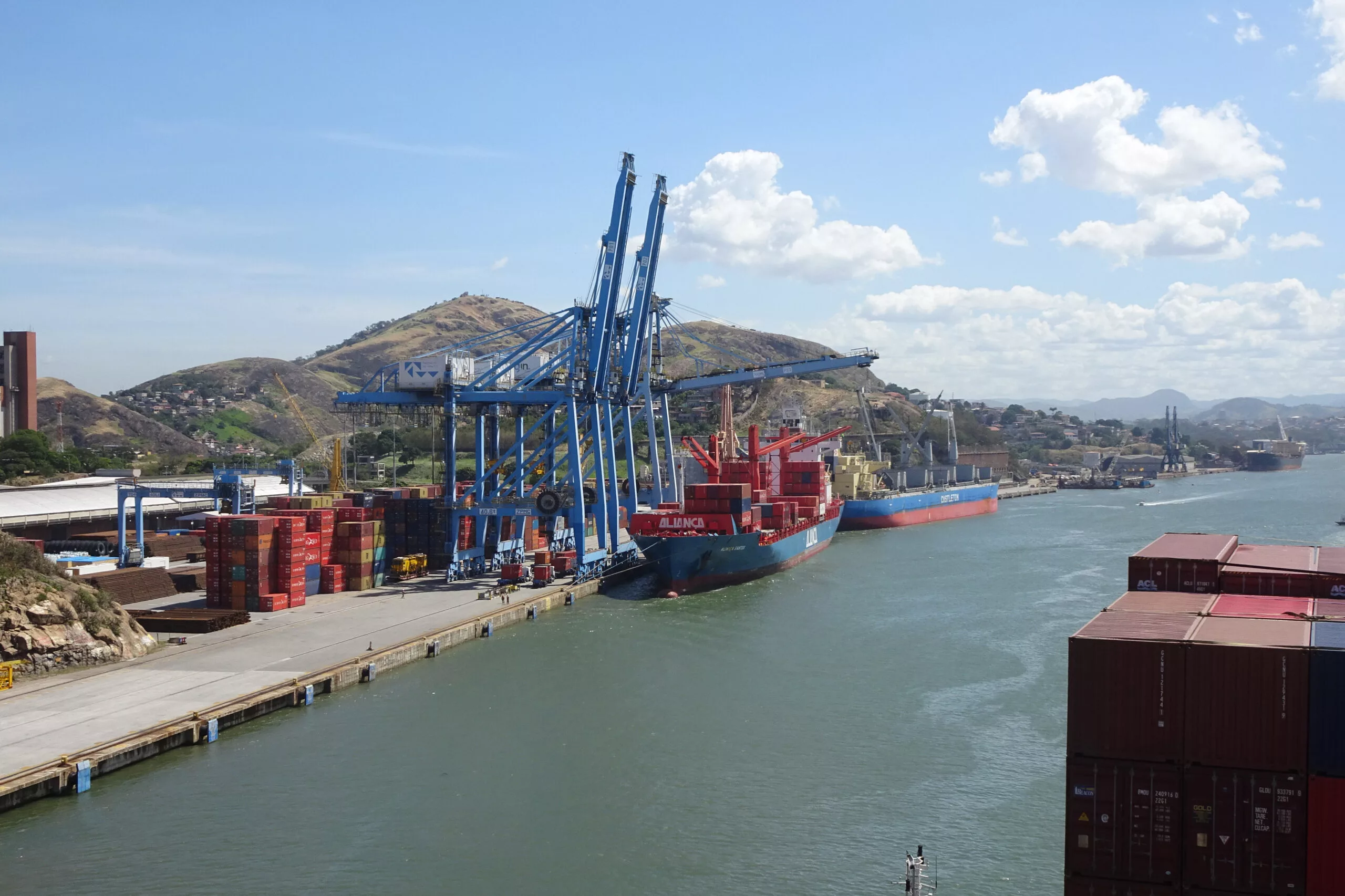
Portonave Navegantes, the Santa Catarina container terminal controlled by MSC’s Terminal Investment Limited (TiL), is pushing forward with a roughly R$2 billion (~US$392 million) modernization plan. The private terminal aims to lift its annual capacity from 1.5 million to 2 million TEU and prepare for a deeper access channel, intensifying a capacity race among southern Brazil’s ports.
The Modernization Blueprint
Portonave’s investment is not an area expansion but a densification and upgrade of its existing footprint in Navegantes, on the northern coast of Santa Catarina state. The company detailed a spending split of R$1.6 billion (~US$314 million) for quay reinforcement and civil works, plus R$439 million (~US$86 million) for new, fully electric equipment.
The terminal’s current annual capacity of 1.5 million TEU – a standard measure for a twenty-foot container – will climb to 2 million TEU. This boost is designed to handle larger vessels and higher cargo volumes without physically expanding the terminal’s perimeter.
A critical enabler is the planned deepening of the access channel and berthing area from less than 14 meters currently to a target of 17 meters. This dredging, however, is not part of Portonave’s private investment but hinges on a separate public concession for the port channel, which was under review by Brazil’s federal audit court, the TCU.
The Southern Brazil Port Race
For foreign investors, Portonave’s move is a direct response to a structural shift in global shipping. Container lines are deploying ever-larger vessels, often exceeding 366 meters in length, which require deeper drafts and longer quays.
Ports that cannot accommodate these ships risk being relegated to feeder status, losing direct calls to regional hubs.
Southern Brazil is witnessing a concentrated capacity race. Portonave, already one of the country’s top container terminals by volume, competes directly with nearby terminals like Port of Itapoá and Portonave’s own neighbor, the public Port of Itajaí, just across the river.
Further south, in Santos, Latin America’s largest port, a separate multibillion-dollar auction for a new container terminal is advancing.
Consultancy reports cited in Brazilian media project that Brazilian ports collectively foresee over R$10 billion in works to increase capacity and receive larger ships. The logic is simple: a port that can handle a 400-meter vessel on a direct Asia-South America route captures cargo that would otherwise be transshipped, reducing logistics costs for exporters and importers.
Portonave’s private nature gives it an agility advantage. As a private-use terminal, it can fast-track investments without the lengthy public bidding processes that constrain federally administered ports.
This model has attracted global terminal operators like TiL/MSC, which view Brazilian agribusiness and industrial exports as a long-term growth corridor.
MSC’s Strategic Footprint
Terminal Investment Limited, the ports arm of Mediterranean Shipping Company, controls Portonave. MSC is the world’s largest container line by capacity.
For an investor, TiL’s deepening commitment signals a strategic bet on Santa Catarina as a core node in MSC’s South American network.
Owning a terminal allows a carrier to guarantee berthing windows, control costs, and optimize its service loops. Portonave’s expansion aligns with MSC’s global pattern of securing dedicated infrastructure in key export markets.
The terminal’s modernization directly supports the carrier’s ability to deploy its largest neo-Panamax vessels on Brazilian routes.
Timeline and Execution
The modernization is being executed in stages. The first stage began in January 2024 and was completed in September 2025.
The second stage is underway and scheduled for completion by the end of 2026, or the second half of 2026, according to company statements.
Portonave has publicly expressed urgency regarding the federal channel concession. The terminal’s full potential to receive the deepest-draft vessels remains locked until the access channel is dredged to 17 meters.
Without this public-sector piece, the private quay upgrades alone cannot deliver the full navigational capability.
What This Means for Foreign Investors
The expansion highlights a broader investment thesis for Brazilian infrastructure. The country’s port sector has attracted significant foreign capital since regulatory reforms allowed private terminals to handle third-party cargo.
Portonave’s R$2 billion plan is a tangible example of a global terminal operator doubling down on this framework.
For expat entrepreneurs and foreign funds, the capacity race signals both opportunity and risk. Improved port infrastructure lowers export logistics costs for Brazilian commodities and manufactured goods, potentially boosting margins for producers. Conversely, terminals that fail to keep pace with the depth and scale requirements may see volumes migrate to better-equipped rivals.
The Santa Catarina port complex, including Navegantes, Itapoá, and Itajaí, is a critical gateway for Brazil’s southern and midwestern export corridors, particularly for frozen proteins, wood products, and machinery. Portonave’s investment helps secure the region’s relevance in global trade lanes for the next decade.
Frequently Asked Questions
Who owns Portonave Navegantes?
Portonave is controlled by Terminal Investment Limited (TiL), the ports division of Mediterranean Shipping Company (MSC), the world’s largest container shipping line.
How much is Portonave investing and what will it achieve?
Portonave is investing roughly R$2 billion (~US$392 million) to modernize its quay and buy new equipment. The project will lift annual container capacity from 1.5 million to 2 million TEU and prepare the terminal for a deeper 17-meter access channel.
When will the Portonave expansion be completed?
The first stage was completed in September 2025. The second stage is ongoing and is scheduled for completion by the second half of 2026.
The deeper access channel depends on a separate federal concession process.
Connected Coverage
Brazil’s Financial Morning Call for Wednesday, July 29, 2026
Sources: Portonave Navegantes.
This article was produced by The Rio Times’ automated newsroom system. How we use AI · Report an error · Editorial responsibility: Matthias Camenzind, Editor-in-Chief
Brazil runoff, Sunday, October 25: Brazil runoff start time and results schedule. Latest: Brazil runoff polls, Flávio 51%, Lula 49%.