Brazil’s Financial Morning Call for Wednesday, July 29, 2026
Key Facts
- The Copom rate-setting committee meets next week, and the market is weighing whether a sticky unemployment print today could delay the start of a long-awaited easing cycle from the current 14.25 per cent Selic.
- Brazil’s unemployment rate for June is due at 12:00 BRT, with economists expecting a slight dip to 5.5 per cent from 5.6 per cent, any surprise here will directly move the needle on August rate-cut odds.
- Wholesale inflation measured by the IGP-M is forecast to show another month of deep deflation, around -1.07 per cent, reinforcing the argument that pipeline price pressures are vanishing even if service costs remain stubborn.
- The Brazilian real starts the day near R$5.12 to the US dollar, a level that has held remarkably steady while traders wait for concrete signals from both the Central Bank and the US Federal Reserve’s preferred PCE inflation gauge this afternoon.
- On the corporate front, keep an eye on Vivo (VIVT3) and TIM (TIMS3), which were hit hard in the last session with falls of 6.3 and 5.8 per cent respectively, as the market digests the competitive impact of a tough mobile market.
Today’s Focus
The air in São Paulo trading rooms this morning is thick with one question: will the Central Bank finally blink in August? The National Monetary Council is meeting even as the unemployment rate is released, creating a noisy backdrop for the final round of positioning before the Copom decision next week. With the Selic stuck at a painful 14.25 per cent, local fund managers are desperate for a clear signal that a cutting cycle can begin, and today’s jobs and inflation data are the last big domestic clues they’ll get.
The wholesale IGP-M inflation index, released at 11:00 BRT, is expected to show a dramatic -1.07 per cent drop, which would be a powerful deflationary headline. However, the Central Bank’s focus is firmly on the job market — a tight labour force is the last bastion of sticky services inflation that has kept the monetary hawks in control. If the jobless rate holds firm or surprisingly drops, the odds of a rate cut in August could evaporate.
This domestic drama will play out against a global tape that is equally tense. The US releases its own quarterly GDP data and the crucial PCE inflation numbers at 12:30 BRT. A hot US inflation reading could prop up the dollar globally, putting immediate pressure on the real and testing the R$5.12 level that has held for days. In this environment, Brazilian equities are likely to stay on a tight leash, with any early gains in cyclical stocks like retailers quickly reined in if the currency wobbles.
What matters today. Whether the Brazilian jobless rate proves the economy is still running too hot for the Central Bank to cut interest rates in August.
Today’s Economic Events
| Instrument | Level | Session |
|---|---|---|
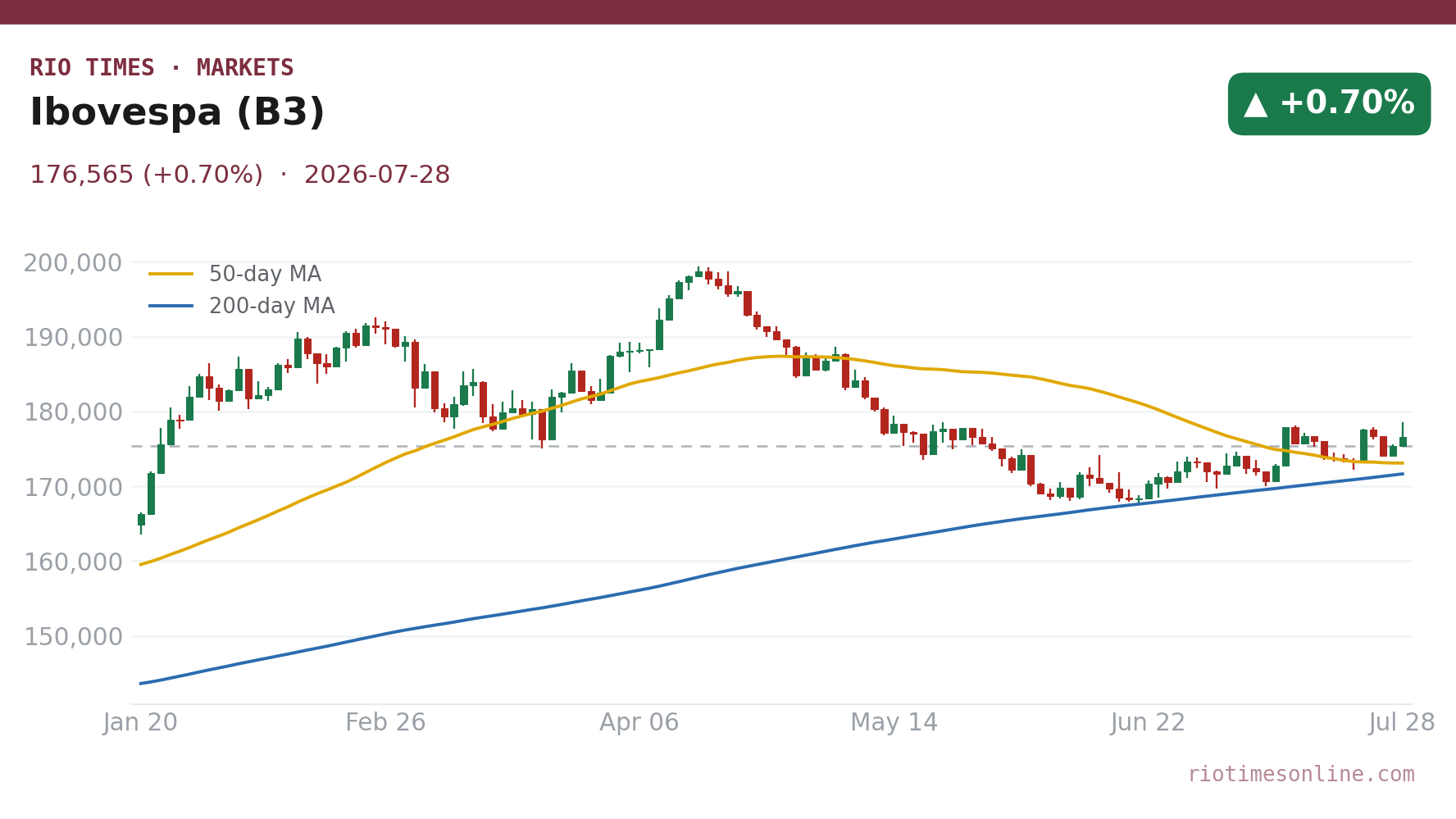
| Ibovespa (Brazil) | 176,565 | +0.70% |
| S&P 500 (US) | 7,429 | +0.21% |
| USD/BRL | 5.1212 | +0.09% |
Ibovespa — Source: RT close, 2026-07-28. Figures rendered directly from the feed.
01 The setup in one read
Brazilian financial markets are waking up to a decisive 24 hours that could finally answer the question of whether the Central Bank will start cutting the Selic, its benchmark interest rate, at the August 5-6 meeting. Today’s unemployment report, coupled with a wholesale inflation number, provides the last major domestic inputs before the Copom rate-setting committee gathers. The stakes are huge: the Selic has been parked at an eye-watering 14.25 per cent, squeezing corporate profits and making the carry trade on the real a wildly popular but nervous bet.
While the domestic story is front and centre, the afternoon will bring a wave of US data — including the Federal Reserve’s preferred inflation measure — that could jolt the dollar globally. The real has been a picture of stability near R$5.12, but it is anchored there by the promise of high Brazilian rates; a combination of weak US inflation data and a hot Brazilian job market would be the worst-case scenario for local rate-cut hopes, potentially strengthening the dollar and knocking the Ibovespa from its recent quiet climb.
The evidence is finely balanced. The IGP-M data should provide a soothing, deflationary read that supports the case for looser monetary policy, yet the Central Bank has repeatedly stated that it is looking past transitory wholesale price drops and focusing on the labour market and services. The expected drop in the unemployment rate to 5.5 per cent would still signal a historically tight market, keeping pressure on wages. The variable to watch is not just the headline jobless figure, but whether average real earnings tick up, which would be a red flag for the Central Bank’s inflation models.
02 Where Brazil is set to open
| Instrument | Last close | Indicated | Watch today |
|---|---|---|---|
| Ibovespa | 176,565 (+0.70%) | — | Whether the index can hold the 176,500 level as traders de-risk ahead of the US PCE print and Brazilian jobs data. |
| USD/BRL | 5.1212 (+0.09%) | — | A clean break below R$5.12 would be a bullish real signal; a spike above R$5.15 on a strong US PCE print could reverse the local mood. |
With pre-market indications not yet firm ahead of the 10 a.m. cash open, the table sets out the last verified levels and the thresholds that will matter when orders hit the book. The Ibovespa’s two-day winning streak has put it within touching distance of the psychological 177,000 mark, a level that has acted as a magnet all month.
The real’s recent stability has been a minor miracle in a turbulent year. It sits 8.4 per cent below its 52-week high against the dollar, but the tight range around R$5.12 suggests that neither dollar bulls nor real bulls are willing to commit before today’s transatlantic data dump. Rio Times · Live Market Intelligence
Live Market IntelligenceBrazil Morning Call — Live Board
Brazil Morning Call — Live Board
Instrument Last Change YoY Prev. High Low Volume
IBOV
187,206.89
-0.56%
+21.85%
188,268.59
168,310
167,142
—
USD/BRL
5.16
+0.01%
-5.13%
5.16
5.18
5.14
—
EUR/BRL
5.95
+1.01%
-5.83%
5.89
5.98
5.94
—
SELIC
14.00%
—
—
—
—
—
BRENT
88.88
-0.03%
+34.42%
88.91
90.07
88.12
29,713
WTI
83.11
-0.11%
+31.57%
83.20
84.35
82.40
166,848
IRON ORE
161.91
—
+58.10%
161.91
161.91
1
GOLD
4,461
+1.78%
+33.20%
4,383
4,503
4,421
139,824
SILVER
65.59
+1.26%
+73.05%
64.77
66.98
64.81
46,406
LITHIUM
75.20
+1.47%
+62.95%
74.11
75.80
75.08
89,275
SOY
1,184
+3.20%
+17.05%
1,148
1,199
1,168
163,179
CORN
480.50
+10.02%
+29.34%
436.75
480.75
459.50
341,248
WHEAT
655.00
+3.93%
+29.70%
630.25
657.75
631.50
128,793
COFFEE
317.25
-5.51%
+0.67%
335.75
321.20
313.55
21,747
SUGAR
16.43
-1.79%
-3.01%
16.73
17.11
16.22
171,992
ORANGE JUICE
138.55
-0.47%
-45.38%
139.20
141.05
137.50
703
COTTON
85.03
+2.33%
+26.78%
83.09
82.90
81.96
16,546
BEEF
223.60
-3.93%
-5.18%
232.75
226.40
223.00
16,126
CATTLE
339.10
-3.16%
-1.82%
350.17
345.50
338.60
10,164
COCOA
5,719
+3.18%
-34.96%
5,543
5,779
5,574
26,773
PETR4
41.64
-0.05%
+35.19%
41.66
41.97
41.15
41,499,400
VALE3
72.97
+0.83%
+30.75%
72.37
73.54
72.66
17,658,000
SUZB3
41.33
+2.35%
-23.55%
40.38
41.48
40.35
3,914,900
KLABIN
17.69
+0.80%
-2.95%
17.55
17.74
17.48
2,057,400
SLCE3
13.34
+0.30%
-12.25%
13.30
13.42
13.20
1,454,200
ABEV3
14.89
-0.80%
+21.91%
15.01
15.07
14.81
16,453,100
ITUB4
38.60
-1.03%
+4.57%
39.00
39.34
38.39
29,487,800
BBDC4
16.85
+0.36%
+3.50%
16.79
16.90
16.67
19,416,900
BBAS3
19.37
+0.47%
+0.73%
19.28
19.44
19.16
11,069,200
B3SA3
14.26
-0.21%
+12.73%
14.29
14.47
14.11
33,037,800
WEGE3
47.59
+0.49%
+29.99%
47.36
48.08
47.36
3,364,600
PRIO3
59.14
-0.19%
+50.67%
59.25
59.81
58.74
3,325,600
RENT3
34.68
-0.09%
+0.84%
34.71
34.96
34.35
7,979,100
AZZA3
15.89
-2.63%
-53.76%
16.32
16.42
15.82
1,330,300
CSNA3
4.30
+0.47%
-42.65%
4.28
4.41
4.26
10,076,100
GGBR4
24.69
+2.19%
+51.38%
24.16
24.85
24.18
7,047,600
ENEV3
24.21
-1.38%
+70.49%
24.55
24.64
23.99
9,297,000
LREN3
11.87
-1.33%
-28.65%
12.03
12.17
11.83
9,683,300
03 On the B3 radar today — data, earnings, and a key meeting
| Item | When | Why it matters |
|---|---|---|
| BCB National Monetary Council | 12:00 BRT | A monthly gathering that sets macro-prudential rules; it runs parallel to the jobs data release and could produce headlines on credit regulation. |
| IGP-M Inflation (Jun) | 11:00 BRT | The wholesale price gauge is forecast to crash -1.07%, its most deflationary read in this cycle, intensifying pressure on the Central Bank to look past sticky services inflation. |
| Unemployment Rate (Jun) | 12:00 BRT | Consensus sees a drop to 5.5% from 5.6%; a tight labour market is the main reason the Copom has refused to cut the Selic from 14.25%. |
| Bank Lending (Jun) | 11:30 BRT | A barometer of credit appetite in the high-rate economy; a weak print would underscore corporate pain. |
| US Q2 GDP and PCE Inflation | 12:30 BRT | The Fed’s favourite inflation number will set the global dollar tone right as São Paulo traders return from lunch. |
The calendar is stacked in a way that will force traders to pivot fast. The IGP-M drop and the bank lending data land just as the morning order book thickens, giving a clear macro picture before the cash session gets into full swing. Then, at midday, the National Monetary Council meets just as the unemployment rate crosses terminals — a double whammy of fiscal and labour-market news.
The US data is the wild card. A US GDP report landing at 2.3 per cent and a core PCE reading at a sticky 3.3 per cent could remind everyone that the Federal Reserve is in no rush to cut, stealing the thunder from any local good news and sending a shiver through emerging-market currencies including the real.
04 Copom and the macro backdrop
Next week’s Copom meeting is casting a long shadow over today’s session. Central bank chief Gabriel Galípolo and his board have stuck to a rigidly hawkish script, arguing that a tight labour market will keep services inflation alive even as goods prices crash. The IGP-M deflation is a vivid example: heavy industrial and agricultural commodities are getting cheaper wholesale, but a haircut at the barbershop still costs more than it did last year.
That is why the unemployment rate is the magic number. Brazil’s economy may be slowing from its 2.3 per cent sprint in 2025, but with the jobless rate clinging to single-digit territory, workers still have wage-bargaining power. A reading of 5.5 per cent or below would likely be used by the Central Bank hawks as final proof that the economy is too hot to warrant a rate cut. The currency market is already on edge; the real’s remarkable calm at R$5.12 has been built on the assumption that sky-high real interest rates will persist, attracting foreign carry traders.
05 Corporate stories to watch today
The telecom sector is in the spotlight for all the wrong reasons. Shares of Vivo, Brazil’s largest integrated telecom, and TIM, one of the big three mobile operators, were routed in the last session, dropping 6.3 per cent and 5.8 per cent respectively on enormous turnover. The market appears to be bracing for a ruinous price war or a costly spectrum auction outcome, and follow-through selling at the open would confirm that the investment thesis has cracked.
Elsewhere, the Vamos dealership group (VAMO3) will be tested after a 5 per cent bounce, while hospital chain Hapvida (HAPV3) looks to extend a 4 per cent rally on a day with no fresh corporate releases. The real action is in the heavyweights: Petrobras (PETR4) and Vale (VALE3) together accounted for over R$2.1 billion in trading volume, and their ADRs are the local market’s direct channel to the global commodity cycle. If US GDP surprises to the upside, expect a lift in big iron-ore and oil names; if not, they’ll act as anchors.
06 The levels to watch at the open
For the Ibovespa, 176,500 is the first floor. The index closed there and has built a two-day winning streak on the back of steady money flows into heavy turn-over names like Itaú (ITUB4) and Ambev (ABEV3). A break above 177,000 in early trading would signal that local funds are buying the dip ahead of next week’s Copom meeting, betting that the data will force a dovish turn. A slide back toward 175,000, however, would suggest that the smart money is trimming risk before the US PCE release.
On the currency side, the USD/BRL pair’s recent range has been remarkably tight. The 5.12 handle has acted as a pivot; a break below R$5.10 would likely trigger a cascade of stop-losses from dollar longs and signal a major real rally. The upside alarm is set at R$5.15. A surge through that level — especially if the US PCE data comes in hot — would rip up the carry-trade playbook and likely send the Bovespa sharply lower, with rate-sensitive stocks tied to consumer spending bearing the brunt of the pain.
07 What to watch
- Unemployment and IGP-M: The dual release will either back the tight-labour-market hawkish narrative or give the Central Bank an off-ramp to signal a cut at the August Copom meeting.
- US PCE Inflation: This is the Fed’s north star. A hot number will send a wave of dollar strength through emerging markets just as the Brazilian market closes out the afternoon session.
- Telecom rout: Watch VIVT3 and TIMS3 for signs of a dead-cat bounce or a capitulation sell-off that could spread contagion to other defensive, high-dividend names.
- Real at R$5.12: The exchange rate has been range-bound, but it is a coiled spring. The direction of the break will set the tone for the entire equity market’s sector rotation for the rest of the week.
Background: Vivo Brazil Profit Hits US$308M on Mobile, Fiber Growth.
Background: TIM Brazil Profit Hits Record US$203M on Fiber, Mobile.
More: Brazil news in English, every day from The Rio Times.
Frequently Asked Questions
Why is the IGP-M deflation big news if the Central Bank ignores it?
The IGP-M is a wholesale price index that captures factory-gate and agricultural prices, which are crashing. While the Central Bank officially focuses on consumer prices (IPCA), a deep deflation here makes it politically harder for them to argue that inflation is a broad-based problem and delays the public pressure to cut the Selic.
What is the Copom?
The ‘Comitê de Política Monetária’ is the Brazilian central bank’s rate-setting committee. They meet roughly every 45 days to decide the Selic rate, which is the country’s main tool to control inflation. Their next decision is due on 5-6 August.
Why is the unemployment rate so important today?
The Central Bank worries that a tight job market — where almost everyone who wants a job has one — will push up wages and then prices in service industries like restaurants and salons. At 5.5 per cent, this rate would signal that the economy is still running hot, limiting the scope for interest rate cuts.
Which stocks are most sensitive to today’s data?
Retailers and consumer-discretionary stocks that rely on credit are the most sensitive to the interest-rate outlook. Petrobras (PETR4) and Vale (VALE3) will move more with global commodity prices, but are also heavily traded and act as benchmarks for the overall index.
This article was produced by The Rio Times’ automated newsroom system. How we use AI · Report an error
LatAm Markets: Live Signals → — real-time movers, turnover leaders and FX across Latin America.