Playa del Carmen Sargassum: City Moves to Return Recovered Sand to Beaches as Hotel Building Continues
MEXICO · TRAVEL & EXPAT LIFE
Key Facts
- —The plan Playa del Carmen is seeking a federal permit to return sand that was stripped from beaches during two years of sargassum cleanup back onto eroded stretches of the central coast.
- —The season Quintana Roo had collected 127,941 tonnes of sargassum by 11 September 2026 — already above the 92,782 tonnes of all 2025 — with Playa del Carmen carrying roughly a third of the total. Arrivals are now tapering.
- —The response A 2 billion Mexican peso (about US$117 million) federal program is shifting collection offshore, with Navy vessels and longer containment barriers.
- —The paradox In the same week, the city announced more than US$1.6 billion in new hotel, retail and industrial projects.
- —The strain Hotel occupancy fell to 30 percent in Playa del Carmen and 15 percent in Tulum in August, the state tourism minister acknowledged.
After Quintana Roo’s heaviest sargassum season to date, Playa del Carmen wants to give its beaches back the sand that cleanup crews carried away with the seaweed — while investors keep building hotels through the downturn.
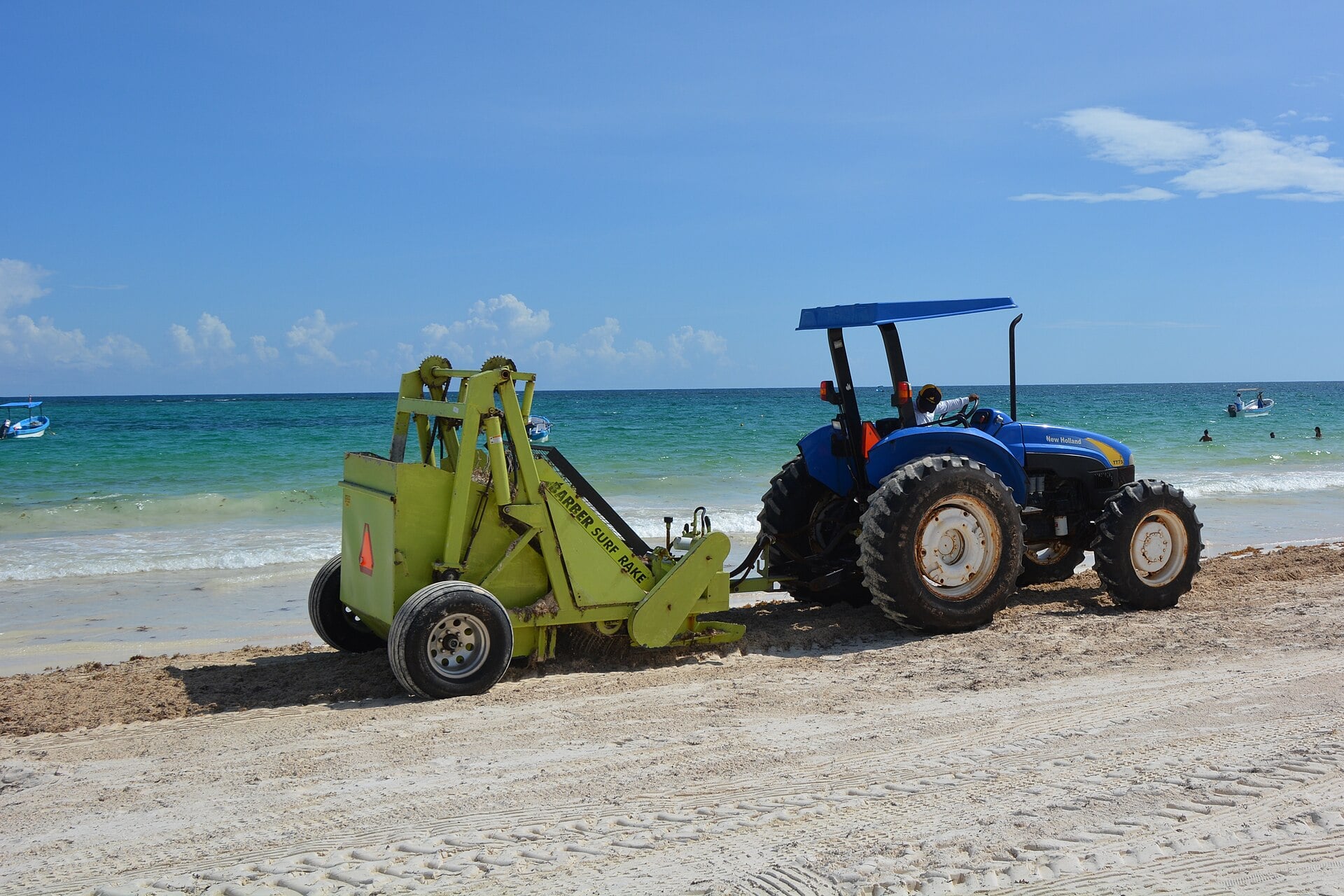
Playa del Carmen sargassum cleanup has entered a new phase. The city government confirmed on 18 September 2026 that it is seeking a federal permit to return to its beaches the sand that was removed, mixed with seaweed, during the last two seasons of sargassum collection.
Irving Rafael Lili Madrigal, director of the Federal Maritime Terrestrial Zone (Zofemat), told Reportur that the project has already been filed with Semarnat, Mexico’s federal environment ministry. The city is now working through the requirements the ministry set before granting the permit.
Where the Sand Would Go
The target zones are specific. Lili Madrigal named El Recodo, a beach with visible erosion, the Calle 10 and Calle 12 corridor in the center, and the area near the Xamán-Ha pier on the Playacar side. During cleanup operations in 2025 and 2026, tractors and trucks removed sargassum together with the sand trapped inside it. That sand now sits separated, or partly separated, at collection points.
The municipality plans to automate the separation with a hopper and containers. “We do the separation ourselves; we are automating it with a hopper and containers, which is a bit more engineering, and the separation will be faster,” Lili Madrigal said. What is not yet known: when Semarnat will rule, how much sand can legally be returned, and when the work would start. No date has been announced.
A Record Season, Now Past Its Peak
The sand question exists because the Playa del Carmen sargassum season broke the pattern in 2026. The seaweed began arriving in January, months earlier than the historical April-to-May window. State collection statistics put the total for Quintana Roo at 127,941 tonnes by 11 September — already well above the 92,782 tonnes gathered in all of 2025, itself a record year at the time. Playa del Carmen accounts for the largest municipal share, roughly a third of the statewide volume, and local officials say the season is on track to be the heaviest the state has recorded.
The response has shifted from shovels to ships. On 30 July, President Claudia Sheinbaum announced a 2 billion Mexican peso program (about US$117 million, at roughly 17.15 pesos to the US dollar on 18 September) run through the Navy. A second collection vessel joined the first; the Navy has removed more than 16,000 tonnes at sea this season. Containment barriers now cover nearly 12 kilometres of Quintana Roo coastline, and Playa del Carmen’s own barrier line grew from 2.5 to five kilometres. The stated goal is to raise daily collection capacity from 1,227 tonnes toward 4,000.
The trend is now the visitor’s friend. The Navy lowered its sargassum alert for Quintana Roo from red to yellow on 27 August as arrivals eased. Conditions still vary beach by beach and week to week: the Quintana Roo Sargassum Monitoring Network, directed by hydrobiologist Esteban Amaro Mauricio, tracks around 140 beaches individually — 13 of them in Playa del Carmen. In mid-August its traffic-light map showed 22 northern beaches in red, 17 in orange, 13 in yellow, 45 in green and three free of the algae. Amaro’s network projects arrivals will keep declining through September and largely taper off by October. His caution, worth noting for planners: because 2026 began in January, an early start in January 2027 cannot be ruled out. That is a forecast from the monitoring network, not a certainty.
Building Through the Downturn
The seaweed arrived during a difficult year for the sector. State tourism minister Bernardo Cueto Riestra acknowledged on 14 August that Tulum’s hotel occupancy had fallen to 15 percent — the lowest in its history — while Playa del Carmen stood at 30 percent. He attributed the drop to the atypical sargassum influx and to airlines cutting frequencies to the Mexican Caribbean as fuel costs rose. Some Tulum hotels have closed temporarily; others operate only in high-demand weeks.
Yet the investment pipeline has not paused. On 18 September, Estefanía Hernández, the city’s Secretary of Economic Development and Investment Attraction, announced more than US$1.6 billion in new tourism, residential and commercial projects for Playa del Carmen, Reportur reported. The list includes US$700 million for 900 new hotel rooms, US$400 million for the Plaza La Isla retail project by developer Gicsa, US$300 million in a residential development, and US$200 million for a new Grupo Modelo plant and distribution center. The Mandarin Oriental Kanai Riviera Maya — 120 suites and 49 private residences, estimated to open in 2028 — was named separately, because its investment figure is still being defined.
The global brands are moving the same way. In late August, Marriott confirmed that three Reef resorts in Playa del Carmen — The Reef Playacar (198 rooms), the adults-only Reef 28 (120 suites) and The Reef Coco Beach (198 rooms, expanding to 358 by early 2028) — will join its Tribute Portfolio in 2027, adding 676 rooms to its all-inclusive pipeline. In May, Semarnat authorized a two-hotel complex by Oleum Joint Ventures on the Riviera Maya coast: 286 rooms each, 572 in total, with an investment reported at 800 million Mexican pesos (about US$47 million), according to Riviera Maya News. These are announced figures, not completed construction; the gap between announcement and opening is where downturns usually bite.
What This Means for Travelers and Residents
For anyone planning a trip or living in the city, the practical map is simple. From November through April the beaches are historically largely clear; that remains the most reliable window, though after 2026’s January start the monitoring network cautions that no winter month can be guaranteed. If you are traveling in the coming weeks, treat conditions as changeable: wind direction can move the rafts onshore or away within 48 hours, so check the monitoring network’s live map for your specific beach rather than relying on a general forecast.
Alternatives are unaffected. The cenotes, the ruins inland, and Cozumel’s sheltered west coast see no sargassum. Playa Norte on Isla Mujeres, facing northwest, is among the most reliably clear beaches near Cancún. And the downturn has a flip side for visitors: with occupancy at 30 percent, hotels have cut rates, so autumn stays are cheaper than the same rooms were a year ago. The Rio Times covered the broader season and the new-resort pipeline when it opened in our August report on Cancún and the Riviera Maya, and we track daily costs in our Playa del Carmen cost-of-living guide.
Sargassum is now a structural feature of Caribbean summers, not an anomaly — and Playa del Carmen is learning to manage it as one. The sand permit, the offshore collection, and the continued hotel building all point the same direction: a destination adjusting to a cycle it expects to meet again.
Frequently Asked Questions
Is sargassum still a problem in Playa del Carmen in September 2026?
Yes, but Playa del Carmen sargassum arrivals are receding. The Quintana Roo Sargassum Monitoring Network expects arrivals to keep declining through September and largely taper off by October. Conditions vary by beach and can change within 48 hours, so check the network’s live map before choosing a beach.
What is Playa del Carmen doing about sand lost during sargassum cleanup?
The city has applied to Semarnat, the federal environment ministry, for a permit to return sand recovered from sargassum collection to eroded beaches, including El Recodo, the Calle 10-12 corridor and the Xamán-Ha pier area. No start date has been announced.
Which new hotel projects are planned for Playa del Carmen?
The city announced more than US$1.6 billion in projects on 18 September 2026, including US$700 million for 900 new hotel rooms. Separately, Marriott will convert three Reef resorts into Tribute Portfolio all-inclusives in 2027, and the Mandarin Oriental Kanai Riviera Maya is estimated to open in 2028.
When is the best time to visit Playa del Carmen to avoid sargassum?
November through April is historically the clear window. The monitoring network cautions that 2026 began unusually early, in January, so no winter month can be guaranteed; February and March have been the most reliable.
Connected Coverage
More: Mexico news in English, every day from The Rio Times.
Sources
- reportur.com — sand recovery permit (18 September 2026)
- reportur.com — US$1.6 billion project announcement (18 September 2026)
- reportur.com — occupancy figures (14 August 2026)
- travelerstoday.com — monitoring network outlook (17 August 2026)
- blueplayarentals.com — SEMA collection figures (21 August 2026)
- caribjournal.com — Marriott Reef conversions (31 August 2026)
- riviera-maya-news.com — Oleum two-hotel authorization (May 2026)
This article was produced by The Rio Times’ automated newsroom system. How we use AI · Report an error
Read More from The Rio Times