Peru Count Points to Runoffs in 15 of 25 Regions
Peru's government called governor runoffs in 15 of 25 regions for Sunday 6 December 2026, after the first-round count of 4 October.

POLITICS · PERU
Key Facts
- The country Peru, an Andean nation of about 34 million people, elected 25 regional governors on Sunday 4 October for 2027 to 2030. It is one of the world’s biggest copper producers.
- Why it matters Several runoff regions host mines run by US-listed Freeport-McMoRan, Southern Copper and Newmont. Governors shape local permits, roads and the handling of protests.
- Why now ONPE, the national electoral office, published near-complete official counts on Monday 5 October. They replace Sunday night’s exit-poll estimates.
- What happened On ONPE counts published between 8:06 and 10:46 a.m. Lima time on 5 October, no ticket reached 30% of valid votes in 15 of 25 regions.
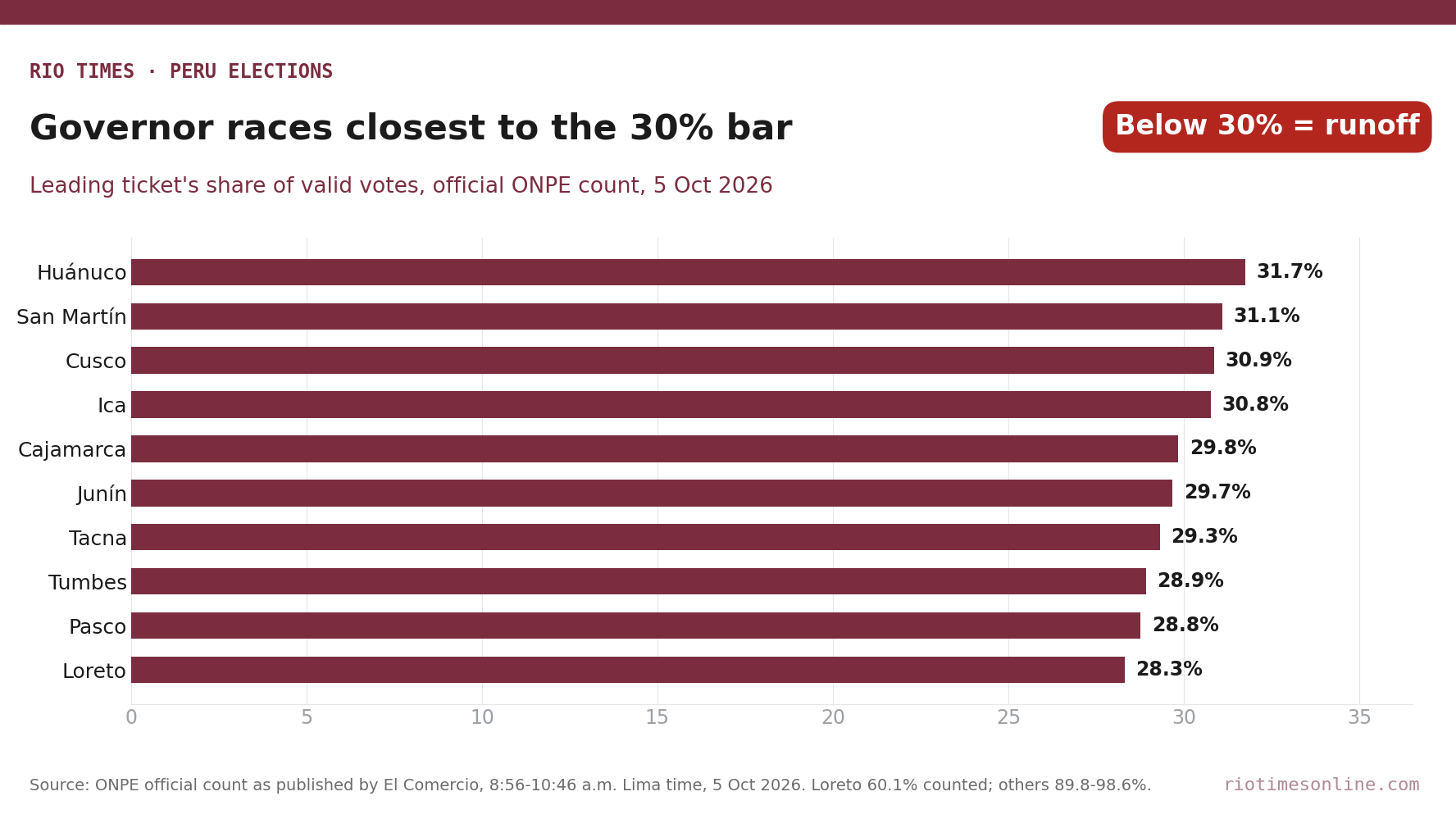
- The numbers Closest misses: Cajamarca 29.659%, Junín 29.673%, Tacna 29.32%. Narrowest passes: Ica 30.765%, Cusco 30.87%, San Martín 31.086% (ONPE, 5 October).
- What it means for you Expect local campaigning until 6 December in copper regions such as Arequipa, Moquegua and Tacna. Mines run under national permits and are not on the ballot.
- Still open The vote is called: Supreme Decree 150-2026-PCM sets the runoff for Sunday 6 December in 15 regions.
This story is part of our coverage of the Peru regional runoff 2026. The official date, the regions in the runoff and how it works are in our Peru regional runoff guide.
Peru holds governor runoffs in 15 of 25 regions on Sunday 6 December, after the first-round count of the 4 October vote and a decree of 10 November. They include Arequipa, Moquegua, Tacna and Cajamarca, home to mines run by US-listed Freeport-McMoRan, Southern Copper and Newmont.
In those 15 races, no ticket reached the 30% of valid votes needed to win in the first round. The figures come from ONPE, the national electoral office, as published by the Lima daily El Comercio between 8:06 and 10:46 a.m. Lima time.
Fifteen Regions Below the Bar
Peru elects its regional governors under a simple rule. A ticket needs at least 30% of valid votes, or the top two meet again.
The national elections jury (JNE) first set Sunday 29 November for that second round and moved it to Sunday 6 December on 7 October. See Peru Sets Regional Election Runoff for December.
Mayors face no runoff, so Lima’s close race ends on the first count. See Lima Vote Count at 60.6%: López Aliaga List Leads.
For the date, the legal basis and the latest counts, read our guide to the Peru regional runoff 2026. ONPE’s own plan of 14 October now gives the same figure of 15 regions as an estimate.
On Monday morning’s official figures, 15 regions fell short. They are Amazonas, Áncash, Arequipa, Cajamarca, Junín, La Libertad, Lambayeque, Lima region, Loreto, Moquegua, Pasco, Piura, Puno, Tacna and Tumbes.
Ten regions had a leader above 30%. Callao was the clearest, where Pedro Spadaro had 51.73% with 97.655% of tally sheets counted.
Spadaro, who resigned as Callao’s provincial mayor in March to run, is the candidate of Renovación Popular, the conservative party led by Rafael López Aliaga. Verónika Mendoza, a former presidential candidate, led Cusco for Venceremos, a left-wing alliance, with 30.87% at 89.832% counted.
RPP had her ticket at 30.481% earlier on Monday, so her margin over the bar grew as counting went on. The other outright leaders were in Apurímac, Ayacucho, Huancavelica, Huánuco, Ica, Madre de Dios, San Martín and Ucayali.
In Madre de Dios, Ahora Nación, the left-wing party of economist Alfonso López Chau, its April presidential candidate, had 36.477% with 92.955% counted.
How the Official Count Redrew the Exit Poll
Sunday night’s exit poll by Datum, a Lima polling firm, pointed to up to 14 runoffs. See Peru Exit Poll Points to Up to 14 Regional Runoffs.
The official count keeps the total close but changes several names. Cajamarca, Junín, Pasco and Tacna now look headed for a second round.
Datum’s exit poll had all four leaders above 30%. Its later quick count already showed Pasco and Tacna below the bar.
In Tacna, Alianza para el Progreso had 29.32% with 98.646% counted, a share Diario Correo also reported. The party was founded by businessman César Acuña.
In Cajamarca, Somos Perú stood at 29.659% with 98.653% counted, just 0.341 points short (El Comercio, ONPE). In Junín, Podemos Perú, founded by José Luna Gálvez, had 29.673% with 90.815% counted.
In Pasco, Frente de la Esperanza 2021, the party of former presidential candidate Fernando Olivera, had 28.509% with 98.479% counted, ahead of Podemos Perú at 24.403%. Three regions moved the other way.
Huancavelica, Ica and Ucayali each had a leader above 30%, with Ucayali’s Somos Perú ticket highest at 35.264%. Ica’s pass is the narrowest, at 30.765% with 98.069% counted.
In Huánuco, País para Todos, which Datum had at 31.6%, stood at 31.44% with 88.46% counted. The party, whose president is Vladimir Meza, ran comedian Carlos Álvarez for president in April.
The Copper Regions at Stake
For US readers, the map matters because of copper. Peru is one of the largest producers of the metal, and much of its output comes from the south.
Arequipa hosts Cerro Verde, majority-owned by Phoenix-based Freeport-McMoRan. There, Fuerza Arequipeña, the regional movement of former Arequipa mayor Alfredo Zegarra, led with 25.301% at 97.973% counted.
Ahora Nación was second at 14.4%. Moquegua and Tacna host the Cuajone and Toquepala mines of Southern Copper.
The company trades in New York and is controlled by Grupo México, the Mexican mining group of Germán Larrea. Moquegua is the tightest of the copper races.
Acción Popular, the party founded by former president Fernando Belaúnde, had 26.028% and Somos Perú 25.185% with 98.077% counted. Cajamarca is home to Yanacocha, the gold mine run by Denver-based Newmont.
Its leader was about a third of a point below the bar.
Close Fights in La Libertad and Puno
La Libertad, home to the coastal city of Trujillo, has a near tie for first place. Somos Perú had 24.793% and Podemos Perú 24.458% with 97.376% counted.
Both look set for the runoff, as the third-placed ticket trails with 18.56%. Puno has a three-way race for two runoff places.
ASI-Juntos por el Perú had 22.49%, Ahora Nación 21.267% and País para Todos 20.073% at 98.047% counted. Juntos por el Perú is the left-wing party of Roberto Sánchez, an ally of former president Pedro Castillo.
The Lima region, which surrounds but excludes the capital, is just as close. Somos Perú had 16.282% and the Renovación Popular alliance 16.016%.
What It Means for You
For investors in Freeport-McMoRan, Southern Copper and Newmont, a runoff does not halt mining. Large concessions are granted by the national government, and sitting governors stay in office until the new term begins in 2027.
Governors do shape local permits, roads and how protests near mines are handled. Expect local campaigning until 6 December in Arequipa, Moquegua, Tacna and Cajamarca before the runoff.
For travellers, little changes in the short term. The runoffs are local contests, and mayors’ races, including Lima’s, end on the first count.
What Is Not Known
The national elections jury (JNE) told the government that 15 regions need a second round. President Keiko Fujimori signed Supreme Decree 150-2026-PCM, an order from the president, on 10 November, and the official gazette El Peruano published it on 11 November.
We have not confirmed the final pairings of candidates in each region. The decree does not list the 15 regions in the text we read.
The JNE agreed to the 6 December date on 7 October, moving it from 29 November. ONPE, the national electoral office, had asked for more time, saying it needed an extra week to produce and move electoral material.
More: Peru news in English, every day from The Rio Times.
Frequently Asked Questions
Which Peruvian regions are heading for a governor runoff?
On ONPE’s official count on 5 October, 15 regions had no ticket above 30%. They are Amazonas, Áncash, Arequipa, Cajamarca, Junín, La Libertad, Lambayeque, Lima region, Loreto, Moquegua, Pasco, Piura, Puno, Tacna and Tumbes. The list becomes final only after electoral juries rule on disputed tally sheets.
Why does Peru hold regional runoffs but not mayoral ones?
Peru’s regional elections law requires a governor ticket to win at least 30% of valid votes in the first round. Mayors are elected by simple plurality, so the list with most votes wins and there is no second round.
Do the Peru regional runoffs affect US mining companies?
Not directly. Large mining concessions are granted by the national government, and mines keep operating. Governors in regions such as Arequipa, Moquegua and Tacna do influence local permits, roads and how protests near mines are handled.
Sources: ONPE regional results via El Comercio (Tacna page; series for all 25 regions), 5 Oct 2026 (elcomercio.pe); Andina, La Libertad count at 95.48%, 5 Oct 2026 (andina.pe); RPP, live ONPE regional count, 5 Oct 2026 (rpp.pe); La República, live ONPE count incl. Callao, 5 Oct 2026 (larepublica.pe); ATV, Datum exit poll and JEE timetable, 4 Oct 2026 (www.atv.pe); Diario Correo/EFE, Datum projection, 4 Oct 2026 (diariocorreo.pe); RPP, ONPE asks JNE to reconsider runoff date, 3 Oct 2026 (rpp.pe); JNE, plenary agreement of 7 October 2026 (gob.pe); ONPE, operating plan for the Second Regional Election, 14 October 2026 (gob.pe).
This article was produced by The Rio Times’ automated AI newsroom. Editorial responsibility: Matthias Camenzind, Publisher and Editor-in-Chief. The Rio Times also runs Ask Rio Times, which answers from 100,000+ of our own articles, the daily Latin America Power Map, and prediction-market odds on elections and markets.. How we use AI · Report an error
Brazil runoff, Sunday, October 25: Brazil runoff: date, poll closing times and when results start. Latest: Brazil runoff polls, Flávio 51%, Lula 49%.