Peru Pushes Regional Runoff Back a Week to 6 December

POLITICS · PERU
Key Facts
- —The country Peru elected regional governors and mayors on Sunday 4 October. A governor needs at least 30% of valid votes to win outright.
- —Why it matters Regions with runoffs include Arequipa, Cajamarca and Moquegua, home to large copper and gold mines run by US-listed companies.
- —Why now The vote-counting agency ONPE said it could not run a runoff before 6 December. El Niño risks to transport weighed on the decision.
- —What happened On Saturday 10 October the electoral court JNE made public its decision to move the runoff from 29 November to Sunday 6 December.
- —The numbers At least 11 regions look set for a runoff. Electoral juries had received 6,930 disputed tally sheets and resolved 2,402 by Friday.
- —What it means for you Travellers to Arequipa, Puno or Cajamarca in early December should plan around a Sunday vote. Investors get one more week of uncertainty.
- —Still open The final list of runoff regions, which depends on recounts that must finish by Wednesday 28 October, and President Keiko Fujimori’s formal decree.
The Peru regional runoff will take place on Sunday 6 December, a week later than planned. Peru’s National Jury of Elections (JNE) made the change public on Saturday 10 October. It affects at least 11 regions, several of them home to big copper mines owned by US-listed companies.
The JNE is Peru’s top electoral court. It had first set the second round for Sunday 29 November. The National Office of Electoral Processes (ONPE), which prints ballots and runs polling stations, objected. It said it could not organise a vote safely before 6 December.
The court has now agreed. Its decision covers every region where no candidate for governor reached 30% of valid votes in the first round on Sunday 4 October.
Why the Electoral Court Changed the Date
The decision follows a public dispute between Peru’s two main electoral bodies. Bernardo Pachas, the interim head of ONPE, appeared before the JNE’s full bench on Wednesday 7 October to argue for a later date. El Comercio dates the court’s agreement to that same day, but it was not made public until Saturday.
ONPE said purchasing rules and the time needed to print and ship ballots left no room for 29 November. “We cannot race against the deadlines,” Pachas told the radio network RPP. He warned that a rushed schedule risked breaking down at the ballot printer.
Roberto Burneo, the president of the JNE, had said the court would study ONPE’s request and seek an institutional consensus. The final text of the agreement reads that the court will “request in due course” that the president of the republic formally call the vote.
According to El Comercio, the court cited the logistical complexity of a runoff in more regions than in past elections. It also cited the risk that El Niño weather could disrupt the transport of ballots by road and air.
The JNE ordered ONPE to take the administrative, budget and logistical steps needed to run the vote, according to Infobae. It also notified the armed forces, the national police, the comptroller’s office and the prosecutor’s office.
Which Regions Are Heading to a Second Round
The count is not finished, so the list is provisional. With more than 98% of tally sheets counted, RPP’s election desk listed 11 regions where no candidate passed 30%.
They are Amazonas, Áncash, Arequipa, Cajamarca, Junín, Lambayeque, Moquegua, Pasco, Puno, Tacna and Tumbes. In each one, the two leading tickets for governor and vice-governor would face each other again.
The Peru regional runoff applies only to governors. Mayors, including the mayor of Lima, are elected in a single round. Earlier coverage of the expected match-ups is in our Full List of Peru’s 29 November 2026 Runoffs, which the new date now supersedes.
Before the list is final, Peru’s special electoral juries (JEE), the local first-instance electoral courts, must resolve disputed tally sheets. ONPE has until Sunday 11 October to hand over every observed sheet.
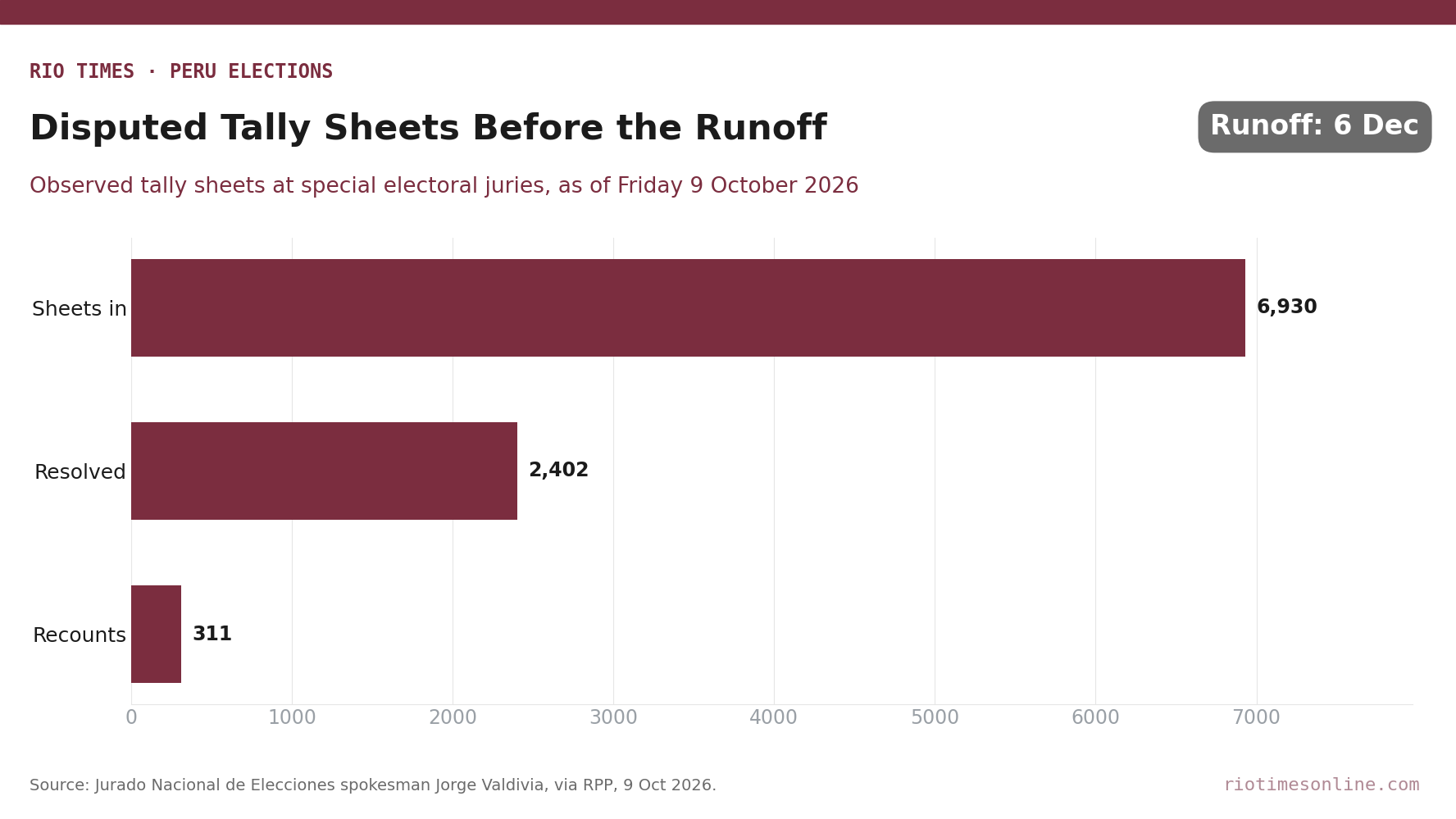
By Friday 9 October the juries had received 6,930 observed sheets and resolved 2,402, JNE spokesman Jorge Valdivia told RPP. They had also ordered 311 recounts. The first recount hearing is set for Monday 12 October in Atalaya, in the Amazon region of Ucayali.
Recount hearings for regional races must end by Wednesday 28 October. Only then will the JNE know exactly which regions vote again on 6 December.
What It Means for You
For investors, the Peru regional runoff matters because regional governments shape local mining politics. They receive a share of mining taxes and deal directly with communities near the mines.
Several runoff regions are mining heartlands. Arequipa hosts Freeport-McMoRan’s Cerro Verde copper mine. Cajamarca hosts Newmont’s Yanacocha gold mine. Moquegua hosts Southern Copper’s Cuajone copper mine. All three parent companies trade in New York.
The extra week does not change who can win. It does extend the campaign season, and with it the window for local protests or promises on mining. The new governors’ policies will only become clear after they take office.
For travellers, the runoff falls on a Sunday in early December. Arequipa and Puno, the gateway to Lake Titicaca, are both on the provisional list. Expect busier transport and some local restrictions around polling day. Check with your hotel or tour operator before booking.
Our Peru Regional Runoffs on 29 November: Expat Guide explains the practical rules, but its date is now out of date.
What Is Not Known
The final number of runoff regions is not known. Recounts and rulings on disputed sheets could still push a candidate above or below 30%.
President Keiko Fujimori, who leads the conservative Fuerza Popular party, must still issue the decree that formally calls the vote. No date for that decree has been announced.
It is also unclear whether ONPE will need extra money for the runoff, or whether the armed forces will fly ballots to areas hit by El Niño weather. Neither body had published details by Saturday evening.
The calendar change itself is settled. With both electoral bodies now on the same date, the main source of friction in this election has eased.
Frequently Asked Questions
When is the Peru regional runoff?
The runoff for regional governors is on Sunday 6 December 2026. Peru’s electoral court moved it from 29 November at the request of the vote-counting agency ONPE.
Which regions will vote in the runoff?
The list is provisional. With over 98% counted, 11 regions had no candidate above 30%: Amazonas, Áncash, Arequipa, Cajamarca, Junín, Lambayeque, Moquegua, Pasco, Puno, Tacna and Tumbes.
Does Lima have a runoff for mayor?
No. Mayors in Peru, including the mayor of Lima, are elected in a single round. Only regional governors face a second round.
Sources: RPP, JNE agreement on the 6 December runoff, 10 October 2026; RPP, regions heading to a runoff, 9 October 2026; El Comercio, 10 October 2026; El Comercio, ONPE position, 7 October 2026; Infobae Peru, 10 October 2026.
This article was produced by The Rio Times’ automated newsroom system. How we use AI · Report an error · Editorial responsibility: Matthias Camenzind, Editor-in-Chief