Iron Ore Miners Slide as Vale Rebounds from 12-Month Low
Key Facts
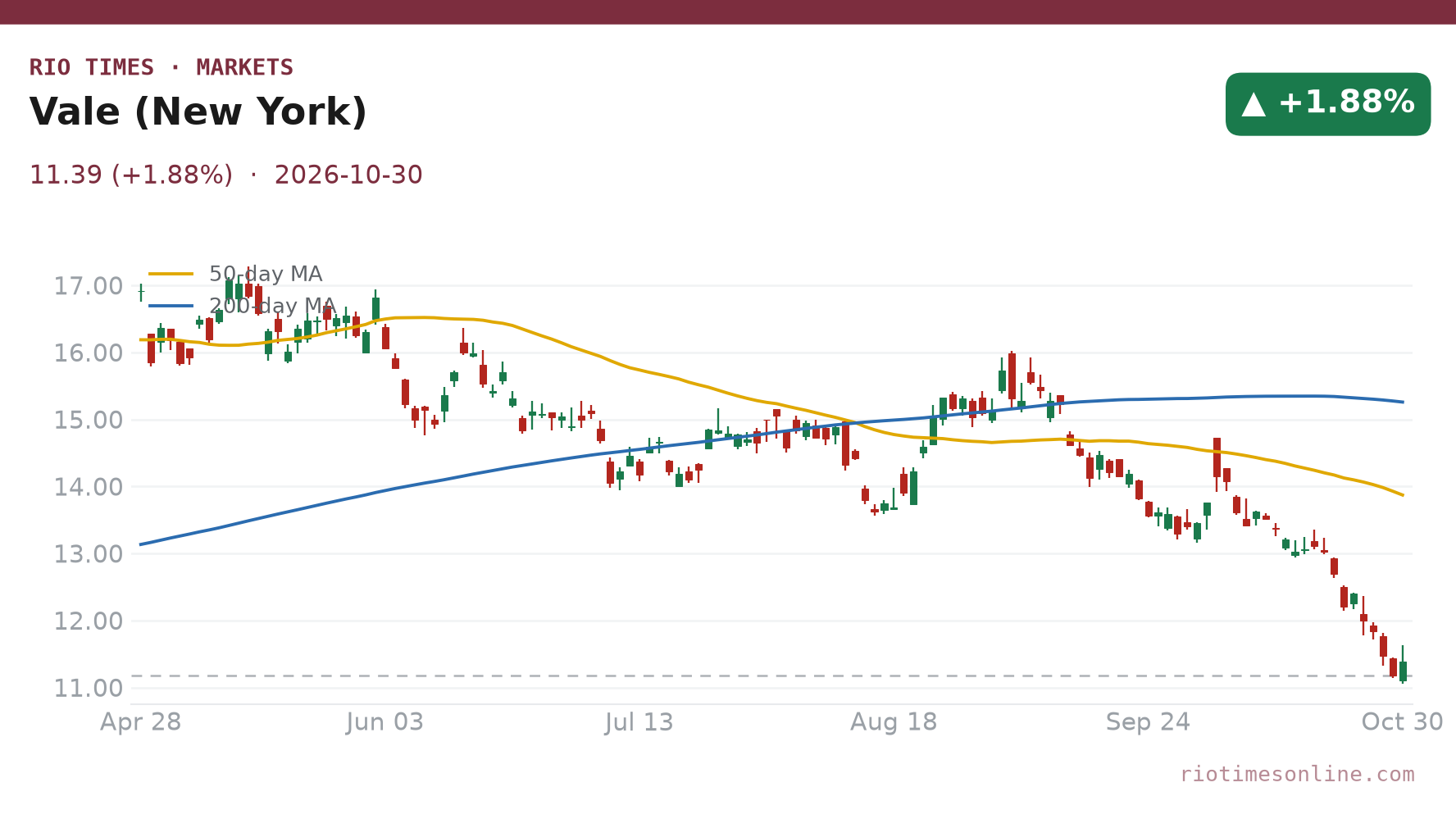
- Vale, the Brazilian iron ore giant, bounced 1.88% to US$11.39 in New York on October 30, 2026. That came one day after its shares closed at a 12-month low of US$11.18, and Vale is still 36.1% below its April high.
- In Sao Paulo, Vale rose 3.28% to R$62.02 (about US$11.40). CSN Mineração, the mining arm of steel group CSN, jumped 8.00% to R$4.86 (about US$0.89).
- Rio Tinto, the British-Australian miner, fell 1.63% to US$81.89, a six-month low close. BHP, the Australian giant, fell 3.25% to US$79.16.
- Brazilian steelmakers fell hard. Usiminas, a Brazilian steel producer, lost 8.59% to R$5.00 (about US$0.92) and steel group Companhia Siderúrgica Nacional lost 8.49% to R$3.88 (about US$0.71).
- Wall Street set the tone. The S&P 500, a US stock index, fell 1.82% and the Nasdaq 2.86% after chipmaker Intel and cloud giant Amazon reported.
- Next test: Vale’s low of US$11.18. A close below it opens the way to US$10, while a close above US$11.84, Tuesday’s level, would show buyers returning.
Today’s Focus
Iron ore miners were split on Friday, October 30, 2026: Rio Tinto and BHP, two global mining giants, fell with the rest of Wall Street, while Vale, the Brazilian giant, bounced from a 12-month low. Vale’s New York shares rose 1.88% to US$11.39, and its Sao Paulo shares rose 3.28% to R$62.02 (about US$11.40).
The sell-off in the US, with the S&P 500 down 1.82% after results and AI-spending plans from chipmaker Intel and cloud giant Amazon, pulled Rio Tinto down 1.63% to US$81.89. Vale’s rebound looks like buyers stepping in after a week of heavy selling around its third-quarter report, in which profit fell 53% to US$1.255 billion as the price it received for its ore dropped 10%.
Behind the day’s noise is a market that has been under pressure for months: China’s steel makers earn little, and a large new supply of ore from Guinea is arriving. Iron ore futures in Dalian fell to about 660 yuan a tonne (about US$99) on October 27, their lowest since September 2024.
For a US reader this matters because Vale and Rio Tinto are widely held in US funds, and a weak ore price lowers their dividends. For Brazil, iron ore is the country’s biggest mining export, so Vale’s results shape tax income, jobs in Minas Gerais and Para, and the real.
What matters today. Vale’s bounce may not last because the ore price and China’s steel demand have not improved, and the next test is its 12-month low of US$11.18.
01 The Session in One Read
Friday, October 30, 2026 split the iron ore miners. Rio Tinto fell 1.63% to US$81.89, its lowest close in at least six months, and BHP fell 3.25% to US$79.16.
Vale went the other way, rising 1.88% to US$11.39 in New York after it had closed at a 12-month low of US$11.18 on Thursday. In Sao Paulo its shares rose 3.28% to R$62.02 (about US$11.40), and CSN Mineração, the mining arm of Brazilian steel group CSN, jumped 8.00% to R$4.86 (about US$0.89).
The difference tells the story: Vale had already fallen hard around its results, so a market-wide sell-off found fewer sellers left. That is a bounce, not yet a change of direction.
We rank the causes by weight: weak Chinese steel demand and rising supply (confidence medium-high), the Wall Street risk-off sell-off on Friday (confidence high for the day’s direction), and a bounce in Vale after a heavy fall (confidence low, because no single trigger is confirmed). The ranking is our own judgement.
The variable to watch is the iron ore price in Dalian, because a lasting rebound in Vale needs it to stop falling. Without that, the bounce is a pause, not a turn.

02 The Board
Vale’s New York shares and Rio Tinto are proxies for the iron ore price, which is not on our board. CSN Mineração is the Brazilian-listed pure iron ore miner of the group.
Over five sessions Vale is down 8.15%, and over 20 sessions it is down 17.22%. CSN Mineração still trades about 30% below its 10 September high of R$6.99.
| Asset | Level | Change |
|---|---|---|
| Iron ore (Vale) | US$11.39 | +1.88% |
| CSN Mineração | R$4.86 | +8.00% |
| Rio Tinto | US$81.89 | -1.63% |
Source: RT close, 2026-10-30. Where a commodity has no spot feed, an exchange-traded tracker or leading producer is shown as a labelled proxy.
Live Market IntelligenceThe live market board
Rio Times · Live Market Intelligence
Latin America — Cross-Market Board
| Instrument | Last | Change | YoY | Prev. | High | Low | Volume |
|---|---|---|---|---|---|---|---|
| IBOV | 167,921.80 | -0.75% | +19.56% | 169,186.42 | 178,526 | 175,157 | — |
| IPSA | 10,253.96 | -2.76% | — | 10,545.26 | 10,722 | 10,633 | — |
| IPC MEX | 69,705.03 | -0.12% | +12.74% | 69,787.41 | 70,008 | 69,383 | 49,372,306 |
| MERVAL | 92,079 | -2.59% | +12.65% | 2,859,051 | — | — | — |
| COLCAP | 2,490.92 | +0.04% | — | — | — | — | — |
| USD/BRL | 5.34 | -1.32% | -0.84% | 5.42 | 5.42 | 5.30 | — |
| EUR/BRL | 5.95 | +7.53% | -4.87% | 5.54 | 6.04 | 5.92 | — |
| USD/MXN | 18.69 | +0.62% | +1.45% | 18.57 | 18.69 | 18.54 | — |
| USD/CLP | 983.47 | -0.57% | +5.64% | 989.13 | 991.87 | 979.07 | — |
| USD/COP | 3,149 | +3.06% | -18.02% | 3,056 | 3,173 | 3,111 | — |
| USD/PEN | 3.45 | +0.17% | +3.85% | 3.44 | 3.45 | 3.44 | — |
| USD/ARS | 1,537 | -0.28% | +3.77% | 1,541 | 1,541 | 1,537 | — |
| USD/UYU | 40.21 | +3.57% | +2.29% | 38.83 | 40.21 | 40.08 | — |
| USD/PYG | 5,803 | +3.78% | -16.54% | 5,592 | 5,803 | 5,735 | — |
| USD/BOB | 11.97 | +4.93% | +77.92% | 11.41 | 11.97 | 11.82 | — |
| USD/DOP | 60.54 | +1.83% | -4.34% | 59.45 | 61.14 | 59.85 | — |
| USD/CRC | 451.24 | +2.13% | -7.80% | 441.83 | 451.40 | 450.04 | — |
| USD/GTQ | 7.64 | +3.23% | +2.18% | 7.40 | 7.64 | 7.64 | — |
Live Company IntelligenceVale SA ADR — the full investor dossier
Price & risk
$10.9152-wk high
$17.44
03 Why Iron Ore Miners Moved
The first cause is the Wall Street sell-off: the S&P 500 fell 1.82% and the Nasdaq 2.86% after chipmaker Intel and cloud giant Amazon reported results and described their AI-spending plans, and the VIX, which tracks expected swings in US stocks, rose 12.91%. When investors cut risk, miners are sold because their earnings depend on the global economy, which is why Rio Tinto and BHP fell.
The second cause is the ore market itself: Dalian iron ore futures touched 660 yuan a tonne (about US$99) on Tuesday, October 27, the lowest since September 2024, because Chinese steel mills make little money and ore stocks at ports are high. China’s official data show crude steel output down 2.9% in the first nine months of 2026, while iron ore imports rose 4.1%, so supply is growing while demand shrinks.
The third cause is company news: Vale reported on Thursday, October 29 that third-quarter profit fell 53% from a year earlier to US$1.255 billion, that iron ore output fell 6% to 88.4 million tonnes and that the price it received for its ore fell 10% to US$85.1 a tonne. Its copper price rose 56%, which cushioned the blow, and our report on the results is in the Background link below.
Vale’s Friday rebound is best explained by relief after a week of heavy selling, because the report did not contain a new surprise on Friday; we put low confidence on that reading. Brazilian steelmakers fell the most, with Usiminas down 8.59% after its own quarterly report, because cheaper ore does not help them when steel demand is weak.
04 The Trend Behind It
This is a continuation of a long decline. Vale is 36.1% below its 12-month high of US$17.82 from 20 April, and it has lost 22.6% over the last 60 sessions.
Rio Tinto is 26.9% below its 12-month high of US$112.04 from 13 May, and it has lost 17.8% over 60 sessions. CSN Mineração sits about 30% below its 10 September high.
Our own price history adds a base rate: after earlier 20-session falls of this size, Vale was higher 20 sessions later in 20 of 37 cases, just over half, with a median gain of 0.7% and a worst case of a 43.4% fall. Rio Tinto was higher in 25 of 46 cases, also just over half, with a median gain of 1.9%; history is not a forecast.
05 What It Means for the US, Brazil and Australia
For US investors, Vale and Rio Tinto pay large dividends, and a lower ore price shrinks them. Cheaper ore helps steelmakers that buy it, but Friday showed that weak steel demand can hurt them more than cheap ore helps.
For Brazil, iron ore is the country’s largest mining export, so a lower price cuts export income, royalties and tax payments, and Vale’s profit has already fallen by more than half. For Australia, BHP and Rio Tinto earn most of their profit from the same ore, so Australian-linked miners feel the same pressure as Vale.
Chile and Argentina are not large iron ore exporters, so the direct effect there is small. The link is China: weaker Chinese demand also weighs on copper, Chile’s main export, and Southern Copper fell 7.42% on Friday.
06 The Names to Watch
Vale is the first name to watch, because it holds a 12-month low that was set on Thursday and is the main American-listed way to follow Brazil’s mining sector. Its copper business, where the price it received rose 56% to US$15,314 a tonne, is the part of the company that is growing.
Rio Tinto and BHP are the global benchmarks and tell us whether the pressure is spreading beyond Brazil. Usiminas and CSN, the Brazilian steelmakers, show whether weak steel prices are hurting the whole chain.
07 What Would End It
The first test is Vale’s 12-month low of US$11.18: a close below it would open the way to US$10, while a close above US$11.84, the level of Tuesday, October 27, would show that buyers have returned. For Rio Tinto, the 12-month low of US$67.89 from 4 November 2025 is far away, but a close above US$85.74, Tuesday’s close, would be the first sign of recovery.
The second test is the Dalian price against 660 yuan, the level touched on October 27. A move back above 700 yuan, together with higher Chinese steel output in the data due in mid-November, would suggest demand is catching up with supply.
The honest answer to whether this stops soon is that the Wall Street part can fade within days, while the ore part needs either Chinese steel mills to earn more money or the big miners to cut shipments. Until one of those happens, bounces are likely to be sold.
08 What to watch
- Vale’s low: Whether the New York shares hold US$11.18 on Monday, November 2 and the days after.
- Dalian futures: Whether the most-traded contract stays near 660 yuan a tonne or recovers above 700 yuan.
- China steel data: Chinese output and import figures in mid-November, which show whether mills are buying more ore.
- Guinea supply: The pace of new ore shipments from Guinea, which adds to supply in an already well-supplied market.
Background: Vale Copper Price Jumps 56% as Ore Falls.
Frequently Asked Questions
Why did Vale shares rise on Friday?
Vale rebounded 1.88% in New York after closing at a 12-month low on Thursday. We read it as relief after heavy selling, with low confidence, because no new news was confirmed.
Why did Rio Tinto and BHP fall?
A Wall Street sell-off hit all miners, with the S&P 500 down 1.82% on Friday. Weak steel demand in China and rising ore supply also weigh on both companies.
Is the iron ore price itself falling?
Dalian futures touched 660 yuan a tonne on October 27, the lowest since September 2024. We show Vale, Rio Tinto and CSN Mineração as proxies, because the ore price is not on our board.
What does this mean for Brazil?
Iron ore is the country’s largest mining export, so a lower price cuts export income and tax receipts. Vale’s profit fell 53% in the third quarter.
Market data: The Rio Times
Primary sources: Vale investor relations; B3, the Brazilian stock exchange; Dalian Commodity Exchange.
This article was produced by The Rio Times’ automated newsroom system. How we use AI · Report an error · Editorial responsibility: Matthias Camenzind, Editor-in-Chief
LatAm Markets: Live Signals → — real-time movers, turnover leaders and FX across Latin America.