Honduras 2027 Budget Puts University Behind Defence

ECONOMY · HONDURAS
Key Facts
- —The country Honduras, Central America’s second-most populous nation, is debating a draft 2027 budget of L455.37bn (about US$17.0bn) sent to Congress in September 2026.
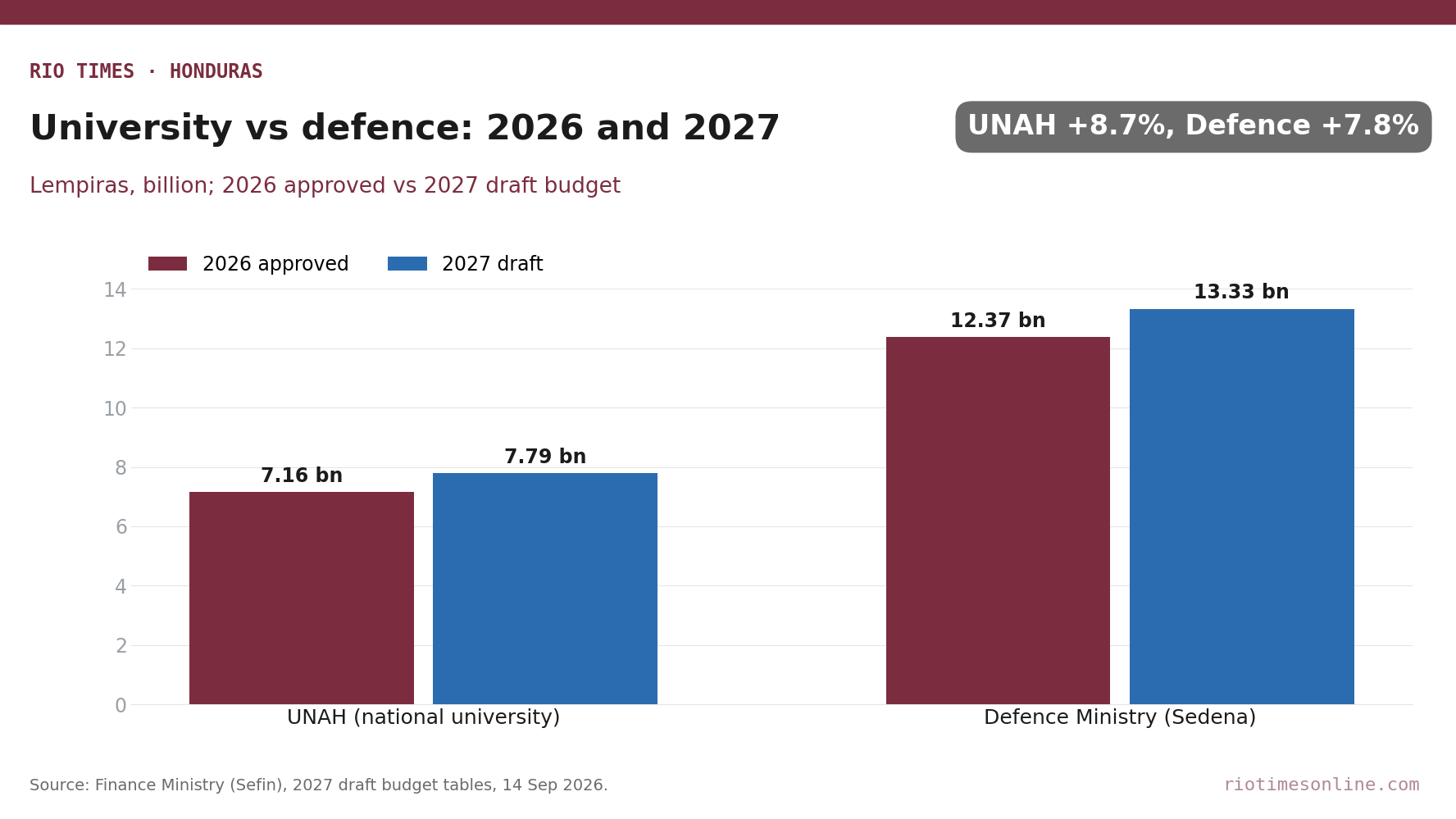
- —What happened On 2 October 2026, Criterio.hn reported that the draft gives the national university, UNAH, L7.79bn (about US$290m) and the Defence Ministry L13.33bn (about US$497m).
- —The numbers Against 2026 approved figures, UNAH rises 8.7% and Defence about 7.8%, according to Finance Ministry draft tables dated 14 September 2026. The whole budget grows 2.5%.
- —What it means for you UNAH serves more than 80,000 students. Its leaders warn of strain on maintenance, laboratories and equipment if the figure stands.
- —Still open Congress sent the draft to its budget committee on 21 September 2026 and has not voted. Lawmakers can still move money between institutions before approval.
The Honduras 2027 budget draft gives the National Autonomous University of Honduras (UNAH) L7.79bn (about US$290m). The Defence Ministry, known as Sedena, would receive L13.33bn (about US$497m) for its operations.
The figures were published on 2 October by Criterio.hn, an independent news site in Tegucigalpa, and match Finance Ministry draft tables. Lempira amounts are converted at 26.85 per US dollar, the rate on 2 October 2026.
How the two budget lines compare
Finance Ministry tables put the university’s approved 2026 budget at L7.16bn (about US$267m). The 2027 draft adds L626m (about US$23m), an increase of 8.7%.
Defence received L12.37bn (about US$461m) in 2026, according to the Finance Ministry’s approved spending budget. The 2027 draft lifts that by about L963m (about US$36m), or roughly 7.8%.
The draft also sets aside L12.33bn (about US$459m) for the Military Pension Institute (IPM), the armed forces’ social security fund. UNAH notes that Defence and the IPM together come to L25.66bn (about US$956m).
That combined figure mixes two different things, however. Pension and social security payments are obligations to retired soldiers, not spending on troops or equipment.
What the university says
The university’s governing board, the Junta de Dirección Universitaria (JDU), calls the 2027 figure insufficient for an institution responsible for public higher education across the country. Its head, economist Mauricio Díaz Burdett, compared the university and Defence lines directly.
The board will ask the university council to adopt a multi-year budget, planning income and spending over three to five years. The aim is steadier funding than a single annual allocation allows.
Juan Umanzor, who coordinates the university’s economics observatory, said spending plans are ready. His main request is that the money arrive on time and not in instalments.
The wider budget picture
The executive of President Nasry Asfura sent the draft to Congress with a total of L455.37bn (about US$17.0bn), El Heraldo reported. That is 2.5% above the budget approved for 2026.
Both lines grow faster than the budget as a whole, the university by 8.7% and Defence by 7.8%. The gap is one of scale: the Defence line is 1.7 times larger.
The draft is already under scrutiny for other reasons. Rio Times reported that the Honduras 2027 Budget Draft Keeps Congress and Presidency Spending Secret.
The picture is not one of cuts. Economist Mario Sosa told Criterio.hn the academic offer is being maintained, and that university funding pays back through skilled workers.
What Is Not Yet Known
Criterio.hn gave L7.75bn as the university’s final 2026 budget, a sum Finance Ministry tables list as the 2025 figure. Against that base, the 2027 draft would be almost flat.
It is also unclear whether Congress will move money towards UNAH during committee hearings. For background on the government, see Who Is Nasry Asfura, the President of Honduras in 2026.
Sources: Criterio.hn, 2 Oct 2026; El Heraldo, 21 Sep 2026; Finance Ministry (Sefin), 2027 draft budget tables for Defence and UNAH, 14 Sep 2026.
This article was produced by The Rio Times’ automated newsroom system. How we use AI · Report an error · Editorial responsibility: Matthias Camenzind, Editor-in-Chief