
ETHIOPIA · ENERGY
Key Facts
- The country Ethiopia, Africa’s second most populous nation, has no sea coast and buys its refined fuel abroad.
- Why it matters Imported fuel is among Ethiopia’s largest foreign currency costs, so home-grown gas could ease dollar pressure.
- Why now The first 26 gas-converted city buses entered service in Addis Ababa, announced on 29 October 2026.
- What happened The prime minister announced the buses, a 50% fare cut and 400 more gas buses arriving soon.
- What it means for you Travelers see little change yet; investors get a first test of Ethiopia’s gas-for-fuel plan.
In Plain English
Natural gas buses are ordinary city buses whose engines have been converted to burn gas instead of diesel. The government points to the Calub gas field in the Somali region, in the east of the country, as the local source.
A foreign currency expenditure is money that Ethiopia must pay in US dollars or other hard currencies. Fuel bought abroad is one example.
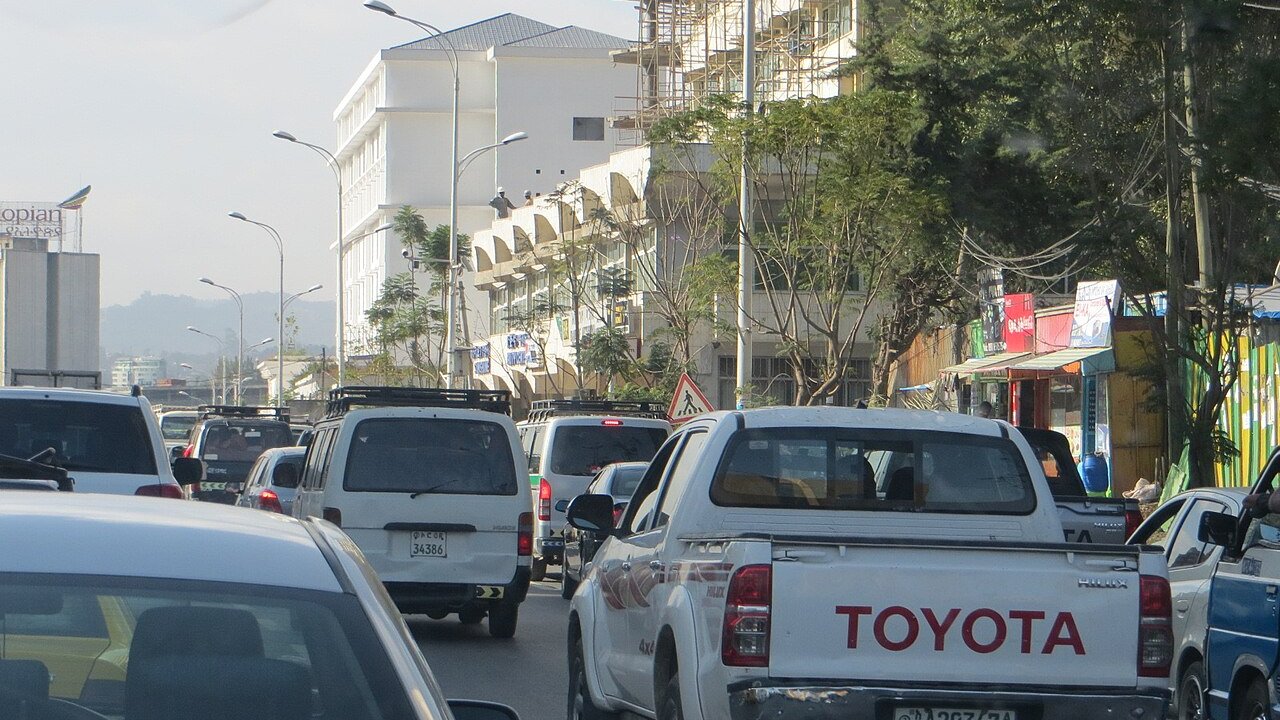
Ethiopia has put its first 26 city buses converted to run on natural gas into service in Addis Ababa, Prime Minister Abiy Ahmed announced on 29 October 2026. He called it a historic milestone that cuts foreign currency spending on fuel, lowers the running costs of public transport and halves passenger fares.
For US readers the story is about dollars more than buses, because the prime minister has named imported fuel and fertilizer as Ethiopia’s largest foreign currency expenditures. The announcement does not name the gas field, but the government has promoted the Calub site in the Somali region as the local source it wants to substitute for imported petrol and diesel, a push followed on the Ethiopia page.
What Was Announced
The prime minister said the conversion followed months of work to carry locally produced natural gas to the capital, set up refueling stations and retrofit existing buses. He added that the conversions were done inside Ethiopia, which he described as proof of growing domestic technical ability and technology transfer.
He also said that 400 additional new natural gas buses are expected to arrive soon as the country cuts its reliance on conventional fuels in public transport. He linked the project to what he called continued progress on food security, housing and transportation.
The statement as published gives no fare in birr, the national currency, no start date for the lower tariff and no name for the bus maker or the converting workshop. Until a tariff is posted, the fare cut remains the prime minister’s announcement rather than a price a passenger can pay.
Where the Gas Comes From
The government points to the Ogaden Liquefied Natural Gas Project at Calub, whose first phase the prime minister inaugurated on Thursday 2 October 2025 with an annual capacity of 111 million liters. He said a second phase, launched the same day, would add 1.33 billion liters a year.
At that ceremony he said the site can also support 1,000 megawatts of power generation and supply the input for fertilizer production. The Chinese developer GCL Group said the wider gas project would help close Ethiopia’s gap in gasoline, diesel and liquefied petroleum gas.
On 28 October 2025 the prime minister told parliament that gas and oil development in the Somali region was key to cutting inflation, because transport costs drive prices. He said the plan would begin by moving trucks and other locally owned vehicles to gas.
The government also announced in October 2025 that public transport and cargo vehicles powered entirely by natural gas can be imported duty free. It presented the measure as part of a strategy to promote local gas and reduce dependence on imported petroleum products.
Why Fuel Bills Weigh on Ethiopia
Ethiopia relies on imported refined fuel that reaches the country through Djibouti, and a US$660 million pipeline from Damerjog in Djibouti to Dewele in Ethiopia was launched on Thursday 24 September 2026. The project, led by the state wealth fund Ethiopian Investment Holdings with Nigeria’s Dangote Group, is meant to take less than two years to build, as earlier coverage of the pipeline described.
Supply came under strain earlier this year, when the prime minister asked fuel distributors, stations and consumers on 16 March 2026 to use oil economically because of the crisis in the Middle East. He said countries that buy and use oil had difficulty finding supply.
The National Bank of Ethiopia, the central bank, has sold dollars to commercial banks at auctions since 7 August 2024, and earlier coverage of the birr traced the latest pressure on the currency to the import bill. Gas that replaces diesel in the city fleet would reduce, in a small way, the dollars that have to be found for fuel.
What It Means for You
For a traveler to Addis Ababa the change is small for now, because 26 converted buses are a first batch and the 400 new ones are only expected. Visitors will meet the buses only if they use the city transit network, and no fare has been posted.
For investors and importers, the test is whether domestic gas starts to cut Ethiopia’s demand for dollars and hold down transport costs. The signals to watch are the arrival of the 400 buses, a published fare and progress on the second phase at Calub.
What Is Not Known
The fare in birr, the date the cheaper tariff starts and the number of refueling stations in Addis Ababa have not been published. It is also unclear whether the buses burn compressed or liquefied gas, who converted them and what each conversion cost.
No arrival date has been given for the 400 new buses, and no figure shows how much foreign currency the program will save. It is also unclear when the second phase at Calub will be finished and how much gas the capital will receive.
Frequently Asked Questions
Who announced Ethiopia’s natural gas buses?
Prime Minister Abiy Ahmed announced on 29 October 2026 that the first 26 converted city buses entered service in Addis Ababa. He also said 400 more new gas buses are expected soon.
How much cheaper will Addis Ababa bus fares be?
The prime minister said passenger fares will fall by half. No new fare in birr and no start date for the lower tariff has been published.
Where does Ethiopia’s natural gas come from?
The government points to the Calub field in the Somali region, where the first phase of a liquefied natural gas plant opened on 2 October 2025 with 111 million liters a year. A second phase would add 1.33 billion liters.
Does this matter to American travelers or investors?
For travelers the change is small for now, because only 26 buses are converted so far. For investors it is a first test of whether domestic gas can cut Ethiopia’s imported fuel bill.
Sources: Prime Minister Abiy Ahmed, announcement of the first 26 natural gas city buses, government news release of 29 October 2026; Prime Minister Abiy Ahmed, inauguration of the Ogaden Liquefied Natural Gas Project, 2 October 2025; Prime Minister Abiy Ahmed, address to the House of People’s Representatives, 28 October 2025; Government of Ethiopia, duty-free import of natural gas vehicles, 10 October 2025; Prime Minister Abiy Ahmed, call for economical fuel use, 16 March 2026; National Bank of Ethiopia, foreign exchange sale auctions.
This article was produced by The Rio Times’ automated newsroom system. How we use AI · Report an error · Editorial responsibility: Matthias Camenzind, Editor-in-Chief
Horn of Africa and the Red Sea
- Horn of Africa 2026: Why It Matters and Who Backs Whom
- Ethiopia’s Neighbors Explained, Ports, Eritrea, Somalia
- Eritrea Explained 2026, a Red Sea Country Guide
- Somalia Explained: Al-Shabaab, Somaliland, the Ports and the Fight Over a 2026 Vote