Cost of Living in Costa Rica: Budgets & Rent
Guides · Costa Rica
The stakes: The cost of living in Costa Rica is what residents actually pay, not what a tourist menu prints.
The facts: Consumer prices are falling and the colón is strong against the US dollar. Rent is the line that separates one town from the next.
The context: Every figure below is dated and attributed, because a cost-of-living number without a date is worth very little.
Key Facts
—The rate. The Ministerio de Hacienda published the Banco Central reference rate at 451.86 colón to the US dollar on 23 September 2026.
—The prices. The INEC index put consumer prices 0.17% below their year-earlier level in August 2026. That is a fortieth month below target.
—The month. A single person in Costa Rica spends about ¢437,346 a month (about US$968) before rent, on Numbeo’s September 2026 panel.
—The rent. A one-bedroom flat in a city centre runs about ¢383,959 (about US$850). Outside it, about ¢292,028 (about US$646).
—The health bill. Legal residents must join the Caja. The 2026 scale takes 7.05% to 19.11% of an assessed income, across five bands.
—The catch. Rent is where the spread lives. Apartment asking prices cleared US$15 a square metre in the dearest districts in March 2026.

What a Month Actually Costs
The cost of living in Costa Rica is best read as two numbers, not one. There is what you spend, and there is what you pay for a roof.
Numbeo’s Costa Rica panel, updated on 19 September 2026, puts one person at about ¢437,346 a month (about US$968) before rent. A family of four comes to about ¢1,624,442 (about US$3,595).
That panel rests on 1,291 price entries from 98 contributors over the preceding twelve months. It is crowd-sourced, so treat it as a well-dated sketch rather than an official statistic.
Colones are converted here at 451.86 to the US dollar. That is the Banco Central de Costa Rica reference selling rate, published by the Ministerio de Hacienda on 23 September 2026.
Rent, the Line That Moves Most
Rent is where two households on identical incomes end up living different lives. Numbeo’s September 2026 figures put a one-bedroom flat in a city centre at about ¢383,959 a month (about US$850).
The same flat outside the centre comes to about ¢292,028 (about US$646). Those are national averages across a country whose housing markets barely resemble one another.
The Global Property Guide, in research covering the second quarter of 2026, reports one-bedroom apartments at US$950 to US$1,200 a month. It puts two-bedroom units at US$1,100 to US$1,800 and three-bedroom units at US$1,300 to US$2,900.
Its average gross rental yield for Costa Rica is 7.63%, with Heredia at 8.69% and Escazú at 6.29%. Over the 36 months to May 2026 housing rents rose 3.67% while consumer prices fell 0.81%.
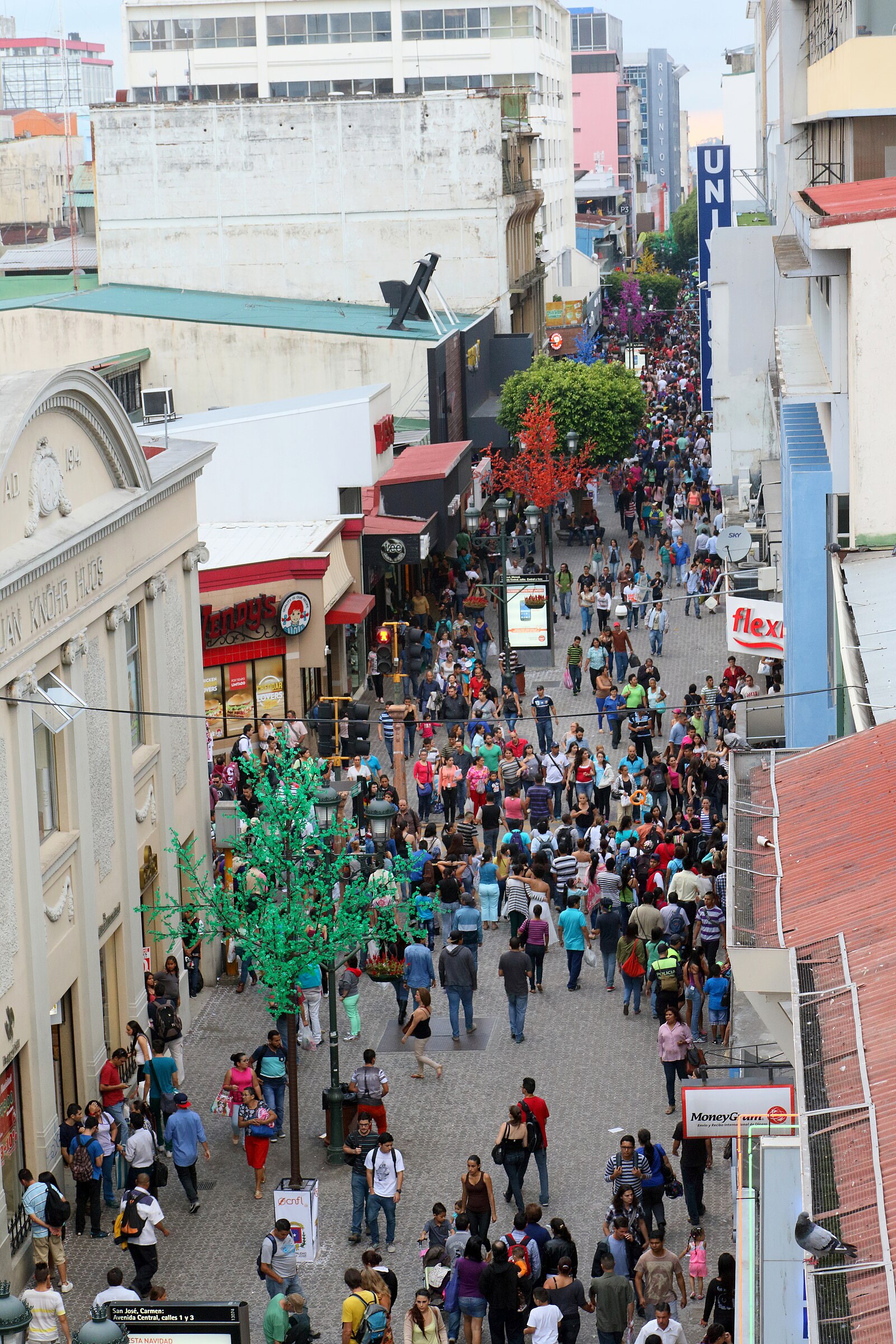
El Financiero mapped 70 districts of the Greater Metropolitan Area on 4 March 2026, using encuentra24 price guides. Apartments cleared US$15 a square metre in Mata Redonda, Cinco Esquinas, Carmen, Santa Ana and Merced.
Houses in that survey reached US$9 a square metre and never passed US$13. An 80 square metre two-bedroom came to roughly ¢600,000 a month (about US$1,328).
A day later the same paper priced an 80 square metre apartment in Escazú or Santa Ana at about US$1,200 a month. Central canton against outlying one is the largest single variable in any budget.
Food and Everyday Shopping
Supermarket prices are the part newcomers can check for themselves before they arrive. The Numbeo panel of 19 September 2026 gives a litre of milk at ¢1,077 (about US$2.38).
A 500 gram loaf of white bread is ¢1,448 (about US$3.20), a kilo of rice ¢565 (about US$1.25). Twelve eggs come to ¢1,823 (about US$4.03) and a kilo of chicken fillets to ¢2,134 (about US$4.72).
Local produce is where the country is genuinely cheap. Tomatoes run ¢691 a kilo (about US$1.53) and potatoes ¢699 (about US$1.55).
Imported apples, by contrast, cost ¢1,040 a kilo (about US$2.30), and beef round ¢2,838 (about US$6.28). A meal in an inexpensive restaurant is listed at ¢5,000 (about US$11).
Power, Water and Internet
The Autoridad Reguladora de los Servicios Públicos, the utilities regulator known as ARESEP, sets both the electricity tariffs and the drinking-water tariffs. Its rates are published on aresep.go.cr, block by block and supplier by supplier.
Numbeo’s September 2026 panel puts basic utilities for an 85 square metre flat at about ¢43,214 a month (about US$96). That line covers electricity, water and rubbish collection together.
Home internet at 60 Mbps or faster is listed at about ¢26,733 a month (about US$59). Bills swing with the climate, because Central Valley homes rarely need air conditioning and coastal ones do.
Getting Around
A monthly public transport pass appears on the same panel at ¢30,000 (about US$66). Buses reach most of the country and are the cheapest way to move.
Petrol was listed at ¢715.63 a litre (about US$1.58). Fuel has been pulling the price index down rather than up.
Gasoline, diesel and new vehicles were among the strongest downward contributors to the August 2026 consumer price index. That was reported by Delfino.cr on 7 September 2026, citing INEC.
Health Cover and the Caja
Legal residency brings a compulsory contribution to the Caja Costarricense de Seguro Social, the state health and pension insurer. It is not a flat fee and it is not optional.
The Caja bills foreign residents on its scale for independent workers and voluntary contributors. In 2026 the affiliate’s combined health and pension share runs across five income bands, from 7.05% to 19.11% of an assessed income.
The Caja assesses that income rather than simply accepting the figure you declare. It also applies a contributory floor, set from January 2026 at ¢346,789 for health (about US$768) and ¢324,590 for pensions (about US$718).
Those floors come from Decreto 45303-MTSS, published in La Gaceta 229 of 5 December 2025. Many foreign residents carry private cover as well, for faster access to specialists.
Prices, the Colón and the Rent You Pay
Two forces move the cost of living in Costa Rica for a foreigner: local prices and the exchange rate. The INEC consumer price index fell 0.11% in August 2026 and stood 0.17% below its level a year earlier.
That was the fortieth consecutive month below the Banco Central target of 3%, which carries a tolerance band of 2% to 4%. Of the 293 goods and services tracked, 44% fell in price and 34% rose.
Falling prices matter directly to tenants. Article 67 of Ley 7527, reformed by Ley 9354 of 4 April 2016, caps the annual rent rise at accumulated twelve-month inflation.
That calculation uses the official INEC index, so a negative reading produces no increase. A rent agreed in foreign currency is fixed for the whole contract term, with no right of adjustment.
Value added tax is the other thing to read before signing. Under Ley 9635 a residential rent is exempt at or below ¢693,300 in 2026 (about US$1,534), which is 1.5 salarios base.
Above that line the 13% rate applies to the whole rent. The salario base was held at ¢462,200 for 2026 (about US$1,023) by the Corte Plena on 16 December 2025.
Who Can Qualify, and on What Income
Two of the residency categories foreigners use most carry their own income floors. Article 81 of Ley 8764 asks a pensionado for a pension from abroad of not less than US$1,000 a month.
Article 82 sets the rentista threshold at US$2,500 a month. Those are entry conditions for the category, not an estimate of what living in the country costs.
| Item | Colón a month | US dollar equivalent |
|---|---|---|
| One-bedroom flat, city centre | ¢383,959 | about US$850 |
| One-bedroom flat, outside the centre | ¢292,028 | about US$646 |
| Living costs, one person, before rent | ¢437,346 | about US$968 |
| Living costs, family of four, before rent | ¢1,624,442 | about US$3,595 |
| Basic utilities, 85 square metre flat | ¢43,214 | about US$96 |
| Internet, 60 Mbps or faster | ¢26,733 | about US$59 |
| Monthly public transport pass | ¢30,000 | about US$66 |
| Meal, inexpensive restaurant | ¢5,000 | about US$11 |
Numbeo Costa Rica, last updated 19 September 2026, from 1,291 entries by 98 contributors over the preceding twelve months. Colón figures converted at 451.86 to the US dollar.
Sources: INEC; Banco Central de Costa Rica, via the Ministerio de Hacienda indicator service; Caja Costarricense de Seguro Social. Also ARESEP, El Financiero, Delfino.cr, the Global Property Guide and Numbeo.
More from the Latin America section — guides, analysis and country briefings from The Rio Times.
More: Costa Rica news in English, every day from The Rio Times.
Frequently Asked Questions
How much does it cost to live in Costa Rica each month
Numbeo’s panel of 19 September 2026 puts one person at about ¢437,346 a month (about US$968) before rent. A family of four comes to about ¢1,624,442 (about US$3,595) on the same basis.
What does rent cost in Costa Rica
About ¢383,959 a month in a city centre (about US$850) and ¢292,028 outside it (about US$646), on the September 2026 panel. The Global Property Guide put one-bedroom apartments at US$950 to US$1,200 for the second quarter.
Can a landlord raise the rent every year
Only by up to accumulated twelve-month inflation on the INEC index, under article 67 of Ley 7527 as reformed in 2016. The index was negative in August 2026, so the formula yields no increase, and a foreign-currency rent is fixed for the term.
Is health cover included in those budgets
No, and many residents carry private cover on top. Legal residents contribute to the Caja on a five-band 2026 scale, from 7.05% to 19.11% of an assessed income.
Is there one national cost-of-living figure worth using
Not really: price the town, not the country. El Financiero’s March 2026 survey of 70 Greater Metropolitan Area districts found apartments above US$15 a square metre in the dearest ones.
This article was produced by The Rio Times’ automated newsroom system. How we use AI · Report an error · Editorial responsibility: Matthias Camenzind, Editor-in-Chief
Expat Guide to Costa Rica
What The Rio Times publishes for foreigners who live in or move to Costa Rica.
Start here
- Fer De Lance Snake Facts and Safety Tips
- Best Places to Live in Costa Rica for Expats 2026
- Costa Rica Income Tax Bill Would Charge Residents 15% on Five Kinds of Foreign Investment Income
- Costa Rica Permanent Residency and Citizenship: How the Rules Work
City guides
Coming up in Costa Rica
- Def Leppard Costa Rica Concert Set for 27 October 27 Oct
- Ozuna Plays Costa Rica on 31 October 31 Oct
- Alejandro Sanz Plays Costa Rica on 7 November 2026 7 Nov
- Cazzu Plays Alajuela, Costa Rica, on 12 November 2026 12 Nov
Understand Costa Rica