Kast’s Border Plan: 5-Meter Walls, Drones, and the Orbán Model
Key Facts
— — Chilean President José Antonio Kast visited Viktor Orbán and Giorgia Meloni in January and February to study their immigration control models, adding them to a tour that had already included Bukele in El Salvador and Abinader in the Dominican Republic.
— — Kast’s “Plan Escudo Fronterizo” calls for 5-meter walls with motion sensors, 3-meter trenches, electrified fencing, watchtowers with thermal radar, and drones equipped with facial recognition along Chile’s border with Peru and Bolivia—a frontier three times longer than Hungary’s and Italy’s combined.
— — In March, the government detained 2,905 migrants in operations across Santiago, Antofagasta, Rancagua, and other cities, of whom 700 were found to be in irregular status. Orbán’s landslide defeat in Hungary on Sunday complicates the optics but not necessarily the policy: voters rejected Orbán’s government, not his border controls.
Chile’s new president is borrowing from four continents to build a border policy: walls from Hungary, offshore processing from Italy, gang suppression from El Salvador, and deportation flights from the United States. Whether it can work in a country with 6,000 kilometers of frontier is the question no model answers.
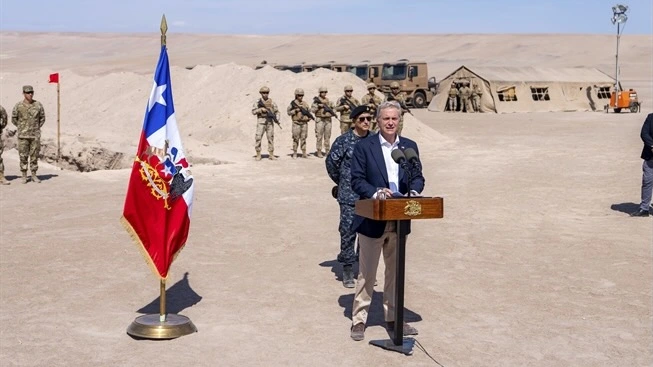
President Kast has spent his first weeks in office assembling a border policy from the components he observed firsthand during visits to Budapest, Rome, San Salvador, and Santo Domingo, according to Sputnik LATAM, IPS, La Tercera, and Duplos. The centerpiece is “Plan Escudo Fronterizo,” a program that includes physical barriers modeled on Israel’s and Hungary’s border fences: walls or security fences up to 5 meters high equipped with motion sensors and drone surveillance, 3-meter trenches in high-traffic crossing zones, electrified perimeter fencing with military and Carabineros patrols, watchtowers with thermal radar, and drones with facial recognition cameras. The plan targets the northern border with Peru first, then Bolivia, covering the primary routes used by irregular migrants crossing through the Atacama Desert and the Colchane pass.
The Scale Problem
Political analyst Marcelo Mella told Sputnik that the European models face a fundamental geography problem in Chile. “Both in Italy and Hungary, the dimension of the migration problem is very different. Chile’s land border extends to more than three times the combined terrestrial frontier of both countries, so we are talking about a problem of a different magnitude,” he said. Mella considers it “unlikely” that Kast will achieve the political consensus needed for infrastructure of this scale, and suggested the European references may function more as symbolic tools to unify his conservative coalition than as practical policy templates. Chile has 18.4 million inhabitants and approximately 1.6 million foreign residents (8.8% of the population), with the migrant population doubling in seven years, driven primarily by Venezuelan arrivals. An estimated 338,000 migrants are in irregular status, including 182,000 who were biometrically registered under the previous Boric government.
Enforcement Has Already Begun
The Kast government has not waited for infrastructure. Between March 12 and 22, immigration authorities conducted operations across Santiago, Aysén, Rancagua, Antofagasta, and Chillán, detaining 2,905 people of whom 700 were found to be in irregular status, according to new Servicio Nacional de Migración director Frank Sauerbaum. Joint task forces between immigration and labor inspectors are now targeting workplaces employing irregular migrants. Human rights organizations CODEPU and the Movimiento de Acción Migrante have criticized the operations as criminalizing migration and violating due process, noting that it remains unclear whether detainees received individual assessments of their protection claims or access to legal counsel. The UN Committee on Migrant Workers has urged states to adopt rights-based approaches rather than enforcement-first models.
The Orbán Irony
Kast studied Orbán’s model the same month Orbán lost power. But as our Hungary analysis detailed, voters rejected Orbán’s government on corruption and economic stagnation—not his border policy, which remained popular across the political spectrum. Péter Magyar, the man who defeated Orbán, has not promised to reverse the fence or the migration controls. The lesson for Kast is the one Orbán himself learned too late: nationalist border policy can sustain a government for 16 years, but only if the government behind it is perceived as competent, clean, and focused on the living standards of its citizens. Kast also proposed a “humanitarian corridor” for Venezuelan returnees requiring cooperation from Ecuador, Colombia, and Venezuela—all three countries with which Chile’s relations are currently strained by exactly the kind of nationalist posturing that makes multilateral cooperation difficult. The border plan is ambitious. The question is whether it is achievable, affordable, and sustainable—or whether it becomes, as Mella suggested, a symbol that unifies the coalition but never quite materializes into concrete and steel.
Related Coverage: Hungary After Orbán: Europe’s Most Successful Populist Falls
More: Chile news in English, every day from The Rio Times.
This article was produced by The Rio Times’ automated newsroom system. How we use AI · Report an error
Read More from The Rio Times