Brazil Polls Put Lula and Flávio Bolsonaro Level Nationally but Split the Southeast
ELECTIONS 2026 · BRAZIL
Key Facts
- —The country Brazil, Latin America’s largest economy, votes on Sunday 4 October. A runoff follows on 25 October if no candidate wins more than half of valid votes.
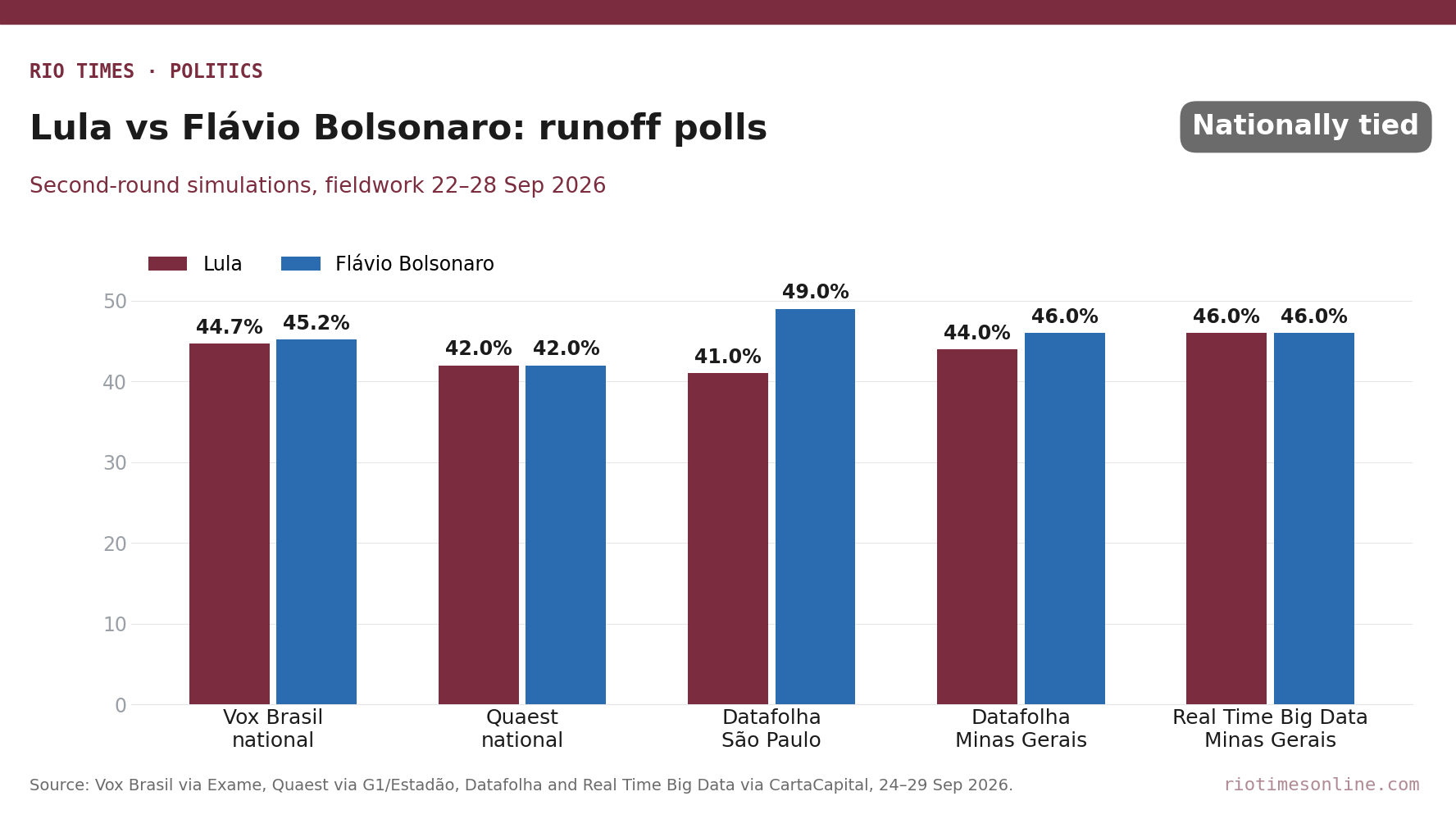
- —What happened A Vox Brasil poll published on 29 September has Flávio Bolsonaro on 45.2% and Lula on 44.7% in a runoff, inside its 2.15-point margin of error.
- —The numbers Datafolha, released 25 September: São Paulo runoff 49% to 41% for Flávio Bolsonaro, Minas Gerais 46% to 44%. Quaest, 28 September: 42% each nationally.
- —What it means for you A second round on 25 October looks likely and open. Residents and investors should plan for four more weeks of campaigning after Sunday.
- —Still open Whether the Southeast tilts or stays tied. Both men are rejected by over half of voters in Vox Brasil: Flávio Bolsonaro 53.1%, Lula 51.5%.
New Brazil polls show a presidential runoff tied nationally but split inside the Southeast, the country’s most populous region. A Vox Brasil survey of 29 September puts Senator Flávio Bolsonaro half a point ahead of President Luiz Inácio Lula da Silva.
State surveys by Datafolha put the senator clearly ahead in São Paulo and level in Minas Gerais. A regional reading from Quaest points the other way, with Lula gaining ground in the same region.

Brazil Polls Show a National Tie
Vox Brasil interviewed 2,100 voters at home from 26 to 28 September, Exame reported. Flávio Bolsonaro has 45.2% and Lula 44.7%, a gap well inside the 2.15-point margin.
The pollster paid for the survey itself, and Poder360 carried the same runoff figures. Since the August wave, Flávio Bolsonaro gained 0.1 point and Lula 0.2.
In the first round, Lula leads with 41.1% to Flávio Bolsonaro’s 37.8%, with Ronaldo Caiado on 3.8%. Rejection is high for both: 53.1% would not vote for the senator, 51.5% for Lula.
Quaest, polling for the Globo group from 24 to 27 September, shows the runoff tied at 42% each. Its first round has Lula on 39% and Flávio Bolsonaro on 34%.
The Southeast Pulls Two Ways
Datafolha released state polls on 25 September, fielded between 22 and 24 September. In São Paulo, Flávio Bolsonaro leads a runoff 49% to 41%, up from 47% to 42% on 12 September.
São Paulo polled 1,610 voters on 22 and 23 September, with a two-point margin of error. In the first round there, the senator leads 38% to 33%.
In Minas Gerais, Datafolha heard 1,204 voters from 22 to 24 September, with a three-point margin. The runoff reads 46% to 44% for Flávio Bolsonaro, a statistical tie, after 46% to 45% for Lula before.
Lula keeps a narrow first-round lead in Minas Gerais, 39% to 37%. Rio de Janeiro gives the senator his widest runoff lead, 51% to 42%.
A second Minas Gerais survey, by Real Time Big Data, found the runoff tied at 46% each. It ran 2,000 interviews from 23 to 26 September, with a two-point margin.
Quaest’s regional slice moves the other way. In the Southeast, Lula rose from 30% to 33% in the first round; Flávio Bolsonaro slipped from 36% to 35%, CartaCapital reported.
With a three-point regional margin, that is a technical tie, a reading G1 also reported. A national sample’s regional slice and a state poll measure different things, and Datafolha finished fieldwork at least three days earlier.
Governors: Two First-Round Scenarios
Brazil elects governors on the same day, and a candidate wins outright with more than half of valid votes. In polls, valid votes exclude blank and spoilt ballots and undecided voters.
In Minas Gerais, Datafolha has Senator Cleitinho Azevedo of the Republicanos party on 40%, or 49% of valid votes. Patrus Ananias of Lula’s Workers’ Party follows on 15%, and Alexandre Kalil of the PDT on 9%.
In Pernambuco, Governor Raquel Lyra of the PSD leads former Recife mayor João Campos of the PSB 48% to 44%. With 4% blank or spoilt and 2% undecided, her share equals about 51% of valid votes.
Both first-round wins are scenarios, not projections, because each sits within Datafolha’s three-point margin. In a Pernambuco runoff, Lyra leads 51% to 45%.
What Is Not Yet Known
It is not known how many Brazilians will turn out, or how the last undecided voters will split. With both front-runners rejected by about half the electorate, abstention and spoilt ballots could matter.
It is also unclear whether the Datafolha and Quaest readings of the Southeast will converge. The final Brazil polls before Sunday will show whether the region is tilting or simply tied.
What is stable is Lula’s first-round lead in every national poll cited here. What remains open is the runoff, where each national reading sits inside the margin of error.
More: Brazil news in English, every day from The Rio Times.
Sources: Vox Brasil via Exame (runoff) and Exame (first round, rejection), 29 September 2026, also reported by Poder360, CNN Brasil and Metrópoles; Datafolha via CartaCapital (presidential, by state), CartaCapital (Minas Gerais governor) and CartaCapital (Pernambuco governor), 24–25 September 2026; Real Time Big Data via CartaCapital, 28 September 2026; Quaest via CartaCapital and G1, 28–29 September 2026.
This article was produced by The Rio Times’ automated newsroom system. How we use AI · Report an error
Read More from The Rio Times