Brazil Markets: Ibovespa & the Real — July 29, 2026
Key Facts
- The Ibovespa rose 0.70% to 176,565 points, its second positive session, as heavyweight commodity exporters found a bid.
- Embraer, the aircraft manufacturer, jumped 2.3%, topping the blue-chip leaderboard with strong volume behind the move.
- Pulp giant Suzano surged 2.9%, extending a sector rotation into materials names that had been under pressure.
- The Brazilian real finished virtually flat at 5.1212 per US dollar, showing a marginal 0.09% depreciation but remaining comfortably below its 52-week peak.
- Steelmaker Gerdau added 2.7%, feeding a narrative of bargain-hunting in cyclical shares that had sold off heavily in recent weeks.
Today’s Focus
Brazil’s Ibovespa advanced 0.7% to 176,565 points on Tuesday, reversing the opening hesitation that marked the morning session. The move was powered by a synchronised rally in the commodity bloc—miners, steelmakers and oil producers—that together make up a large slice of the benchmark index.
The real barely budged, ending the day at 5.1212 per US dollar, a whisper weaker by 0.09%. That stability offered foreign investors a clean entry point to rotate back into Brazilian hard-asset exporters, whose shares had been beaten down by global growth jitters earlier in the month.
Pulp and paper producer Suzano was the standout large-cap, leaping 2.9%, while aircraft maker Embraer flew 2.3% higher on the session’s fourth-largest turnover. The big-four banks all closed in the green, though their gains were modest, suggesting the rally was a tactical sector play rather than a broad-based melt-up.
What matters today. The session showed a market willing to forgive near-term macro fog and buy quality cyclical exporters at depressed valuations, so long as the real avoids a disorderly slide.
01 The session in one read
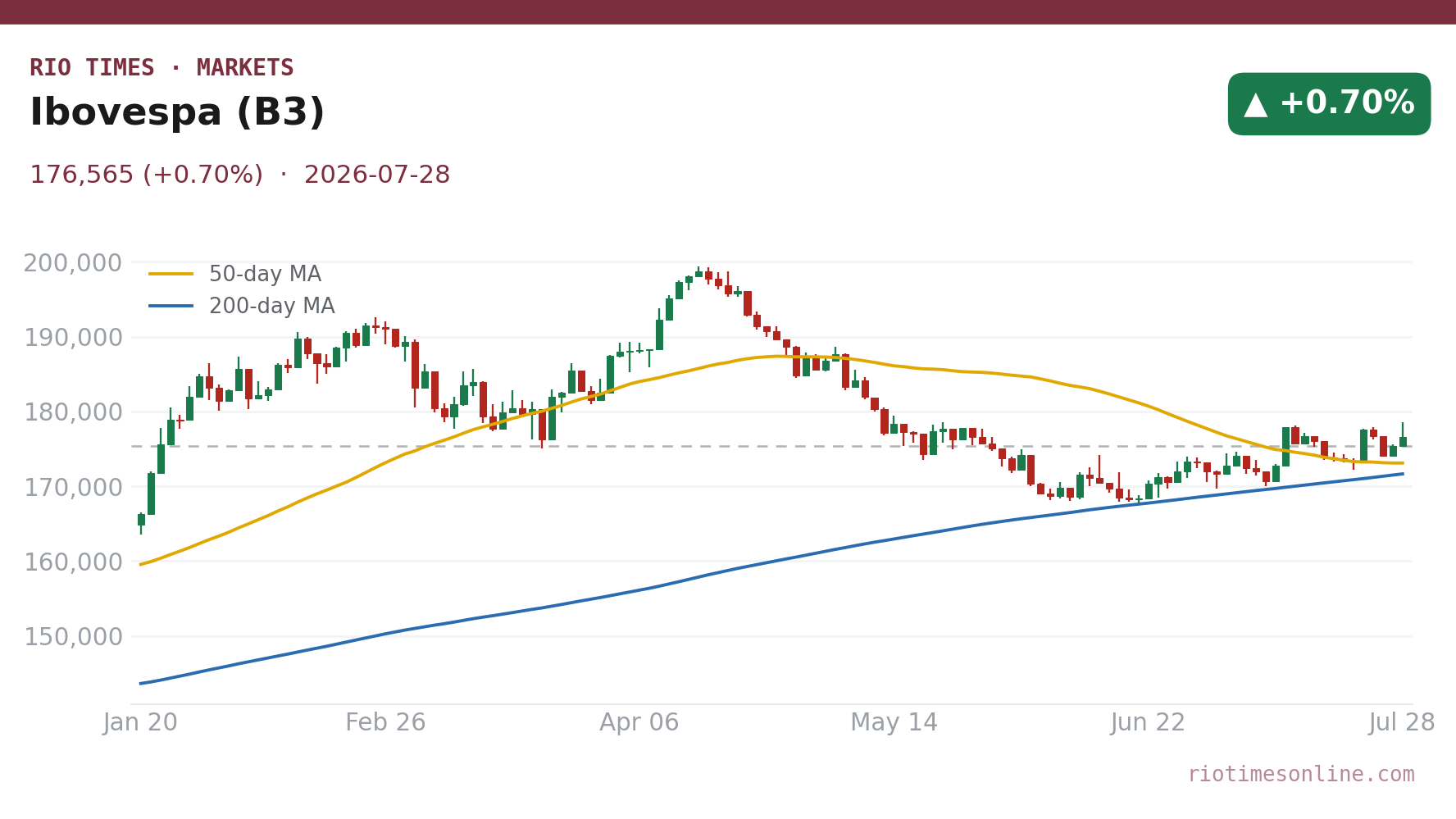
A day that started flat-footed ended with a spring in its step for Brazilian equities. The Ibovespa—the benchmark index that tracks the largest and most-traded companies on the B3 stock exchange in São Paulo—shedded early losses to close 0.70% higher at 176,565 points.
The catalyst was not a single headline but a gradual rotation of capital back into the raw-materials giants that drive so much of the index’s direction. Iron-ore producer Vale, the session’s second most-traded stock, finished unchanged after bouncing off its lows, while state-controlled oil major Petrobras edged up 0.5% on heavy volume of $240 million.
The Brazilian real, the local currency, played the role of quiet enabler. Trading at 5.1212 per US dollar, it moved less than 0.1% on the day, refusing to scare off the international fast money that fuels these rotations.
Smaller cyclical names punched above their weight: ax-energy group Axia leapt 1.9% and independent oil producer Prio matched that gain, both on turnover well above $90 million. The message from the floor was clear—traders were buying the dip in reais, and they were buying it in shares with operational leverage to any global demand uptick.
Tuesday’s price action reads more like a positioning squeeze than a conviction buy-everything signal. The inflows concentrated in beaten-down commodity names with light turnover in defensives, while utilities such as Sabesp and telecoms actually fell hard, giving back recent safety-trade gains. For the rotation to stick, traders will need to see Wednesday’s IGP-M inflation print and the upcoming unemployment report reinforce the narrative that the Selic—Brazil’s benchmark interest rate—has room to keep falling from its current 14.25% without reigniting price pressures. The variable to watch is the real’s behaviour: if USD/BRL slides back toward 5.00, the rotation trade gathers speed; a break above 5.20 likely kills it.
02 The day’s numbers
| Measure | Level | Change | Read |
|---|---|---|---|
| Ibovespa | 176,565 | +0.70% | Gains led by materials and industrials |
| Session range | — | — | Intraday data not provided in scan |
| USD/BRL | 5.1212 | +0.09% | Real virtually flat; still 8.4% below 52w high |
| 52-week position (Ibov) | 176,565 | −11.1% | vs high of 198,657; low sits at 132,129 |
| Key technical level | 131,000–132,000 | — | 52-week low cluster, tested in late 2025 |
The index sits 11.1% below its 52-week peak of 198,657, a ceiling reached during a euphoric rally earlier in the cycle. That gap means the market is pricing in a meaningful slowdown but not a recession; the trough at 132,129 looks distant, a testament to how much economic worst-case thinking has been unwound.
On the currency side, patience is the story. At 5.1212, the real is 8.4% stronger than its weakest point of the past year—5.5901 per dollar—and comfortably inside a range that Brazilian corporates can budget around. A daily move of just 0.09% is a green light for carry trades, where foreign investors borrow in cheap currencies to buy higher-yielding Brazilian assets. Rio Times · Live Market Intelligence
Live Market IntelligenceBrazil — Live Market Board
Brazil — Live Market Board
Instrument Last Change YoY Prev. High Low Volume
IBOV
186,502.64
+0.54%
+21.85%
185,500.88
168,310
167,142
—
USD/BRL
5.16
+0.01%
-5.13%
5.16
5.18
5.14
—
SELIC
14.00%
—
—
—
—
—
PETR4
41.64
-0.05%
+35.19%
41.66
41.97
41.15
41,499,400
VALE3
72.97
+0.83%
+30.75%
72.37
73.54
72.66
17,658,000
ITUB4
38.60
-1.03%
+4.57%
39.00
39.34
38.39
29,487,800
BBDC4
16.85
+0.36%
+3.50%
16.79
16.90
16.67
19,416,900
BBAS3
19.37
+0.47%
+0.73%
19.28
19.44
19.16
11,069,200
B3SA3
14.26
-0.21%
+12.73%
14.29
14.47
14.11
33,037,800
ABEV3
14.89
-0.80%
+21.91%
15.01
15.07
14.81
16,453,100
WEGE3
47.59
+0.49%
+29.99%
47.36
48.08
47.36
3,364,600
PRIO3
59.14
-0.19%
+50.67%
59.25
59.81
58.74
3,325,600
SUZB3
41.33
+2.35%
-23.55%
40.38
41.48
40.35
3,914,900
RENT3
34.68
-0.09%
+0.84%
34.71
34.96
34.35
7,979,100
AZZA3
15.89
-2.63%
-53.76%
16.32
16.42
15.82
1,330,300
CSNA3
4.30
+0.47%
-42.65%
4.28
4.41
4.26
10,076,100
GGBR4
24.69
+2.19%
+51.38%
24.16
24.85
24.18
7,047,600
ENEV3
24.21
-1.38%
+70.49%
24.55
24.64
23.99
9,297,000
03 Why it moved — a commodity rotation on stable FX
Tuesday’s advance had the fingerprints of a sector switch rather than a broad ‘risk-on’ wave. The biggest gainers were concentrated in materials, energy and select industrials, while recent havens such as telecoms and water utilities were sold sharply. This pattern—buy cyclicals, ditch defensives—is the classical hallmark of a market that believes the worst of the growth scare has passed.
Steelmakers provided the clearest signal. Gerdau jumped 2.7% and its peer CSN was not far behind, recovering ground after weeks of pressure tied to sluggish Chinese steel demand. The market seemed willing to look through the immediate demand fog and focus on valuations that had fallen to levels that, historically, have rewarded the brave.
Pulp and paper giant Suzano added 2.9%, reinforcing the theme. Its shares are a proxy for global packaging and tissue demand, and the move suggests that funds were buying the idea that a stabilising world economy would keep pulp prices supported. Embraer’s 2.3% surge—on more than $100 million in turnover—confirmed investors were also comfortable with export-facing industrials that earn dollars and book costs in reais.
While global markets provided a calm backdrop—US equities edged higher—the local trigger that distinguishes this session from a simple copycat rally was the behaviour of the currency. The real at 5.12 is weak enough to flatter exporter margins but strong enough to signal that Brazil’s central bank, whose policy rate the Selic stands at 14.25%, still offers the kind of carry that anchors foreign capital. It is a sweet spot, and the equity market toasted it.
04 The day’s movers
| Driver | Level / Move | Change | Note |
|---|---|---|---|
| SPCX34 | Cross-listed US tracker | +3.7% | Top gainer on the B3; reflects US tech tape, not a domestic stock |
| Suzano (SUZB3) | Pulp & paper producer | +2.9% | Led domestic blue-chip gainers |
| Gerdau (GGBR4) | Steelmaker | +2.7% | Bargain-hunting in cyclical steel |
| Embraer (EMBJ3) | Aircraft manufacturer | +2.3% | Fourth-largest turnover, strong exporter bid |
| Tres Tentos (TTEN3) | Agribusiness retailer | −16.0% | Worst session decline, specific stock event |
The most-traded list reveals where the real conviction sat. Vale saw $181 million change hands and ended flat—a tug-of-war between bulls betting on China stimulus and bears cutting exposure. Petrobras posted a $240 million turnover and a 0.5% gain, a modest but meaningful green tick for the heaviest weight in the index.
Banks were steady rather than spectacular: Itaú (ITUB4) added 0.4% on $160 million in volume; the sector is benefiting from the expectation that a gradual Selic easing cycle—from 14.25% toward a lower plateau—will reduce credit-provisioning costs without crushing net interest margins too quickly. Ambev (ABEV3), the brewer, rose 1.5%, a move that often signals domestic consumption bets being placed alongside the commodity trade.
05 The regional scoreboard
| Index | Country | Change |
|---|---|---|
| Ibovespa | Brazil | +0.70% |
| IPC | Mexico | +0.18% |
| IPSA | Chile | −0.77% |
| Merval | Argentina | −1.48% |
| COLCAP | Colombia | +0.80% |
Latin American markets were a mixed bag, but Brazil punched above its weight on the day. Colombia’s COLCAP led the region with a 0.80% pop, while Mexico’s IPC crept up 0.18% in a subdued session. Argentina’s Merval was the outlier on the downside, sliding 1.48% as idiosyncratic political noise weighed on Buenos Aires-listed assets.
Chile’s IPSA shed 0.77%, reflecting a drag from Andean commodity names that did not enjoy the same rotational love as their Brazilian peers. The live market board embedded above carries the exact closing levels for all tracked indices, updated after every session.
06 The technical picture
The Ibovespa’s 0.70% gain keeps the index in a consolidation zone between the psychological 170,000 floor and the stubborn resistance that has formed around 180,000. Tuesday’s action did not challenge either boundary, but the move was built on improving market breadth—more stocks rose than fell within the index—which technicians read as a healthier foundation than a rally led solely by one or two mega-caps.
The 52-week range tells a story of compressed volatility. The gap between the 132,129 low and the 198,657 high is wide, but the index has spent most of the past quarter drifting in the middle third of that range, suggesting a market that has priced in a slowdown and is now waiting for hard data—jobs, inflation, and GDP—to confirm the direction of the next leg.
07 What to watch
- IGP-M wholesale inflation: Wednesday’s print is expected at −1.07%, reinforcing the disinflation trend that lets the central bank keep cutting the Selic. A smaller-than-expected fall could rattle the easing narrative.
- Unemployment rate: Also due Wednesday, with consensus at 5.5%. A tight labour market is a double-edged sword: it props up consumption and retail stocks but can make the central bank cautious on rate cuts.
- US PCE inflation data: Thursday’s core PCE reading is the global macro event of the week. A hot number would strengthen the dollar and likely push USD/BRL back toward 5.20, unravelling Tuesday’s calm.
- China economic sentiment: Vale’s flat close on heavy turnover shows the market is split on China’s demand outlook. Any fresh policy stimulus signal from Beijing would be a direct catalyst for the entire materials sector.
Background: Petrobras Energy Transition Chief Named in Brazil Oil Clash.
Background: Vports Espirito Santo Posts Record First Half.
More: Brazil news in English, every day from The Rio Times.
Frequently Asked Questions
What is the Ibovespa?
It is Brazil’s main stock-market index, tracking a basket of the most traded companies on the B3 exchange in São Paulo, weighted by market value. Think of it as the Brazilian equivalent of the FTSE 100 or S&P 500.
Why did Brazil’s stock market rise on Tuesday?
Investors rotated money back into commodity exporters such as Vale, Petrobras and steelmakers, betting that recent sell-offs had made their valuations too cheap to ignore. A stable currency at 5.12 reais per dollar kept the mood calm.
What is the Selic and why does it matter for stocks?
The Selic is Brazil’s benchmark interest rate, set by the central bank’s Copom committee. At 14.25%, it attracts foreign capital seeking high returns, but lower rates help company earnings and consumer spending—so every cut is a balancing act.
Which stocks moved the most?
Suzano (pulp) rose 2.9% and Embraer (aircraft) gained 2.3% on strong turnover. On the downside, agribusiness retailer Tres Tentos fell 16% and telecoms Vivo and TIM dropped more than 5% as traders exited recent safe-haven positions.
This article was produced by The Rio Times’ automated newsroom system. How we use AI · Report an error
LatAm Markets: Live Signals → — real-time movers, turnover leaders and FX across Latin America.
Read More from The Rio Times