Brazil Markets: Ibovespa & the Real — July 30, 2026
Key Facts
- Brazil’s benchmark Ibovespa index fell 1.52% to 173,885 points, tracking a sharp sell-off on Wall Street where the S&P 500 also lost 1.52%.
- The Brazilian real held remarkably steady at 5.1174 per US dollar, slipping just 0.07% and extending its role as a haven in a volatile emerging-market session.
- Petrobras preferred shares jumped 1.9% with heavy turnover of $258m, defying the gloom after reports the oil major is preparing to enter nuclear power generation.
- Utility Sabesp plummeted 5.9% and stock-exchange operator B3 shed 4.2%, leading a rout in rate-sensitive names as a cautious global mood swept through São Paulo.
- The index is now 12.5% below its 52-week high of 198,657, though it remains well above the year’s low of 132,129, keeping the bull-market structure intact for now.
Today’s Focus
Brazil’s main stock index, the Ibovespa, fell 1.52% to 173,885 points on Wednesday, caught in a global downdraft that sent the S&P 500 down by the same 1.52% margin. Every major financial and utility stock in São Paulo ended the day in the red, with the heaviest selling hitting the exchange operator B3 and the water utility Sabesp.
The real barely budged, trading at 5.1174 to the dollar for a marginal 0.07% decline, as Brazil’s towering 14.25% benchmark Selic interest rate continued to attract carry-trade flows even while equities struggled. It was a classic two-speed session: the currency anchored by yield, the stock market dragged by risk aversion.
Petrobras was the standout contrarian. Its preferred shares rose 1.9% on turnover of $258m—the busiest name on the B3 exchange—after reports it is preparing a push into nuclear power. Rival commodity giant Vale was absent from the most-traded list, suggesting the iron-ore miner saw more modest, albeit likely negative, action.
What matters today. The 1.52% slide was an almost perfect mirror of Wall Street’s own 1.52% loss, confirming that global mood—not local politics or commodities—drove the session.

01 The session in one read
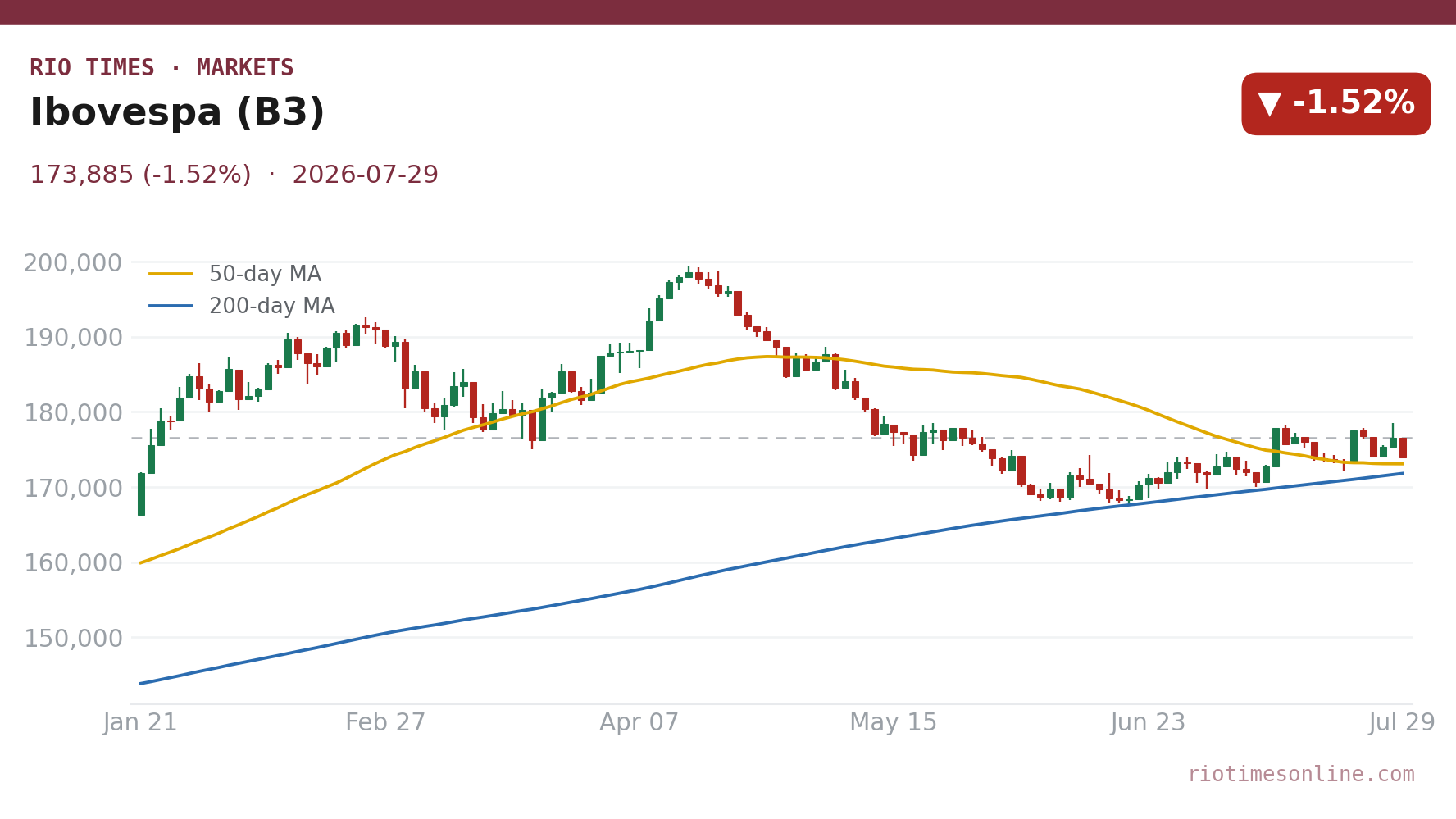
The São Paulo trading floor had little to cheer on Wednesday, July 29, as the Ibovespa—Brazil’s main stock index, which tracks the most-traded companies on the B3 exchange—slumped 1.52% to 173,885 points. It was a rout with a distinctly imported flavour: the S&P 500, America’s benchmark share index, fell by exactly the same 1.52% margin overnight, and traders in Brazil spent the session reacting rather than acting.
The Brazilian real, the country’s currency, was a pocket of calm. It edged down just 0.07% to 5.1174 per US dollar, barely a ripple in a storm that sank equities across the Americas. That steadiness reflects an enduring reality of 2026: with Brazil’s central-bank interest rate, the Selic, still parked at a lofty 14.25%, the real offers a carry-trade cushion that stocks simply cannot match on a risk-off day.
Beneath the headline index move, the session told two distinct stories. In one, rate-sensitive names like utility Sabesp and the B3 exchange itself were pummelled—down 5.9% and 4.2% respectively—as investors fretted about the cost of money and market volumes. In the other, state-controlled oil giant Petrobras rallied 1.9% on heavy volume after reports it is exploring a move into nuclear power generation, a bold diversification play that caught the market’s imagination.
The evidence for a purely imported sell-off is strong. The Ibovespa and S&P 500 fell in lock-step, the real was flat, and the only domestic story with price impact—Petrobras’s nuclear ambitions—was a positive one. Brazil’s fiscal and monetary backdrop did not suddenly deteriorate on July 29; what changed was overseas appetite for risk. Watch tonight’s US futures open for any signs of stabilisation, because if the global tape remains weak, the Ibovespa’s 12.5% discount to its 52-week high makes it a candidate for bargain-hunting but also a hostage to another day of de-risking.
02 The day’s numbers
| Measure | Level | Change | Read |
|---|---|---|---|
| Ibovespa | 173,885 | −1.52% | Sharp loss, mirroring Wall Street’s 1.52% S&P 500 fall |
| Ibovespa 52-week high | 198,657 | — | Index is 12.5% below this peak |
| Ibovespa 52-week low | 132,129 | — | Remains well above the year’s trough |
| USD/BRL | 5.1174 | −0.07% | Real virtually flat; high carry keeps currency anchored |
| USD/BRL 52-week high | 5.5901 | — | Real is 8.5% stronger than this weakest point |
| USD/BRL 52-week low | 4.8909 | — | Real is 4.4% weaker than its strongest level |
The day’s numbers paint a picture of a stock market taken to the woodshed while the currency market shrugged. The Ibovespa’s 1.52% fall took it decisively away from the 52-week high of 198,657 set in a stronger global environment, but the index remains comfortably above the year’s low of 132,129, meaning the longer-term uptrend is bruised but not broken.
On the currency side, the real’s 0.07% dip is little more than market noise. At 5.1174, it sits roughly in the middle of its 12-month range—stronger than the 5.5901 low and weaker than the 4.8909 high—reflecting the gravitational pull of the 14.25% Selic rate, which keeps foreign capital interested even when Brazilian stocks are out of favour. Rio Times · Live Market Intelligence
Live Market IntelligenceBrazil — Live Market Board
Brazil — Live Market Board
Instrument Last Change YoY Prev. High Low Volume
IBOV
187,206.89
-0.56%
+21.85%
188,268.59
168,310
167,142
—
USD/BRL
5.16
+0.01%
-5.13%
5.16
5.18
5.14
—
SELIC
14.00%
—
—
—
—
—
PETR4
41.64
-0.05%
+35.19%
41.66
41.97
41.15
41,499,400
VALE3
72.97
+0.83%
+30.75%
72.37
73.54
72.66
17,658,000
ITUB4
38.60
-1.03%
+4.57%
39.00
39.34
38.39
29,487,800
BBDC4
16.85
+0.36%
+3.50%
16.79
16.90
16.67
19,416,900
BBAS3
19.37
+0.47%
+0.73%
19.28
19.44
19.16
11,069,200
B3SA3
14.26
-0.21%
+12.73%
14.29
14.47
14.11
33,037,800
ABEV3
14.89
-0.80%
+21.91%
15.01
15.07
14.81
16,453,100
WEGE3
47.59
+0.49%
+29.99%
47.36
48.08
47.36
3,364,600
PRIO3
59.14
-0.19%
+50.67%
59.25
59.81
58.74
3,325,600
SUZB3
41.33
+2.35%
-23.55%
40.38
41.48
40.35
3,914,900
RENT3
34.68
-0.09%
+0.84%
34.71
34.96
34.35
7,979,100
AZZA3
15.89
-2.63%
-53.76%
16.32
16.42
15.82
1,330,300
CSNA3
4.30
+0.47%
-42.65%
4.28
4.41
4.26
10,076,100
GGBR4
24.69
+2.19%
+51.38%
24.16
24.85
24.18
7,047,600
ENEV3
24.21
-1.38%
+70.49%
24.55
24.64
23.99
9,297,000
03 Why it moved — a global sell-off lands in São Paulo
The 1.52% drop in the Ibovespa was almost a carbon copy of the 1.52% decline on the S&P 500, and that symmetry is the session’s smoking gun. When the world’s most important stock market falls by that much, emerging markets like Brazil rarely escape, and July 29 was no exception. There was no fresh political scandal in Brasília, no commodity-price crash, and no sudden fiscal-policy scare—the selling was simply a case of global risk appetite evaporating.
That matters because it determines how investors should read the move. A sell-off driven by external mood swings is less damaging to the long-term case for Brazilian assets than one triggered by homegrown problems. The real’s near-total stability at 5.1174—down a mere 0.07%—backs that reading: if the trouble were local, the currency would likely have fallen harder.
Rate-sensitive sectors felt the most heat. Sabesp, the São Paulo water utility, plunged 5.9% as higher-for-longer interest-rate expectations—fueled by the global uncertainty—made its steady dividend stream look less attractive relative to bonds. B3, the company that runs the exchange itself, shed 4.2% in a cruel irony: falling trading volumes on a day when everyone was trading more were a reminder that market infrastructure stocks are highly cyclical.
The counterpoint was Petrobras. Its preferred shares, trading under the ticker PETR4, rose 1.9% with the session’s heaviest turnover of $258m, after reports the oil producer is preparing to enter nuclear power generation as part of a decarbonisation push. It was the kind of stock-specific catalyst that can buck even the ugliest global tide, and on this day it did.
04 The day’s movers
| Driver | Level / Move | Change | Note |
|---|---|---|---|
| Petrobras PN (PETR4) | $258m turnover | +1.9% | Top traded; rallied on nuclear-power diversification reports |
| Itaú Unibanco PN (ITUB4) | $167m turnover | −2.4% | Heavy selling; banks led the risk-off slide |
| Sabesp ON (SBSP3) | $157m turnover | −5.9% | Worst large-cap fall; utilities crushed by rate fears |
| B3 ON (B3SA3) | $155m turnover | −4.2% | Exchange operator hit as volumes and sentiment fell |
| Prio ON (PRIO3) | $110m turnover | +2.9% | Oil junior rose with Petrobras; sector-wide bid |
The most-traded table reveals a market split down the middle between a handful of oil-linked winners and a broad mass of financial and utility losers. Petrobras’s 1.9% gain on $258m of turnover made it the undisputed king of the session, with smaller oil producer Prio riding its coattails to a 2.9% rise on $110m.
On the losing side, Itaú Unibanco—Brazil’s largest private bank—fell 2.4% on $167m of trades, reflecting a global rotation out of financials that hit every major bank on the B3. Sabesp’s 5.9% plunge was the most eye-catching number: it was the worst-performing large-cap and a clear signal that investors were pricing in a tougher environment for indebted utilities. B3’s 4.2% drop confirmed that when markets turn sour, the exchange operator is often the first to feel the chill.
05 The regional scoreboard
| Index | Country | Change |
|---|---|---|
| Ibovespa | Brazil | −1.52% |
| IPC (S&P/BMV IPC) | Mexico | −1.23% |
| IPSA | Chile | +0.52% |
| Merval | Argentina | −0.71% |
| COLCAP | Colombia | +0.15% |
The pain was uneven across Latin America. Mexico’s IPC—the main index tracking the largest firms listed on the Bolsa Mexicana de Valores—fell 1.23%, almost as hard as Brazil, while Argentina’s Merval shed a more modest 0.71%. Chile and Colombia bucked the trend entirely: Chile’s IPSA rose 0.52% and Colombia’s COLCAP added 0.15%, making them rare green spots on a mostly red map.
The divergence between Brazil and the Andean markets underlines that Wednesday’s sell-off was not a uniform emerging-market rout. Each exchange’s sector mix mattered: Brazil’s heavy weighting in banks and commodities made it more vulnerable to the global mood shift, while Chile’s copper-linked names and Colombia’s locally-driven liquidity offered some insulation. The live market board above carries the full closes for all regional indices throughout the trading day.
06 The technical picture
The Ibovespa’s 1.52% decline to 173,885 leaves it 12.5% below the 52-week high of 198,657, a level that now acts as a towering resistance point. That is not yet correction territory—defined as a 10% drop from a recent peak—but it is close enough to make chart-watchers nervous. The index’s next major support sits at the 52-week low of 132,129, a long way down, meaning the critical test will be whether buyers step in before the index tests its 200-day moving average, a widely followed trend indicator.
On the currency chart, USD/BRL at 5.1174 is trading in a comfortable range, 8.5% below the 52-week high of 5.5901 and 4.4% above the 52-week low of 4.8909. The real’s resilience on a day when stocks fell hard reinforces the idea that the currency is being supported by Brazil’s 14.25% Selic rate—one of the world’s highest real interest rates—and is not yet flashing the kind of stress signal that would normally accompany a deeper stock-market correction. For now, equities are the weak link, and the currency is the stabiliser.
07 What to watch
- US futures open: Whether Wall Street stabilises or extends Wednesday’s 1.52% S&P 500 decline will set the tone for São Paulo’s open; the two markets are moving in near-perfect lock-step.
- Petrobras nuclear plans: Any official confirmation or detail on the nuclear-power entry could sustain the oil giant’s rally, offering the Ibovespa a counterweight to broader selling pressure.
- Selic rate expectations: If the global sell-off deepens, traders may reprice the speed of future rate cuts by Brazil’s central bank, affecting bank and utility shares which are acutely sensitive to the Selic.
- Iron-ore futures in Asia: Vale was not among the top movers but remains a heavyweight; any sharp move in iron-ore prices overnight in Asian trade will directly affect a big chunk of the Ibovespa.
Background: Petrobras Energy Transition Chief Named in Brazil Oil Clash.
Background: Vports Espirito Santo Posts Record First Half.
More: Brazil news in English, every day from The Rio Times.
Frequently Asked Questions
What is the Ibovespa?
The Ibovespa is Brazil’s main stock-market benchmark, traded on the B3 exchange in São Paulo. It tracks the most actively traded and financially significant companies listed in Brazil, from banks and oil producers to utilities and retailers.
Why did the Ibovespa fall on July 29, 2026?
The 1.52% drop was driven almost entirely by a global risk-off mood: the US S&P 500 index fell by the same 1.52% margin, and selling spread to Brazil despite no major local political or economic shock. Rate-sensitive stocks like Sabesp and B3 were hit hardest.
What does USD/BRL 5.1174 mean?
It means one US dollar buys 5.1174 Brazilian reais. A falling number means the real is strengthening against the dollar; on July 29 the real was virtually flat, down just 0.07%, showing the currency held its ground despite the stock-market slide.
Why did Petrobras rise when everything else fell?
Petrobras preferred shares (ticker PETR4) gained 1.9% on reports the company is preparing to enter nuclear power generation as part of its long-term energy transition strategy. The news was specific to the company and strong enough to attract buyers even on a very negative day for the broader market.
This article was produced by The Rio Times’ automated newsroom system. How we use AI · Report an error
LatAm Markets: Live Signals → — real-time movers, turnover leaders and FX across Latin America.
Read More from The Rio Times