By Assis Moreira
The BRICS group, comprising Brazil, Russia, India, China, and South Africa, wants to expand its forces and have more influence in the new geopolitical scenario.
Still, the entry of new members continues to cause disagreements among current members.
The BRICS foreign ministers meeting ended today in South Africa with a “friends of the BRICS” session with 13 other countries, illustrating the interest that the emerging group attracts in an increasingly fragmented world.
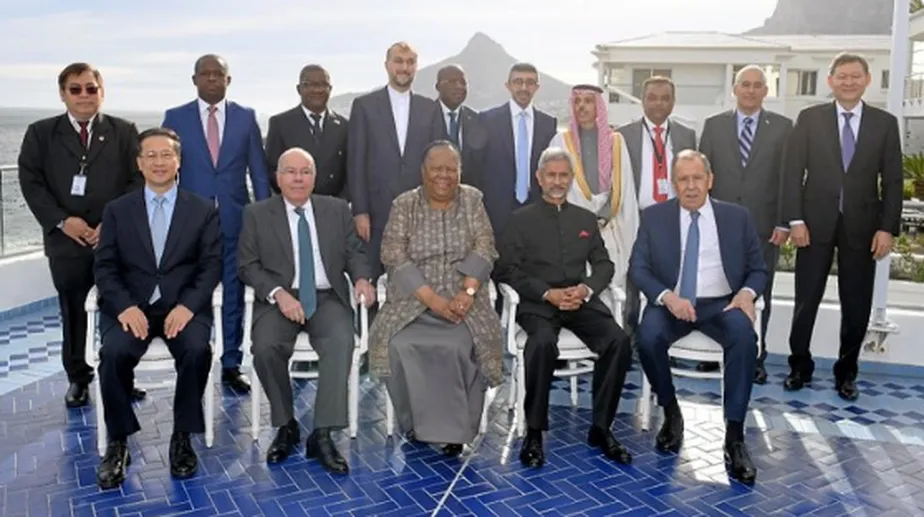
Ministers from Saudi Arabia, Iran, Indonesia, Argentina, Bangladesh, Kazakhstan, Comoros, Cuba, Egypt, United Arab Emirates, Gabon, Guinea-Bissau, and Congo participated in the session, which, however, has not yet defined open doors.
Valor confirmed that there is still a lack of consensus on the criteria and how to advance, at this moment, in the Brics enlargement.
On one side, China wants to accelerate the accession of other members, clearly seeking to take advantage of all the mechanisms in which it has a presence to expand its power.
On the other side, Brazil and India have maintained a cautious position, insisting on first defining criteria for entry into the group.
And also what kind of participation the new ones would have, whether in a “link-minded” dialogue (positions on converging positions) or as a full member.
For one observer, a large group expansion reduces current members’ influence.
On the other hand, Beijing wants as many members as possible, hoping to be the leader of its obvious economic clout.
The divergence within the BRICS on the expansion is not new.
But it draws more attention in a scenario where the group wants to be the voice of the Global South.
Russia has not defined a position, but it is not in a position to close doors.
As for South Africa, there are internal disagreements between the ruling party and the Foreign Ministry, and perhaps only at the BRICS leaders’ summit in August will a clearer position be presented.
The presidents expect to discuss the BRICS expansion at the August South African meeting.
Despite the prudence of Itamaraty, President Lula has publicly defended the entrance of Venezuela.
According to sources, Saudi Arabia, the Emirates, and Indonesia are among the countries most interested in becoming Brics partners.
But one of the ideas under discussion is that an initial instrument of rapprochement with the group of emerging countries could be accession to the New Development Bank (NDB), the bank of the BRICS, currently chaired by Dilma Rousseff.
In his speech to the BRICS, the Minister of Foreign Affairs, Mauro Vieira, did not mention the group’s expansion.
He focused on the effort to expand the number of NDB members and explore new means of engagement with partners in the developing world.
Argentina participated in the meeting of the friends of the BRICS virtually.
At the foreign ministers’ meeting, Brazil, Russia, India, China, and South Africa insisted on encouraging local currencies in international trade and financial transactions between these countries and with other partners.
Some experiences can be examined, as in the case of the use of real and peso between Brazil and Argentina, which is still timid.
But political interest in exploring this path is growing.
Trade between Russia and China increasingly uses the respective currencies, not least because of Russia’s isolation.
South Africa’s foreign minister, Naledi Pandor, said that an executive from the BRICS Bank had briefed the ministers on “the potential use of alternative currencies to the current internationally traded currencies.
According to the minister, the goal is “to ensure that we are not victims of sanctions that have secondary effects on countries that have no involvement in the issues that led to those unilateral sanctions.”
At a press conference, South African minister Pandor said the group’s vision was to provide global leadership in a world fractured by geography.
South African sherpa Anil Sooklal said the group should “provide the global leadership that is missing in the world today.”
The Brics countries have a combined population of over 3.2 billion people, about 40% of the world’s roughly 8 billion people.
They comprise 24% of the global Gross Domestic Product (GDP) and 16% of world trade.
Indian Foreign Minister Subrahmanyam Jaishankar said the meeting should “send a strong message that the world is multipolar, that it is rebalancing, and that old ways cannot cope with new situations.”
“At the core of the problems we face is the economic concentration that leaves many nations at the mercy of a few,” he added.
Brazilian Minister Mauro Vieira said:
“Brazil is also fully committed to strengthening our engagement with the BRICS, which is an indispensable mechanism for building a multipolar world order that reflects the voices and needs of developing countries.”
He added that the autonomous meeting of the BRICS Foreign Ministers is an important political statement.
Mauro Vieira had several bilateral meetings, including with Russian Chancellor Sergey Lavrov. According to sources, it was a follow-up conversation about the war and the BRICS expansion.
For his part, China’s Vice Foreign Minister Ma Zhaoxu insisted that the BRICS group could be expanded to assist developing countries and emerging market economies.
The Iranian Foreign Minister, Hossein Amir-Abdollahian, and his Saudi counterpart, Prince Faisal bin Farhan Al Saud, were present at the meeting of the friends of the BRICS.
With information from Valor
News World, English news World, BRICS
More: Egypt news in English, every day from The Rio Times.
Read More from The Rio Times