Bolivia Elects Interim Attorney General Who Vows to Restructure Prosecution Service

POLITICS · BOLIVIA
Key Facts
- —The country Bolivia, an Andean nation of about 11 million people. Its national congress, the Plurinational Legislative Assembly, chooses the attorney general, who heads the Public Prosecutor’s Office.
- —What happened Shortly after 6:15 a.m. on 3 October 2026, the Assembly elected José Armando Urioste Viera interim attorney general by a show of hands, with more than two-thirds in favour (El Deber, Urgente).
- —Who is involved Urioste, a former judge and court dean in Beni department; Senate President Diego Ávila, who chaired the session; and Roger Mariaca, suspended by 113 votes to 11 hours earlier (Opinión).
- —What it means for you The prosecution service, which handles every criminal complaint in Bolivia, gets an Assembly-appointed chief for 90 days. Urioste promises merit-based appointments of prosecutors.
- —Still open Urioste is due to be sworn in on Monday, 5 October, in La Paz (El Deber, Urgente). As of Saturday afternoon, Mariaca’s defence was appealing a ruling that sends him to ordinary criminal courts.
Bolivia’s Congress elected José Armando Urioste Viera as interim attorney general shortly after 6:15 a.m. on Saturday, 3 October. He won by a show of hands after five earlier rounds left other candidates short of two-thirds.
Urioste replaces Roger Mariaca, whose suspension was covered on Saturday in Bolivia Congress Backs Mariaca Suspension 113 to 11. Within hours, the new chief said hand-picked appointments had turned the prosecution service into a “corruption clique”.
How the Assembly settled on Urioste
The joint session ran from 10:25 a.m. on Friday to about 6:30 a.m. on Saturday, El Deber reported.
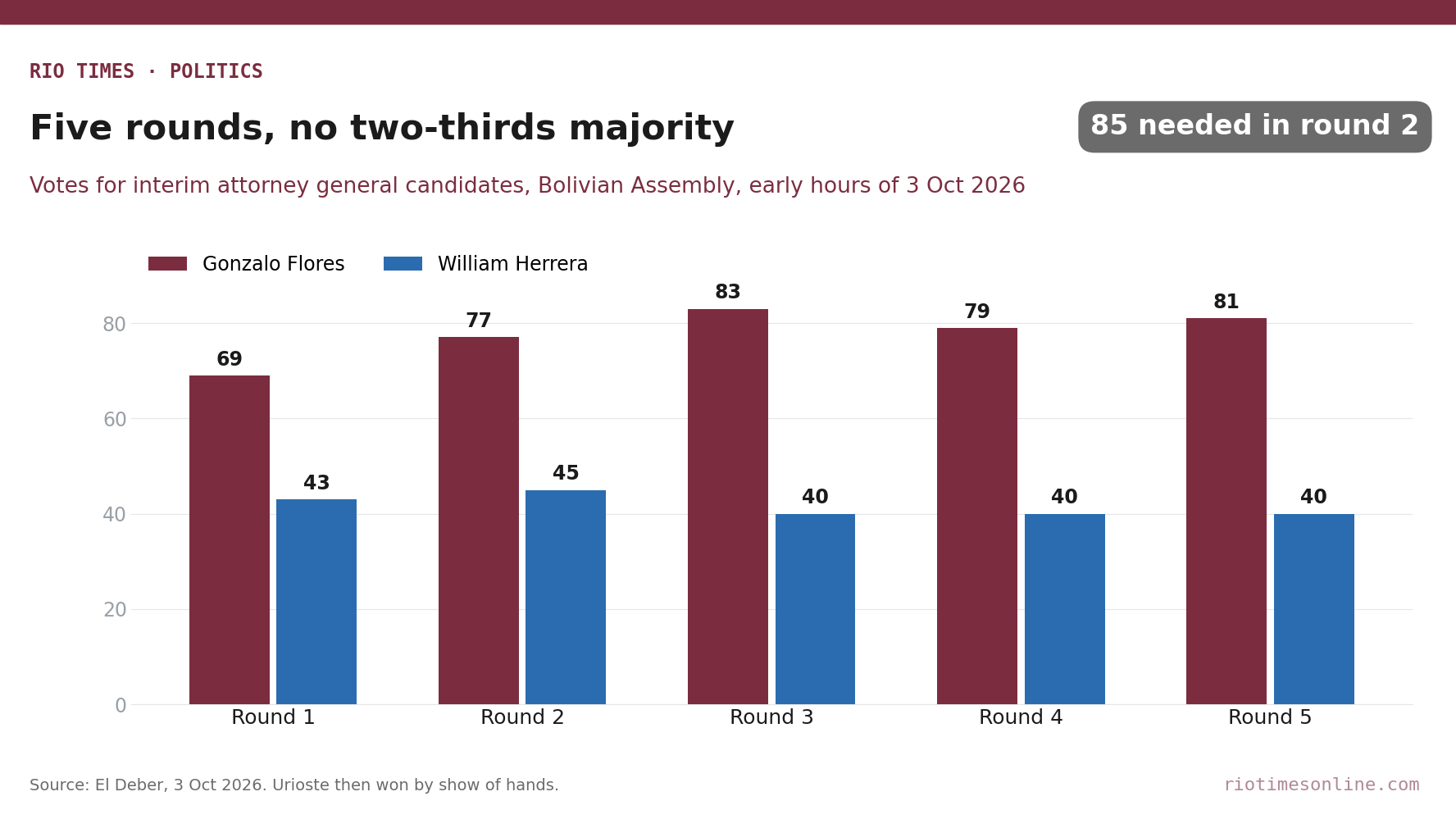
Party leaders first proposed three lawyers: Gonzalo Flores Céspedes, William Herrera Áñez and Julio Coronado. Flores led every roll-call round but never reached two-thirds, El Deber and Urgente reported.
El Deber counted Flores at 69 votes in the first round and 81 in the fifth, with Herrera on 40 to 45. In the second round, 85 votes were needed.
After a recess, the party blocs agreed on Urioste as the sole candidate. “There are more than two-thirds, so Dr Urioste has been selected,” Ávila announced, according to Opinión.
Urgente said the count was of raised hands, and the outlets reviewed reported no exact tally. Opinión described four rounds before the final vote, while El Deber and Urgente counted five.
Not yet sworn in
Ávila said the Assembly’s leadership will swear Urioste in on Monday, 5 October, in La Paz, without a new session. Urioste will then move to Sucre, Bolivia’s judicial capital and seat of the Attorney General’s Office.
His mandate lasts 90 days, El Deber reported. In that time the Assembly must complete the legal process to elect a permanent attorney general for six years.
Urioste had a long judicial career in Beni, including as dean of its departmental court. Luis Montaño, a senior prosecutor who had declared himself interim chief on Thursday, was arrested in Sucre on Saturday (El Deber, Opinión).
The “camarilla” quote
In an interview with the El Deber group in Trinidad, Urioste blamed appointments made by personal choice. “Lamentablemente estamos acostumbrados a que entra el fiscal y pone a sus amigos y eso es lo que ha pasado, se ha vuelto una camarilla de corrupción. Eso debe cambiar.”
In English: “Sadly, we are used to a prosecutor coming in and installing his friends. That is what has happened: it has become a corruption clique. That must change.”
He plans to review the central office first, then the departmental offices, and to fill posts on merit. “I have not spent a single cent,” he said of his own election, after allegations covered in Bolivia Spokesman Alleges Bribes in Mariaca Election.
He will investigate without a “witch hunt” and respect the presumption of innocence, El Deber reported. Any prosecutor found to have committed or covered up a crime must leave, he said.
What remains against Mariaca
On Saturday, Judge Juan Carlos Montalbán of La Paz’s Fifth Criminal Investigation Court rejected Mariaca’s request for a juicio de responsabilidades. That is the special trial for senior officials under Law 044.
The judge ruled that drug trafficking and criminal organisation are common crimes, not offences tied to the office. The case therefore continues as an ordinary criminal proceeding, El Deber, Opinión and Brújula Digital reported.
He also declared he lacked territorial jurisdiction and ordered the file sent to Santa Cruz, while still hearing the detention request. Prosecutors seek six months in La Paz’s San Pedro prison.
Mariaca has been held since 30 September, as reported in Bolivia Attorney General Mariaca Detained at Airport. Defence lawyer Jerjes Justiniano has appealed, Brújula Digital reported, and the charges remain allegations a trial must prove.
What Is Not Yet Known
No exact vote count for Urioste has been published, and Monday’s swearing-in has not yet taken place.
By Saturday afternoon, no ruling on pre-trial detention for Mariaca had been reported. No date had been reported for the appeal against the ruling on the type of trial.
Sources: El Deber (election), El Deber (vote rounds), El Deber (swearing-in), El Deber (session), El Deber (interview), El Deber (Mariaca ruling), El Deber (Montaño), Opinión (election), Opinión (Mariaca ruling), Opinión (Montaño), Urgente, Brújula Digital.
This article was produced by The Rio Times’ automated newsroom system. How we use AI · Report an error · Editorial responsibility: Matthias Camenzind, Editor-in-Chief