Bolivia Congress Backs Mariaca Suspension 113 to 11

POLITICS · BOLIVIA
Key Facts
- —The country Bolivia is an Andean nation of about 11 million people. Its national congress, the Plurinational Legislative Assembly, chooses the attorney general, who heads the Public Prosecutor’s Office.
- —What happened Near midnight on 2 October 2026, the Assembly voted 113 to 11 to permanently suspend Attorney General Roger Mariaca, hours after President Rodrigo Paz signed Law 1773 (Opinión, Brújula Digital).
- —Who is involved Mariaca, in custody since 30 September and charged with drug trafficking and criminal organisation; the Paz government; and 128 legislators, of whom three abstained and one voted blank (Red Uno).
- —What it means for you The prosecution service, which handles every criminal complaint in Bolivia, now has a legal route to a new interim chief. Until one is named, its leadership stays unsettled.
- —Still open No interim attorney general had been named by early Saturday, 3 October. A court hearing on Mariaca’s pre-trial detention was set for 5:00 a.m. that day (El Deber).
Bolivia’s Congress approved the Mariaca suspension near midnight on Friday, 2 October, by 113 votes to 11. The vote came roughly three hours after President Rodrigo Paz signed the law that made it possible.
That law, Law 1773, lets the Plurinational Legislative Assembly remove a charged attorney general with a two-thirds vote. Roger Mariaca has been in custody since 30 September, as reported on 1 October in Bolivia Attorney General Mariaca Detained at Airport.
A law written and signed in one day
The Assembly sat from 10:30 a.m. on Friday, El Deber reported. Three ministers briefed lawmakers, including Government Minister Marco Antonio Oviedo, who runs the police.
Legislators agreed on a short bill amending article 25 of Law 260, the statute that governs the Public Prosecutor’s Office. A Senate committee merged two competing drafts, and the Senate approved the result in the afternoon.
The Chamber of Deputies passed it by more than two-thirds after 8:30 p.m., the news site eju.tv reported. Paz signed it minutes later at the government palace, and eju.tv said it appeared in the Official Gazette straight away.
Brújula Digital, a La Paz news site, wrote that the reform took effect with his signature. “This is the country that decides,” Paz said at the ceremony, according to Urgente and Brújula Digital.
What Law 1773 allows
The law applies when the attorney general is formally charged, or held under a court measure, for crimes punishable by prison. The Senate widened the wording from “serious crimes” to that broader test, Opinión reported.
Any suspension needs two-thirds of the legislators present and ends the official’s duties at once. An interim chief, named in the same session, serves until a permanent holder is elected under the Constitution.
Red Uno, a national broadcaster, reported that the interim term is capped at 90 days. That limit was not described by the other outlets reviewed and is not independently confirmed.
How the Assembly voted on the Mariaca suspension
Of 128 legislators present, 113 voted yes, 11 voted no, three abstained and one cast a blank vote. Opinión, Brújula Digital and Red Uno all reported the same count.
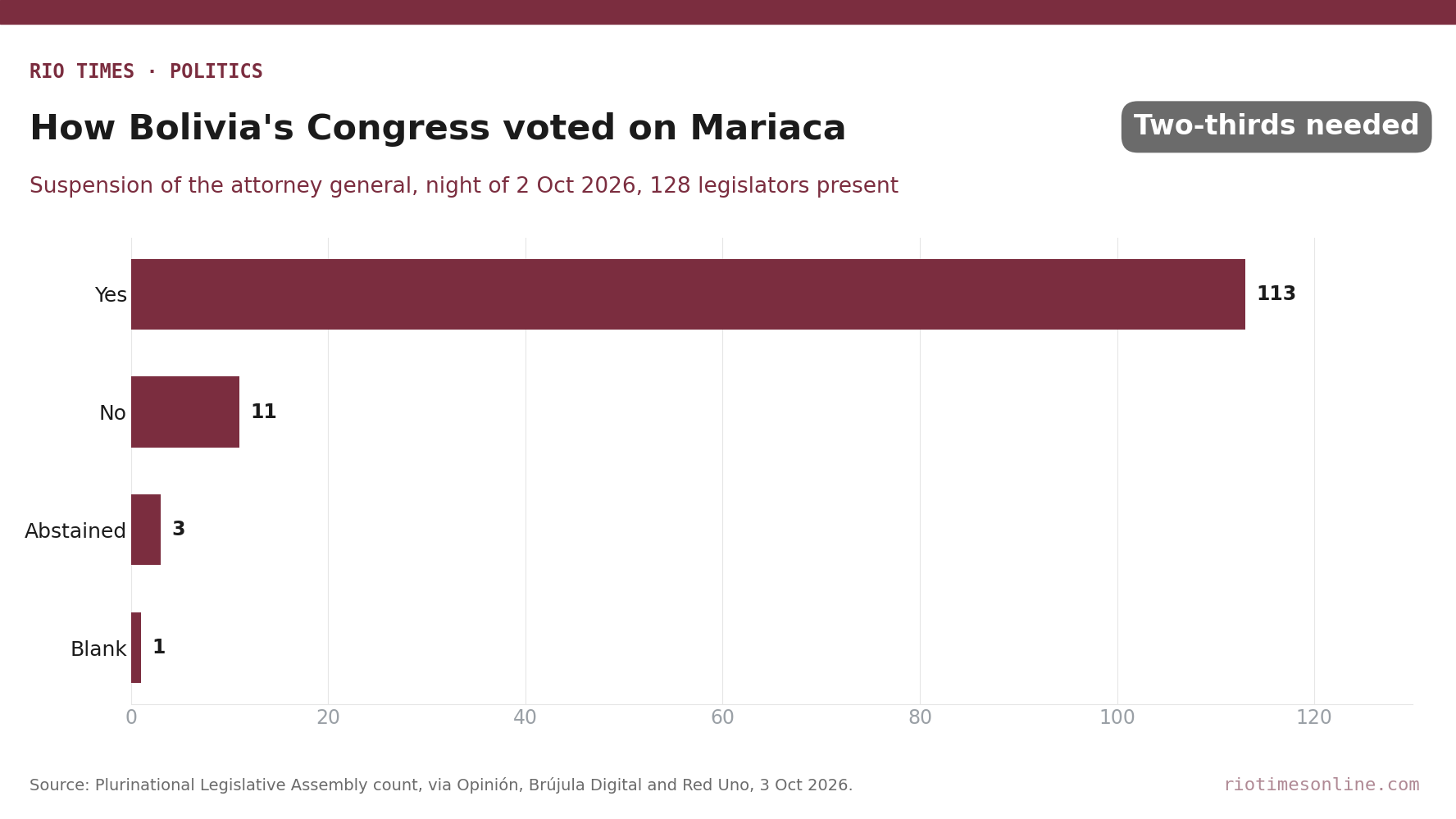
Four deputies from the Christian Democratic Party (PDC) voted against, while other members of that party backed the measure, Opinión reported. Lawmakers from the Libre and Unidad alliances supported it.
The law gives the Assembly a clear way out of a leadership dispute. On Thursday, senior prosecutor Luis Montaño had declared himself interim chief, but the government did not recognise him (Brújula Digital).
The other side of that speed is plain. The rule behind the Mariaca suspension was drafted, passed and applied to one serving official within a single day.
Courts reject release bids
On Friday, Constitutional Chamber 3 in La Paz rejected a release petition from senior prosecutor Martín Irusta. In Santa Cruz, the Third Court rejected one filed for Mariaca, Irusta and prosecutor Alberto Zeballos, Brújula Digital reported.
Prosecutors charged the three and police Major Rubén Aparicio with drug trafficking and criminal organisation. They seek six months of pre-trial detention.
Mariaca’s lawyer Rodrigo Salmón told Red Uno his client never knew the Uruguayan trafficker Sebastián Marset. He also questioned how a video of Marset used in the case was obtained.
The government had raised the stakes on Friday morning, as covered in Bolivia Spokesman Alleges Bribes in Mariaca Election. Rejecting the petitions does not settle guilt, which a trial must establish.
What Is Not Yet Known
After the Mariaca suspension vote, the Assembly went into recess to agree how to choose the interim chief. No name had been announced by early Saturday.
Saturday’s detention hearing, set for 5:00 a.m. Bolivian time by video link, had not yet started at the time of writing. No legal challenge to Law 1773 itself had been reported.
Sources: Opinión (vote), Opinión (Law 1773), Brújula Digital (vote), Brújula Digital (promulgation), Brújula Digital (release petitions), El Deber (session), El Deber (hearing), Urgente, eju.tv, Red Uno (vote), Red Uno (defence).
This article was produced by The Rio Times’ automated newsroom system. How we use AI · Report an error · Editorial responsibility: Matthias Camenzind, Editor-in-Chief