As America Watches: Saudi-Venezuelan Ties Strengthen in Multipolar World
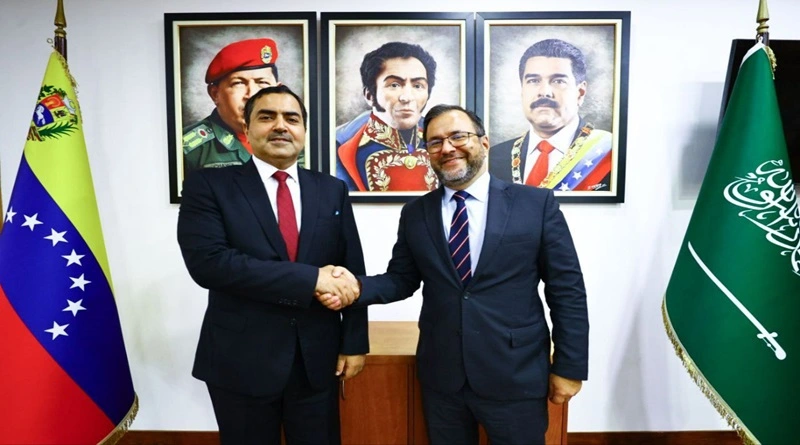
Venezuela’s Foreign Minister Yván Gil met with Saudi Ambassador Abdullah Muhammad Al Saihani on Monday to strengthen diplomatic and economic ties, signaling a deepening partnership between the oil giants.
The meeting focused on enhancing bilateral cooperation in international energy forums and consolidating diplomatic alliances. This relationship, formally established in 1952, has evolved significantly since 1999.
Both nations share a foundational connection as OPEC architects, with Venezuela taking the initiative in 1949 to establish regular communication among petroleum-exporting nations.
Their coordination within OPEC remains crucial for influencing global oil prices and market stability. Recent diplomatic momentum accelerated in June 2023 when President Nicolás Maduro visited Saudi Arabia for talks with Crown Prince Mohammed bin Salman.
This marked Maduro’s first visit to the region since 2015, resulting in cooperation agreements in oil, gas, and petrochemicals. The second High-Level Joint Commission in Riyadh established ambitious objectives for 2030 across multiple development areas.
Trade figures demonstrate growing economic ties. The UN COMTRADE database shows Saudi Arabia imported $3.37 million worth of Venezuelan goods in 2023, primarily wood products ($1.83 million), metal tools ($1.06 million), and iron articles ($280,490).
Venezuela’s position as holder of the world’s largest proven oil reserves—297.5 billion barrels—makes energy cooperation particularly valuable for both nations.
Saudi-Venezuelan Strategic Partnership
This partnership gains significance against the backdrop of changing global alignments. Saudi Arabia pursues a more independent foreign policy despite its historical U.S. alliance, recently restoring ties with Iran and normalizing relations with Syria.
Simultaneously, Venezuela faces ongoing tensions with Washington, which maintains sanctions against Maduro’s government. On May 7, 2025, Maduro signed a strategic partnership with Russian President Vladimir Putin in Moscow.
The agreement promotes joint efforts within OPEC+ and opposes unilateral sanctions. This alignment reflects Venezuela’s strategy to diversify international partnerships and counter economic isolation.
For Saudi Arabia, the relationship with Venezuela represents Crown Prince Mohammed bin Salman’s vision to reduce Western dependence. For Venezuela, Saudi Arabia offers a powerful ally that might help mitigate international sanctions.
U.S. policymakers now face the challenge of navigating these evolving relationships in a multipolar world. As traditional alliances evolve, the Saudi-Venezuelan partnership illustrates how geopolitical realignments are reshaping international relations.
These shifts create both challenges and opportunities for major powers seeking to protect their global interests.
More: Latin America news in English, every day from The Rio Times.
This article was produced by The Rio Times’ automated newsroom system. How we use AI · Report an error
Read More from The Rio Times