Argentina’s YPF Executes Stock Split in Push for Global Top 20
Markets: Argentina
Key Facts
—Ratio. YPF executed a 10-for-1 stock split effective August 4, 2026, converting each ARS 10 par-value share into ten ARS 1 par-value shares, with total share capital unchanged at ARS 3.93 billion.
—Retail push. The split cuts YPF’s nominal share price to roughly the cost of a coffee, part of a plan to let users buy shares directly from the YPF mobile app without a traditional brokerage account.
—Price shift. YPFD shares on ByMA fell from about ARS 82,900 pre-split to roughly ARS 8,155 post-split, a purely mechanical repricing that leaves total portfolio value unchanged.
—Top-20 ambition. CEO Horacio Marín says YPF, with a market capitalisation approaching that of Halliburton, aims to rank among the world’s 20 largest oil companies by 2030.
—Vaca Muerta engine. YPF is targeting shale oil output of 215,000 barrels per day in 2026, up 120% from 2023, with a year-end exit rate near 250,000 barrels per day.
Argentina’s state-controlled oil major cut its share price to a tenth of its former level this week, a technical maneuver dressed up as a democratization drive that fits CEO Horacio Marín’s broader bet on turning YPF into a top-20 global oil company by 2030.
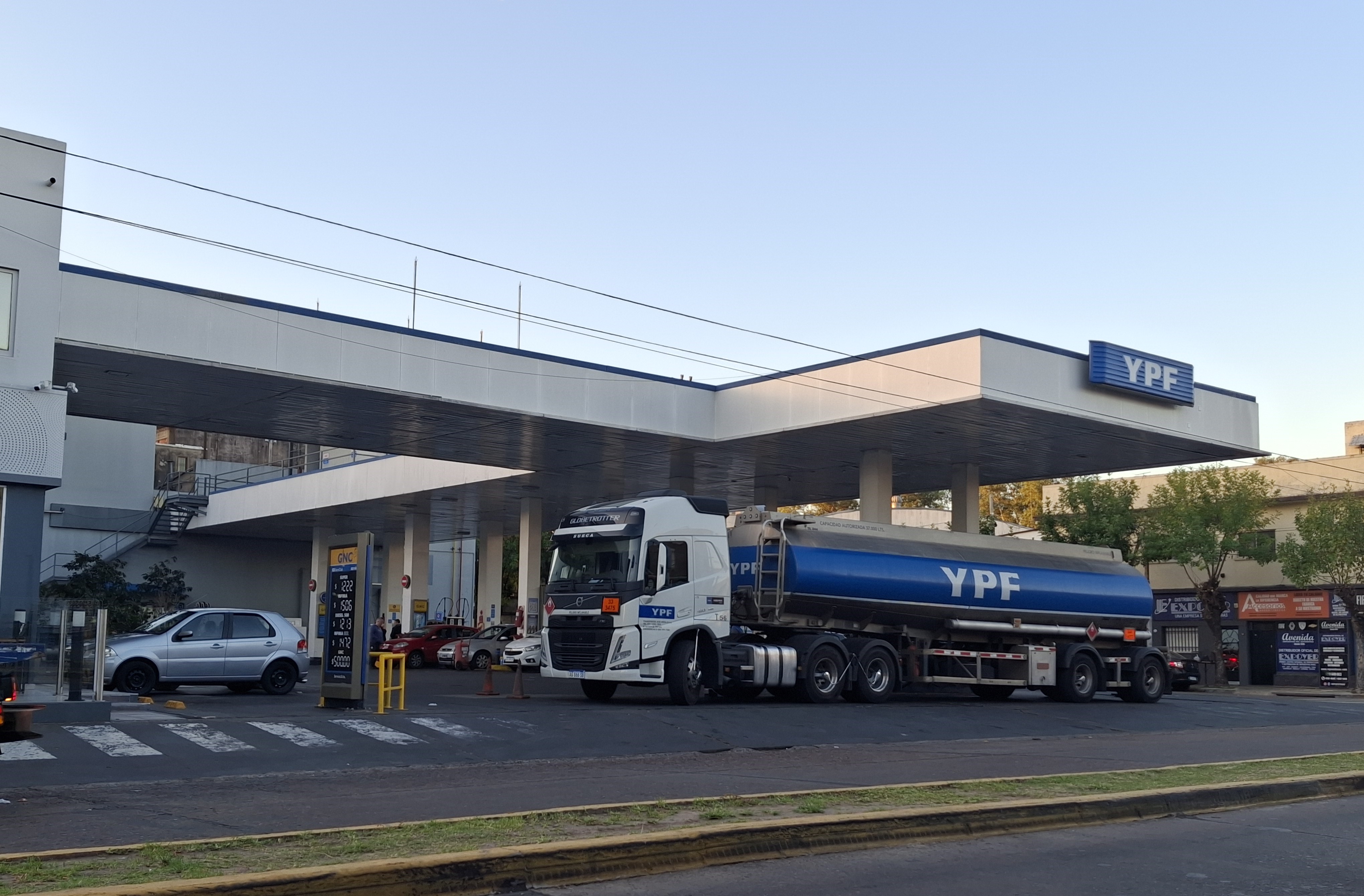
The split mechanics
YPF’s board first floated the 10-for-1 split in a filing to Argentina’s securities regulator, the Comisión Nacional de Valores, on April 9, 2026, and shareholders approved it three weeks later at the company’s ordinary and extraordinary meeting on April 30 (Bloomberg Línea). The company confirmed the operative date to the CNV, Bolsas y Mercados Argentinos (ByMA) and A3 Mercados in mid-July: the split took effect August 4, 2026, for all shareholders of record as of the close of trading on August 3 (iProfesional).
The mechanics are simple: each existing ordinary share, with a par value of 10 Argentine pesos, became ten new shares with a par value of 1 peso each. Outstanding ordinary shares jumped from 393,312,793 to 3,933,127,930, while total share capital stayed fixed at 3,933,127,930 pesos (Infobae). New shares were credited automatically to accounts at Caja de Valores S.A., YPF’s securities depositary, with no paperwork required from investors, and voting rights stayed proportionally identical — one vote per share, before and after (Infobae).
YPF’s own filing lists three reasons for the move: improving stock-market liquidity on ByMA, lowering the unit price to widen retail access, and aligning the company’s share structure with standard practice among comparable domestic and international peers (YPF board proposal, April 2026). Because the ratio divides evenly, no fractional shares needed to be settled under ByMA’s listing rules — a detail that would have complicated the process for a less clean split ratio (Infobae).
Marín’s top-20 ambition
The split lands alongside a much bigger stated goal. At the IAE Summit 2026 in June, YPF’s president and CEO, Horacio Marín, told the audience: “YPF ya es la mitad de Ford y para 2030 va a ser una de las 20 petroleras más grandes del mundo” — “YPF is already half the size of Ford, and by 2030 it will be one of the 20 biggest oil companies in the world” (Infobae). He added that YPF is “more than Halliburton, and half of Ford” already in scale (Infobae).
Marín frames the roadmap under what YPF calls its “4×4” model, a plan to quadruple the company’s market value in four years (Infobae). Since he took over as CEO in December 2023, YPF’s market value has roughly tripled, climbing from about US$6 billion to around US$18 billion (InfoEnergía).
Exports are central to that math. Marín has projected Argentina could export roughly US$30 billion in oil and gas by 2031, with liquefied natural gas cited as a key growth pillar alongside shale crude (InfoEnergía). A cheaper, more liquid, more widely held stock is part of the same pitch: a company aiming to compete with the world’s oil majors wants a shareholder base and market profile to match, not just a resource base.
Live Company IntelligenceYPF Sociedad Anonima — the full investor dossier
Wall Street view
Valuation & profitability
Price & risk
$23.0252-wk high
$57.87
Revenue trend · 6y
Ownership
Dividend
Vaca Muerta as the engine
None of this works without the Neuquén Basin’s Vaca Muerta shale formation, where YPF is the largest operator. The company accounts for 54% of Argentina’s oil output and 24% of its gas output, and it entered 2026 targeting shale oil production of 215,000 barrels per day, a 120% increase versus 2023 levels, backed by capital spending of US$5.5–5.8 billion for the year, roughly 70% of it earmarked for unconventional drilling (Reuters).
“My objective is to eliminate conventional production by the end of the year,” Marín told investors on a call discussing fourth-quarter results, underscoring the shift toward shale as the company’s near-exclusive focus (Reuters). YPF has said it is expanding its own drilling fleet from 12 to 18 rigs and is targeting a year-end exit rate near 250,000 barrels per day, with a new export pipeline to the Punta Colorada terminal in Río Negro expected to start operating in the third quarter of 2026 (Shale24).
Marín has set a full-year 2026 EBITDA target of US$5.8–6.2 billion, and the company’s first-quarter results already showed the turnaround underway, with consolidated upstream production of 525,000 barrels of oil equivalent per day and a net profit of US$409 million, reversing a US$10 million loss in the same period a year earlier (Reuters; The Rio Times). Vaca Muerta’s cash flow is effectively funding both the top-20 ambition and the capital-markets moves built around it.
Retail investor push
Marín has been explicit that the split is meant to solve a psychological pricing problem. “En vez de valer 65 o 70, va a valer 7. Entonces, vos vas a tener un gran problema entre decidir si te tomás un café o te comprás una acción” — “Instead of being worth 65 or 70 [pesos], it will be worth 7. So you’re going to have a real problem deciding whether to have a coffee or buy a share,” he said in an interview explaining the rationale (El Sol Mendoza). On the day the split took effect, shares opened around 8,155 pesos, close enough to the roughly 7,700 pesos a coffee-and-medialunas combo costs at YPF’s own “Full” convenience stores in Buenos Aires that the comparison worked almost to the peso (iProfesional).
The cheaper share price is paired with a technology push: YPF is enabling users to buy shares directly from its mobile app — the same app millions already use to pay for fuel and earn discounts at gas stations — without opening a traditional brokerage account, or “cuenta comitente” (iProfesional). Marín has explained the motivation in personal terms, recalling that “la señora a la que le llevo las camisas quería comprar y no sabía lo que era una cuenta comitente” — the woman who does his shirt laundering wanted to invest but didn’t know what a brokerage account was (El Sol Mendoza).
Announcing the operative date, Marín said: “Queremos que cada vez más argentinos puedan ser parte del crecimiento de YPF. El split de la acción es un paso para acercar el mercado de capitales y hacer más accesible la inversión en la compañía” — “We want more and more Argentines to be able to be part of YPF’s growth. The share split is a step toward bringing the capital markets closer and making investment in the company more accessible” (iProfesional). He has also framed the app-based buying option as a way to protect small savers from scams that use his name and image, saying the company wants to offer a legitimate channel that reduces fraud without affecting other shareholders (iProfesional).
What it means for existing shareholders and the ADR
For anyone already holding YPFD shares in Buenos Aires, the math is straightforward: economic value, ownership percentage and voting rights are all unchanged. Someone who held one share worth 82,900 pesos before the split held ten shares worth roughly 8,155 pesos each afterward — the same total position, split into more, cheaper pieces (iProfesional).
On Wall Street, the mechanics work differently. YPF’s American Depositary Shares, which trade on the NYSE under the ticker YPF, are not being split in number. Instead, the ratio underlying each ADS is adjusting from one Class D share to ten Class D shares, under the Amended and Restated Deposit Agreement the company signed with The Bank of New York Mellon in March 2022 (Infobae). That means the number of ADSs an investor holds does not change, and — unlike the peso-denominated local share — the ADR’s dollar price is not mechanically divided by ten, since the ratio adjustment itself absorbs the split (The Rio Times).
YPF’s own shareholder register shows the state, through Argentina’s Ministry of Economy, holding 51% of Class D shares, with the state pension fund FGS-ANSES holding another 8.04% and the remaining free float, institutional and retail combined, near 41% (YPF Investor Relations). The company describes that free float as “widely held by institutional and retail shareholders,” and the split is designed to grow the retail slice of that pool over time without diluting anyone currently in it (YPF press release via The Globe and Mail).
More: Argentina news in English, every day from The Rio Times.
Frequently Asked Questions
Did the YPF stock split change how much my shares are worth?
No. A 10-for-1 split multiplies the number of shares an investor holds by ten while dividing the per-share price by roughly the same factor, leaving total portfolio value, ownership percentage and voting rights unchanged. YPF’s own filing states explicitly that the split does not modify shareholders’ economic value or their proportional stake in the company (Infobae).
Does the split affect YPF’s NYSE-listed ADR?
The number of American Depositary Shares an investor holds on the NYSE does not change. What changes is the ratio behind each ADS, which moves from representing one Class D share to representing ten Class D shares, under YPF’s deposit agreement with The Bank of New York Mellon. Because that ratio absorbs the split, the ADR’s dollar price is not mechanically cut the way the peso-denominated ByMA share price was (Infobae).
Why does YPF CEO Horacio Marín compare the new share price to a coffee?
Marín has argued that YPF’s high nominal share price, once above 80,000 pesos, priced out small savers who think in everyday amounts. He has said that after the split, buying a share means facing the same kind of decision as buying a coffee, and YPF is building the option to purchase shares directly from its mobile app, the one many Argentines already use to pay for fuel (El Sol Mendoza; iProfesional).
Sources
Infobae, iProfesional, Reuters, Bloomberg Línea, YPF Investor Relations.
Connected Coverage
More Latin America coverage from The Rio Times.
Sources: Infobae (infobae.com), iProfesional (iprofesional.com), Reuters (reuters.com), Bloomberg Línea (bloomberglinea.com), YPF Investor Relations (investors.ypf.com).
This article was produced by The Rio Times’ automated newsroom system. How we use AI · Report an error
In depth
LatAm Markets: Live Signals → — real-time movers, turnover leaders and FX across Latin America.
Read More from The Rio Times