Russia’s Silence on Venezuela: U.S. Naval Power and the New Hemispheric Order
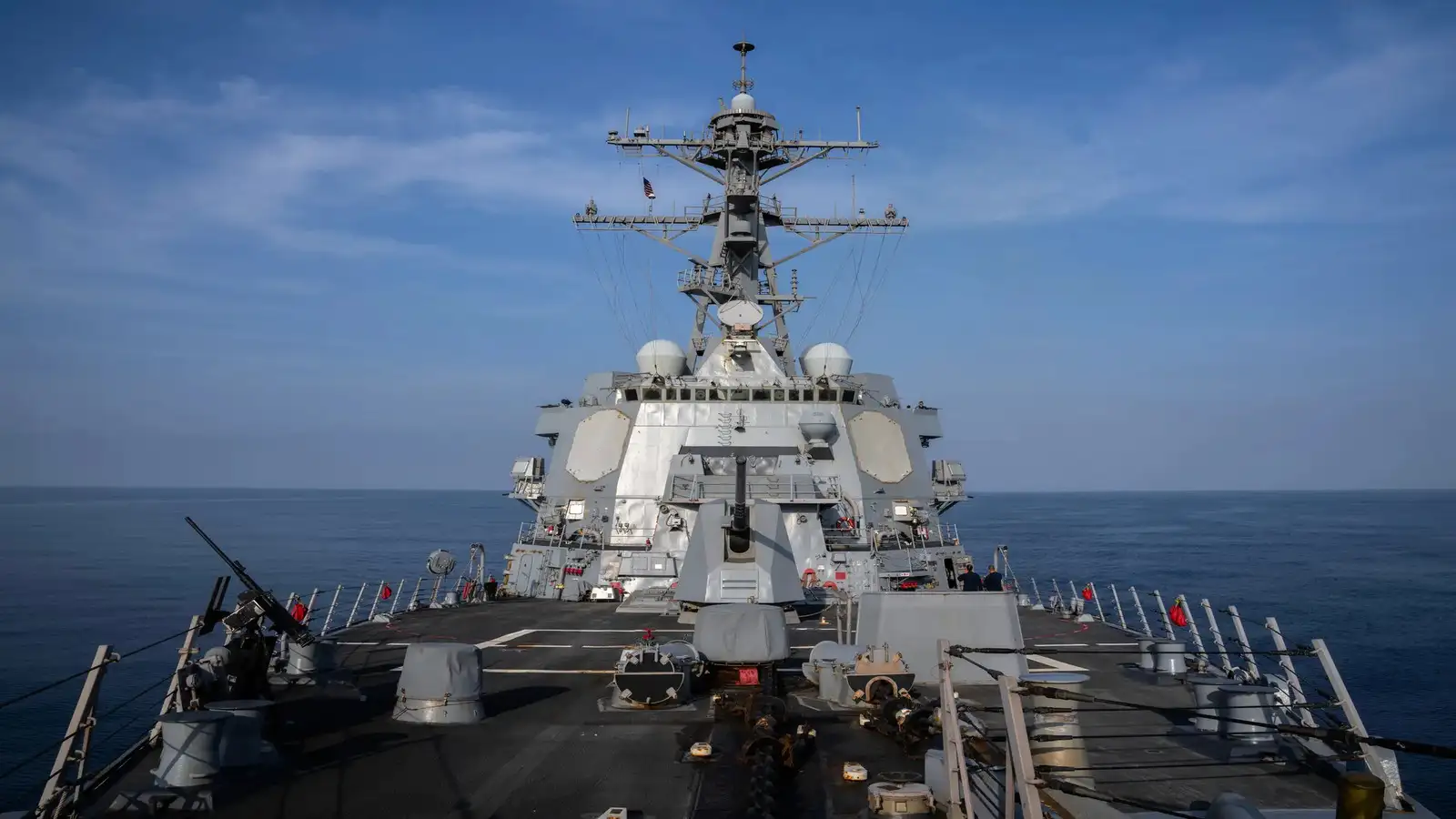
(Analysis) When eight U.S. warships and a nuclear submarine surged into the Caribbean in late August, President Nicolás Maduro denounced the move as “the greatest threat in a century.”
He vowed to turn Venezuela into a “republic in arms” if Washington dared invade, and paraded millions of reservists to prove his defiance. Yet amid the spectacle of U.S. naval power and Venezuelan defiance, a striking absence stood out: Russia’s silence.
For years, Moscow has been Caracas’s loudest patron, sending bombers, warships, and weapons whenever Washington flexed its muscles in Latin America.
The Kremlin’s defiance was a hallmark of the post-Cold War rivalry, a way of reminding the U.S. that it could stir turbulence in America’s own backyard.
But this time, as the U.S. Navy assembled one of its largest deployments in the region in decades, Russia limited itself to cautious diplomatic statements and phone calls. No bombers, no flotillas, no fiery threats.
Why? The answer reveals much about the shifting balance of global power in 2025.
From bombers to words
Contrast today’s caution with 2008, when Russia dispatched Tu-160 bombers to Caracas at the height of its standoff with the West over Georgia. Or 2018, when the same aircraft landed in Venezuela again, prompting U.S. denunciations.
At those moments, Moscow reveled in symbolic shows of force, projecting itself as a global counterweight to Washington.
Even in 2019, when the U.S. recognized opposition leader Juan Guaidó as interim president and hinted at intervention, Russia rushed advisers and vowed to shield Maduro. The Kremlin’s message was clear: Latin America was not America’s alone.
In 2025, however, with U.S. destroyers and missiles off Venezuela’s coast, Moscow has offered Maduro only rhetorical solidarity.
The Russian foreign ministry condemned the “threat of force” and reaffirmed its “strategic partnership” with Caracas. But beyond words, little.
The Ukraine weight
The most obvious explanation is Ukraine. After more than three years of grinding war, Russia is bloodied, overstretched, and cautious. Its Black Sea Fleet has been battered, its economy drained by sanctions, and its military overstretched by constant mobilization.
In this state, Moscow cannot easily stage bomber flybys in the Caribbean, let alone risk a showdown with superior U.S. forces just miles from American shores.
Latin America may remain geopolitically valuable to Russia, but it is no longer a priority it can afford to defend with bravado. Ukraine comes first, and the rest is triage.
A silent understanding?
There is another possibility. Only weeks before the U.S. naval buildup, Donald Trump and Vladimir Putin met in Alaska – their first summit in six years.
The talks were billed as a step toward ending the Ukraine war. But in international politics, such encounters often cover more ground than press releases suggest.
Did Trump and Putin quietly sketch out spheres of influence – Russia in Eastern Europe, America in the Americas? There is no proof, but the circumstantial evidence is suggestive.
Putin emerged from Anchorage praising Trump’s “constructive” approach, uncharacteristically restrained in his anti-U.S. rhetoric. Days later, as Washington tightened its grip on the Caribbean, the Kremlin’s response was conspicuously muted.
If there is indeed a tacit bargain, Venezuela may have become collateral to a bigger deal: peace, or at least relief, in Ukraine.
Washington’s timing
Even without secret understandings, the U.S. chose its moment well. Russia is distracted. China is cautious. Iran is far away. This is the perfect time for Washington to reassert the Monroe Doctrine in practice, if not in name.
By framing its Caribbean operation as an anti-drug mission, the U.S. avoids the optics of outright regime change while signaling that hostile regimes in its backyard will no longer be tolerated.
For Maduro, this means bluster on the podium but caution in practice. For Putin, it means a reluctant silence, aware that an overextension in the Caribbean could jeopardize his real war in Ukraine.
A new era of hemispheric order
The silence from Moscow marks a subtle but profound change. A decade ago, Russia seized every chance to poke the U.S. in Latin America. Today, weakened by war and perhaps bound by new understandings, it stays in the shadows.
The loudest external defender of Caracas is no longer Russia but China, which has condemned the U.S. naval buildup more forcefully than the Kremlin.
The implications are stark. If Russia once sought to project itself as a global counterweight, it now risks being seen as a regional power hemmed in by its own wars. For Latin America, this means that U.S. dominance may once again be less contested than many believed.
The Caribbean crisis of 2025 is not just about Venezuela or drug cartels. It is a window into the new limits of Russian power – and into how Washington is moving to restore an old order while its rival bleeds elsewhere.
In the silence of Moscow, the world hears the echo of a superpower in retreat.
More: Latin America news in English, every day from The Rio Times.
Read More from The Rio Times